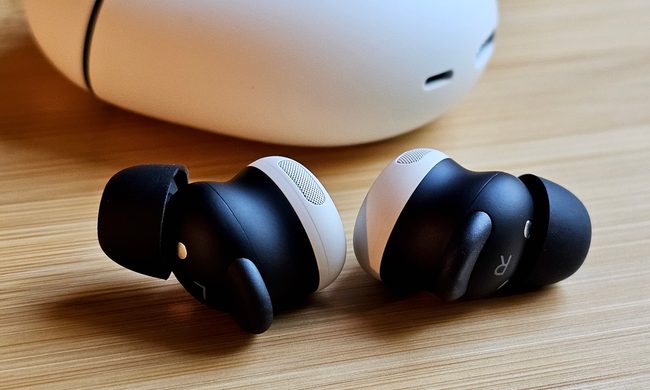
A few weeks ago, I ditched my trusty Sony earbuds and switched to the third-generation AirPods Pro. Apple’s promises of a big leap in audio quality and noise cancellation were pretty tempting, and a few days later, I found myself queuing outside the store to get my pair.
I won’t quite call them an aural nirvana. The lack of dedicated EQ is something that I find pretty limiting, especially when earbuds that sit significantly lower on the price ladder offer that convenience. I told myself that I got the latest AirPods Pro not for audiophile perks, but for overall excellence.
They deliver on those promises of seamless efficiency, offering a fantastic experience straight out of the box. But after spending over a month with the AirPods Pro 3, I discovered that the experience can be enhanced further if you only take a few minutes to personalize the experience by tinkering with a few settings. It’s just surprising that Apple buried these controls (Settings > Accessibility > Audio Visual) to access them.
Truly personalizing them for your ears

As I mentioned above, the AirPods Pro don’t offer a full range of frequency adjustments that you get with an EQ dashboard. And whatever little flexibility is available, it is not easy to access. I asked half a dozen AirPods users in my friend circle if they knew how to customize the audio quality on the earbuds, and they had no clue about that.
Most of them said the AirPods Pro sound fine in their natural state, so they never felt the need for it. Apple doesn’t advertise them either, so a lot of users simply stay oblivious. Now, many brands out there offer custom EQ presets such as Bass, Classical, Jazz, etc., where the frequencies are tuned to get the best out of a specific genre.
On the AirPods Pro, you don’t get that flexibility. Instead, you get a choice between Brightness, Balanced Tone, and Vocal Range. These are pretty self-explanatory. More importantly, you can adjust the intensity of each audio preset across these levels.
These adjustments make a discernible difference in the listening experience. Listening to Kaminh by Jony & Emin, you can clearly feel a discernible improvement in the crooning clarity as you go from Balanced to Vocal Range preset, especially when it’s set to Moderate or Strong level.

On the contrary, if you’re listening to instrumental tracks with slow tempo build-up and delicate bass, the best experience can be had by switching to the Bright preset, but at the Low level. Increasing the intensity muddies the instrumental clarity in, for example, Hans Zimmer’s Lost but Won.
The focus is mostly on mid and high frequency adjustments, which means vocals and percussion instruments will derive the biggest share of benefits. If you prefer bass-heavy tracks, stick with the Balanced profile at Low level. But these settings are not merely there for music listening.
Instead, you can apply them to calls, as well. If you’re someone who is using AirPods Pro predominantly for calls, the Vocal Range preset set to Strong noticeably enhances the clarity in voice and video calls by focusing more on the speaker’s audio stream and suppressing the ambient noise.
The final piece of the puzzle is the custom audio setup. This is the deepest level of personalization that Apple has to offer, as it takes into account the natural listening capability of each person’s ear.

If you have previously had your ear tested, this is where you can upload an audiogram and accordingly get the sound output customized to your ear. Alternatively, you can skip the audiogram and listen to two versions of a test tune and find which one is the most pleasing to your ears.
The AirPods Pro will accordingly adjust the sound profile based on whether you like a softer tuning or prefer higher instrumental clarity. Do keep in mind that when custom audio is set up, headphone accommodations are disabled.
Deep control over transparency
The AirPods Pro excel at noise cancellation and transparency. For a long time, I stuck with the default flavor, switching between each mode with a long-press on the steam. But the quality of ambient awareness depends squarely on your surroundings. In a nutshell, it’s not a one-size-fits-all approach.
I started writing this article while sitting in a crowded cafe at the airport, and finished the latter half on an airplane seat right next to the engine. The noise cancellation mode did a fantastic job of drowning the engine noise, leaving only a flat hum.

But while sitting in the coffee shop, I was also acutely worried about missing crucial announcements as my flight was already delayed and kept pushing until it was well past nine hours from its scheduled departure time.
This is where the Transparency Mode customizations come into the picture. There are plenty of them, actually, each tailored for a unique ambient noise and acoustic situation. The first one is Amplification.
In simpler terms, it enhances certain frequencies that enter your ear canal. This is for scenarios where you can’t quite afford the silence of active noise cancellation, but don’t want to miss out on the occasional important sound cues, such as mic announcements.
Simply put, this is for situations where you want to drown the surrounding noise with a bit of music, while also making sure that certain sounds, especially those coming from a distance, are captured properly even after their direct entry path is blocked.

At the opposite end of the spectrum is another slider called Ambient Noise Reduction. This one takes a more brute-force approach to allowing the entire cluster of external noise frequencies. It works best when you have set it to the max, and also pushed the application slider to roughly the halfway mark.
In doing so, you can manage to drown the external chaos while also letting in important sound cues. Simply put, it’s the anti-noise cancellation. You can even choose the flavor of transparency.
The “Darker” side silences the immediate noises while allowing frequencies coming from afar. It’s a lot more subtle and quiet approach to environmental awareness, and I prefer this one. Going brighter means every single frequency around you enters your ear canal, and it quickly makes you feel overwhelmed. Both systems work like a charm.
Despite losing myself in a zen mode for work while listening to Persian songs, I was still able to hear the intercom alerts and in-flight announcements clearly. Additionally, you can also adjust the transparency focus and decide whether the left or right AirPods Pro should allow in more ambient signals.
After spending a few weeks stuck in crowded buses, cafes blaring folk music, and buzzing marketplaces, I’ve come to realize that AirPods Pro offer more flexibility than one would expect. And if you take a few extra steps, they will serve you a few pleasant surprises.