
Bowers & Wilkins (B&W) has completely revamped its wireless earbuds with a new shape for greater comfort, hi-res and lossless audio, better single-charge battery life, and the ability to connect to two devices simultaneously. Its new flagship, the Pi8, is available starting August 21 for $399, while the midrange Pi6 will follow in early September for $249. Both will be available in a choice of four colors.

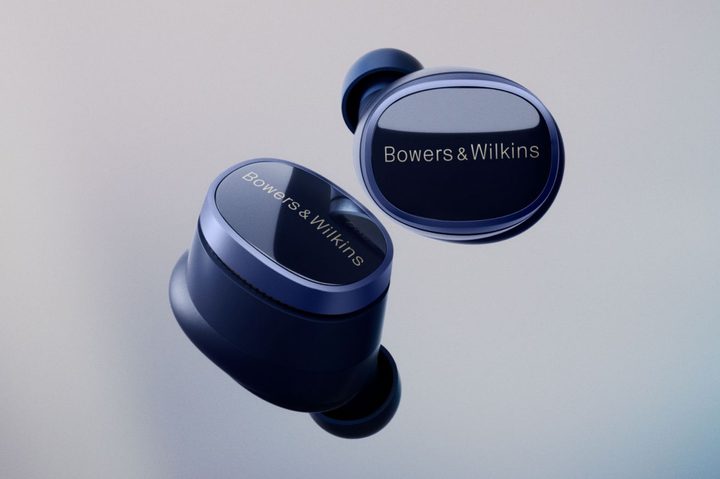
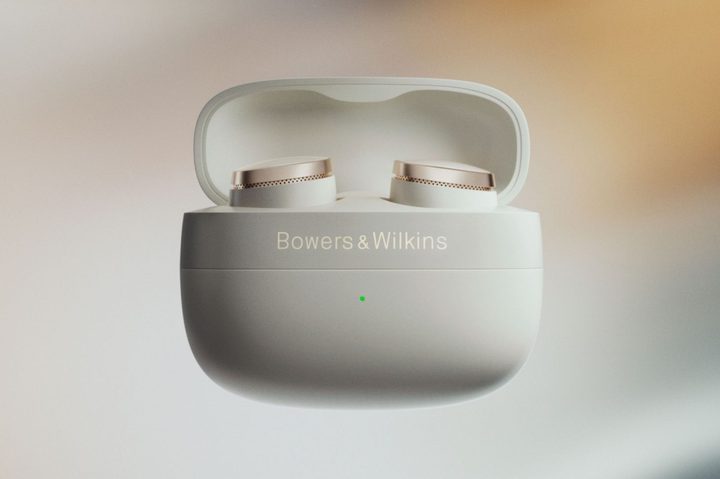
B&W says the shape of the new earbuds was “inspired” by an extensive research project into the variation in human ear form across both gender and ethnicity. The results of this study were used to create a form that “delivers exceptional comfort and fit, plus outstanding noise cancellation.” The charging cases have also been redesigned and are now slimmer.
Both the Pi6 and Pi8 are equipped with Qualcomm’s aptX Adaptive Bluetooth codec, which can transmit hi-res audio at up to 24-bit/96kHz if you’re connected to a compatible smartphone. The Pi8 also gets aptX Lossless, a bit-perfect, CD-quality codec that requires a smartphone with Qualcomm’s Snapdragon Sound platform.
Like its predecessors, the Pi7 and Pi7 S2, the Pi8’s charging case can be used to retransmit audio to the earbuds from both analog and digital sources using the included USB-C and 3.5mm cables. The previous models used aptX Low Latency (LL) for this wireless audio signal. The Pi8 uses aptX Adaptive’s lossy, 16-bit low-latency mode for analog sources, but when used with USB-C digital sources, it can switch to HD mode with support for up to 24/96. For iPhone 15 and newer models with a USB-C port, it’s a way to get around the iPhone’s limited Bluetooth codec support, which lacks any hi-res options.
The internal hardware on the new earbuds has also undergone extensive changes. The Pi6 uses new 12mm bio-cellulose drivers made from the same material used in the Px7 S2 and Px7 S2e over-ear headphones. B&W says this gives the Pi6 similar audio quality to the company’s previous flagship, the Pi7 S2.
Meanwhile, the Pi8 gets new 12mm drivers made using B&W’s Carbon Cone technology — the same material used in its Px8 over-ear headphones. Powering these drivers are dedicated digital signal processing (DSP), digital-to-analog conversion (DAC) ,and amplification from analog devices.

The adoption of audio technology from the company’s wireless headphones isn’t a coincidence. B&W gave responsibility for developing the Pi6/Pi8 to the same team that created the Px7 S2 and Px8. It carries into the earbuds’ noise cancellation, which has also been ported from the over-ear products.
As before, both models get IP54 protection from dust and water, but improvements have been made to battery life. The Pi6 gets a big boost for a single charge — from 5 hours on the Pi5 to 8 hours of ANC listening for the new model. Its charging case, however, drops from 19 hours of extra time to 16 hours, which means the 24-hour total time remains unchanged.
In a similar vein, the Pi8, offers 6.5 hours on a charge (1.5 more than the Pi7 S2), but just 13.5 hours from the case, yielding only 20 hours of total use (one hour less than the previous model.) Both models have fast-charging, with 15 minutes of charging providing two hours of use.
A big plus for the new models is the addition of Bluetooth Multipoint for connecting two devices simultaneously, something B&W’s previous models haven’t offered. The company also says that Google Fast Pair will be added via a future firmware update.
If you don’t find these new models compelling, consider buying the company’s previous models, which have been steeply discounted. B&W is currently selling the Buy at Amazon , while the Buy at Bowers & Wilkins .


