
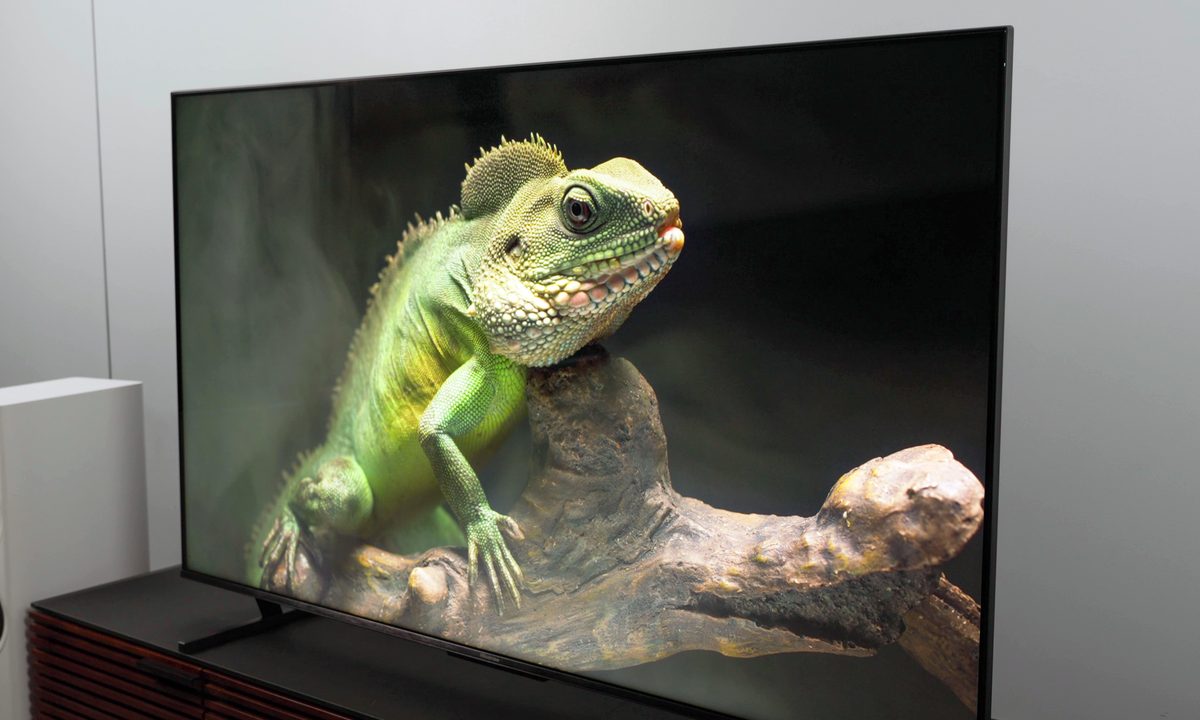

“The Hisense U8K is too good, if that's even possible.”
- Excellent brightness
- Vivid HDR colors
- Very good backlight control
- Excellent contrast
- Great for gaming
- Some color anomalies
- Scattered software bugs


“Why you can trust Digital Trends – We have a 20-year history of testing, reviewing, and rating products, services and apps to help you make a sound buying decision. Find out more about how we test and score products.“
When first I saw the Buy at Amazon , it was doing almost everything right. But there were some anomalies I was sure were indicative of a faulty sample, which, frankly, happens more often than you’d think – a byproduct of getting the first units in the wild, I’m afraid. Hisense quickly sent a replacement, and I’ve had a chance to thoroughly test it and am prepared with a full review.
First, I want to clarify that the model number, U8K, does not mean this is an 8K TV. The K is just the next acceptable letter in the alphabet — in 2022 we had the U8H, we skipped I and J for some reason, and now we’ve landed on the U8K. I repeat: This is just a model number and has nothing to do with the resolution.
No, indeed, the U8K is a 4K HDR ULED TV. ULED is just Hisense’s way of differentiating itself; this TV does use quantum dots. And like all of Hisense’s TVs from the U6 series up, it also has mini-LED backlights. One could call it a QLED, but Hisense likes ULED, so there you go.
Now, let’s get into performance.
Series and size details
While we reviewed the 65-inch (65U8K) model, our review also applies to the 55-inch and 75-inch models in the Hisense U8K Series.
| Screen Size | Model Number | MSRP |
| 55-inch | 55U8K | $1,300 |
| 65-inch | 65U8K | $1,700 |
| 75-inch | 75U8K | $2,300 |
Brightness
Let’s start with peak brightness because that seems like everyone’s favorite metric these days. It’s good news there. As expected, the Hisense U8K offers a peak brightness of right at 2,000 nits. Hisense only promises 1,500 nits on the box, and the U8K is yet another Hisense TV exceeding expectations — we’ve seen this before. The U8H did it, as did the U7H and some of the models before them. Two thousand nits is excellent considering the current street price of the TV is about $1,100 for the 65-inch model, meaning you can easily spend more with some competitors and not get as bright a TV.
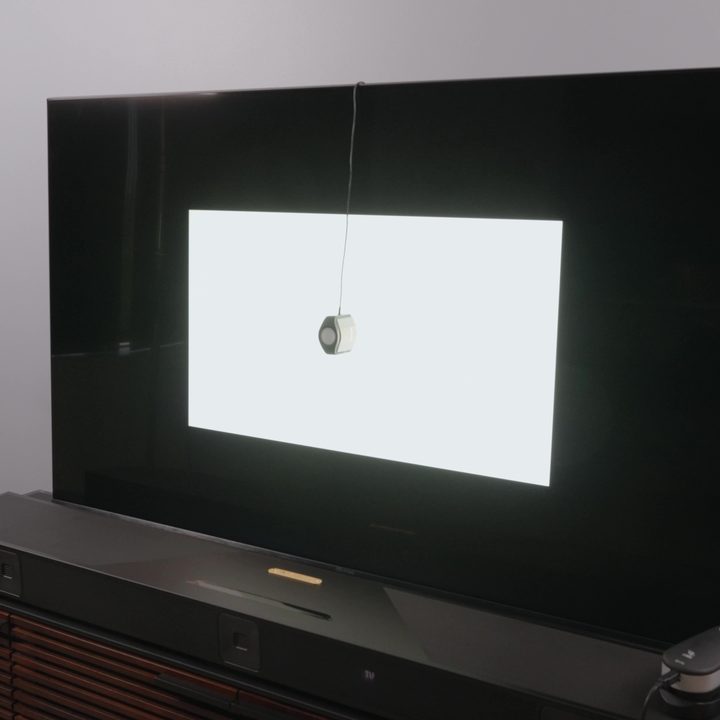
Now, that 2,000 nits is great for HDR highlights. As I’ll discuss shortly, this TV does a great job presenting HDR. But it also means this TV can get very bright for SDR content. It offers full-screen white brightness of about 750 to 800 nits, so its average picture level, or APL for short, is plenty sufficient for, say, viewing sports in a bright room during the middle of the day. That’s another reason to really appreciate this TV, especially for the price.
Color
Now, let’s move on to grayscale and color accuracy. Grayscale is important because it tells us how accurate the color temperature of the TV will be. We want the TV to represent a D65 white point because that’s what Hollywood has decided is most desirable, and thus it grades movies to look correct when a TV’s white point is at D65. Here, the Hisense U8K tested ridiculously well. Like, suspiciously well. Delta errors were under 1, which is as good as you could hope to get with a professional calibration. This led me to think maybe I have a golden sample on my hands — that’s a TV which has been handpicked to be the best example of the technology and, thus, not necessarily a perfect representation of what you’d get from a TV you pick up at the store.
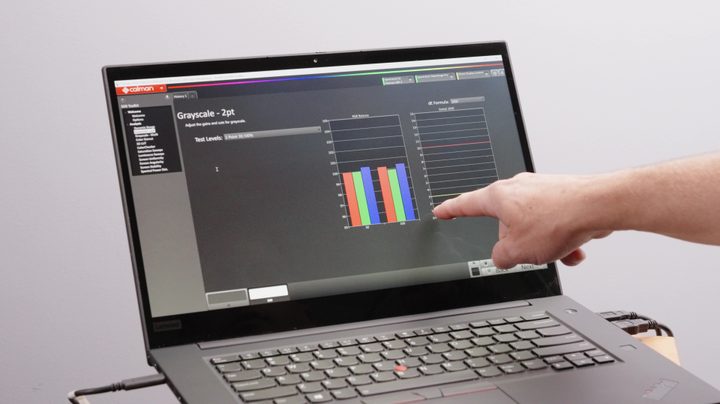
But as I tested color accuracy, I backed off the idea that this may be a so-called golden sample. Or that, if it is a golden sample, there is an issue that I noted in my previous review unit that is carrying over just a bit with this TV.
If you saw my first U8K video, you’ll know that one of the issues that had me thinking the TV might be faulty in some way was that the blue, cyan, and to a lesser extent, green colors were coming up as far less accurate than the other colors in the test. The good news here is that the replacement TV tested much better. However, the blue and cyan still showed up as being much less accurate than all the other colors.
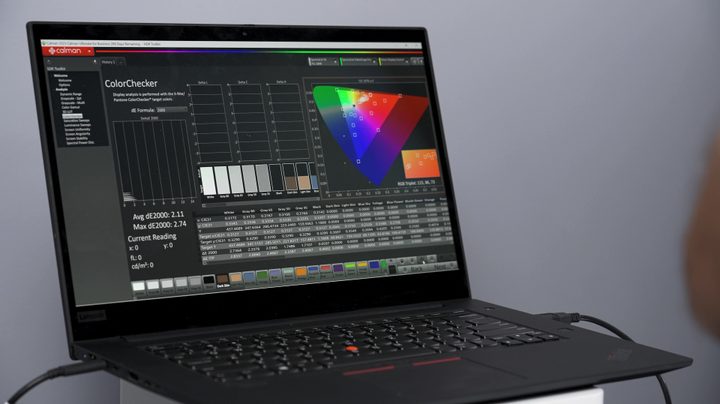
I haven’t gotten to the bottom of why this is. I have a couple of guesses, though, and one of them was that perhaps the color temperature setting was just not warm enough. In the Filmmaker Mode (which, by the way, is doing just fine in terms of brightness on this unit — that was the other concern with the previous unit), the color temp setting by default on this set was Warm 1. I found that odd because I seem to remember Warm 2 being the more accurate of the two. So for grins, I switched to Warm 2 and retested the TV’s grayscale and color, and holy cow, the white balance on this TV was just way, way out of whack. I think it is super strange that Warm 1 would offer among the most accurate out-of-box readings I’ve ever seen, while Warm 2 would be so wildly bad. I guess that’s yet another thing to get to the bottom of and speak to in the TCL QM8 comparison I have planned.
Anyway, I saw some blue and cyan color errors from Filmmaker, Theater Day, and Theater Night picture presets — at least ones I can measure. But as I’ll discuss in a moment, I do not see this bear out when watching normal content. Nothing looks wrong when I’m just watching TV or movies. Furthermore, when I switch to HDR, the color checker results are all excellent so … big shrug emoji from me. But again, when watching HDR content, color looks fantastic.
Motion
In terms of motion resolution, the U8K does pretty well. It doesn’t eliminate judder quite so smoothly as, say, a Sony TV of about the same price or more. It’s on par with a TCL, for example, but I do see better motion resolution from much more expensive Samsung and Sony TVs.
However, upscaling and, specifically, color gradient handling on this TV is impressive! I watched a lot of broadcast TV and some low-bit-depth streaming content, and while this TV doesn’t eliminate color banding entirely, it does a better job than some other TVs in its price class, including a certain TCL model. And that counts for a lot in my book, because between streaming content — especially on YouTube because of YouTube compression — and cable/satellite content, the Hisense U8K is going to make those compressed images just look better. And the larger the screen size, the more important that is going to be.
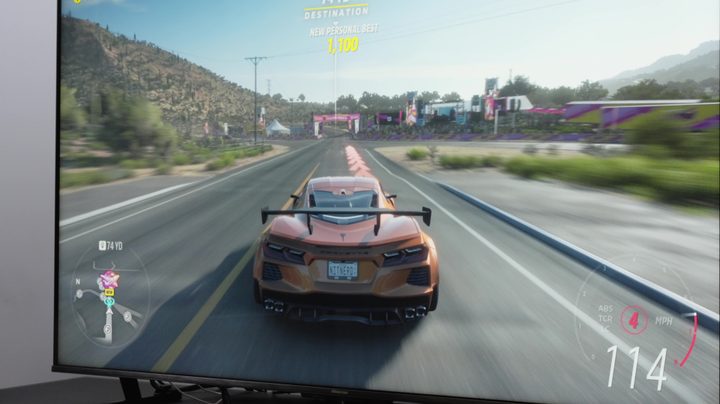
One final thing to share — my input lag tester has gone kaput, so I’m sorry to report that I can’t offer you an input lag measurement in terms of milliseconds. But I haven’t been able to detect any meaningful input lag in Game mode, and so long as the U8K isn’t any worse than the U8H – and I don’t think it is – that number is probably somewhere in the 15-millisecond region for 4K 60Hz, and half that, about 7.5 milliseconds, for 4K 120Hz. I reckon it’s perhaps just slightly lower for 144Hz, which this TV does support if you intend to run a gaming PC on it, though I think most folks will want to game at 4K 60 or 4K 120, or engage variable refresh rate, which the TV also supports.
Black levels
As for black levels and backlight performance: The Hisense U8K definitely is in the upper tiers here. It does much better than more expensive TVs from Sony, and a little better than some pricey TVs from Samsung in terms of preventing too much halo around bright objects on a dark background. It also avoids crushing black so you don’t lose shadow detail. There is only one other non-OLED TV I can think of that is significantly better in the black levels department in terms of backlight control, and that’s the TCL QM8 — which probably comes as no surprise because that TV is something of a unicorn in the backlight control department.
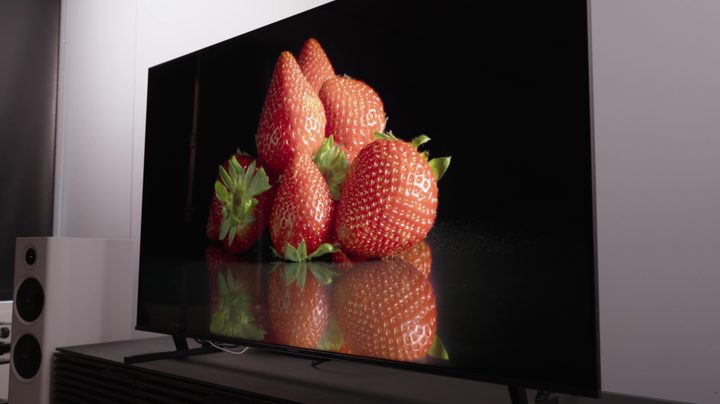
The U8K’s off-angle performance will show some loss in color saturation, the black levels take a bit of a hit, and the backlight is more visible, although this is true of just about every TV that has a VA panel. But this is at extreme angles to the TV. So, if you’re in the seat on the far end of a sectional couch, sitting such that you can almost see the back of the TV, well, that’s not going to be the best seat in the house. But that is true of just about any LCD-based TV.
Speaking of panel types, I am currently trying to confirm whether a VA panel is used across all sizes of the U8K and will update this review once I have official confirmation. But for now, I think it is safe to say you will get very similar performance, no matter which size of this TV you buy.
Tone mapping
I want to address one aspect of the U8K’s performance that is part of increasing coverage on the subject of tone mapping. For those unfamiliar with the concept, tone mapping has to do with how a TV maps the brightness spectrum, from black all the way to the brightest it can get, so that it can show all the details that are available in the source material. A scene on the Spears & Munsil UHD HDR Benchmark disc is super popular for determining how a TV does at maintaining detail in the brightest areas of a picture. If a TV clips the brightest areas, you won’t see trees in the background — you’ll just see a blob of white.
Most HDR content is mastered at 1,000 nits with very, very few exceptions, and the U8K represents that material exceptionally well.
Let me be clear here: The U8K’s tone mapping is spot-on for 99.3% of all the HDR source material you could throw at it. There are a handful of 4K Blu-rays that are mastered at 4,000 nits, and on those discs you may see that some super-bright highlight detail is lost — if you’re even the sort of person who picks up on that kind of thing. Most of you out there won’t. I’m not trying to insult you, I just mean that most folks wouldn’t know if something was missing or not because the opportunity to notice such things is very few and very far between.
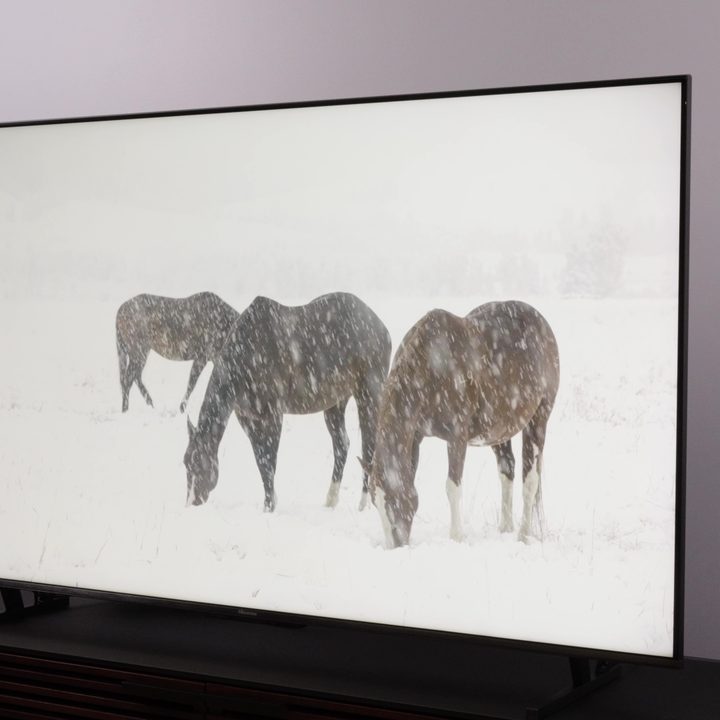
Most HDR content is mastered at 1,000 nits with very, very few exceptions, and the U8K represents that material exceptionally well. It also does just fine with anything mastered up to 4,000 nits. There is no HDR source material that is mastered higher than 4,000 nits that isn’t on a test disc, and there isn’t going to be any time before you replace this TV. So, to me, showing what a TV does with material mastered at above 4,000 nits is not helpful information. That’s just my hot take. I’ll get off my soapbox now.
Sound quality
Arrested by the U8K’s picture quality, I forgot to address the TV’s speaker system and audio quality in my video review. I’m not making the same mistake here. Armed with a subwoofer embedded in its back panel, the U8K is able to offer some reasonably robust sound — for a TV speaker system, anyway. While it in no way compares to that of budget soundbars like the $200 Vizio M-Series, the U8K’s onboard sound system manages to deliver reasonable dialogue clarity and enough oomph to keep the TV from sounding like a tiny, cheap Bluetooth speaker. Kudos to Hisense for putting some effort into the U8K’s sound system, a dying art in today’s TV market.
No surprise here
So, frankly, this TV review was pretty easy. The Hisense U8K performs as I expected it to, which is to say it is a marvelous TV, especially for its price. I don’t think there is a better price-to-performance ratio on the market right now. I could be proven wrong in time, but for now, this TV nails the price-to-performance ratio. Dollar per dollar, this U8K offers more than anything else for those who want the best picture they can get for their money. The only reason I’m not titling this review, “How is this even possible,” is because I already did that. The only reason I expected as much out of the U8K as I did is because I know what the U8H did, so I was prepared for it. And I was not disappointed.


- 4. Hisense U8K
If you have a U8H and are wondering if you should upgrade less than a year after getting your TV – I wouldn’t run out and replace your U8H. I think there are some refinements in the U8K here, but the U8H is still an awesome TV.
Short-list this TV. It is outstanding. And if you buy it, I’m pretty sure you’ll be thrilled with your decision.


