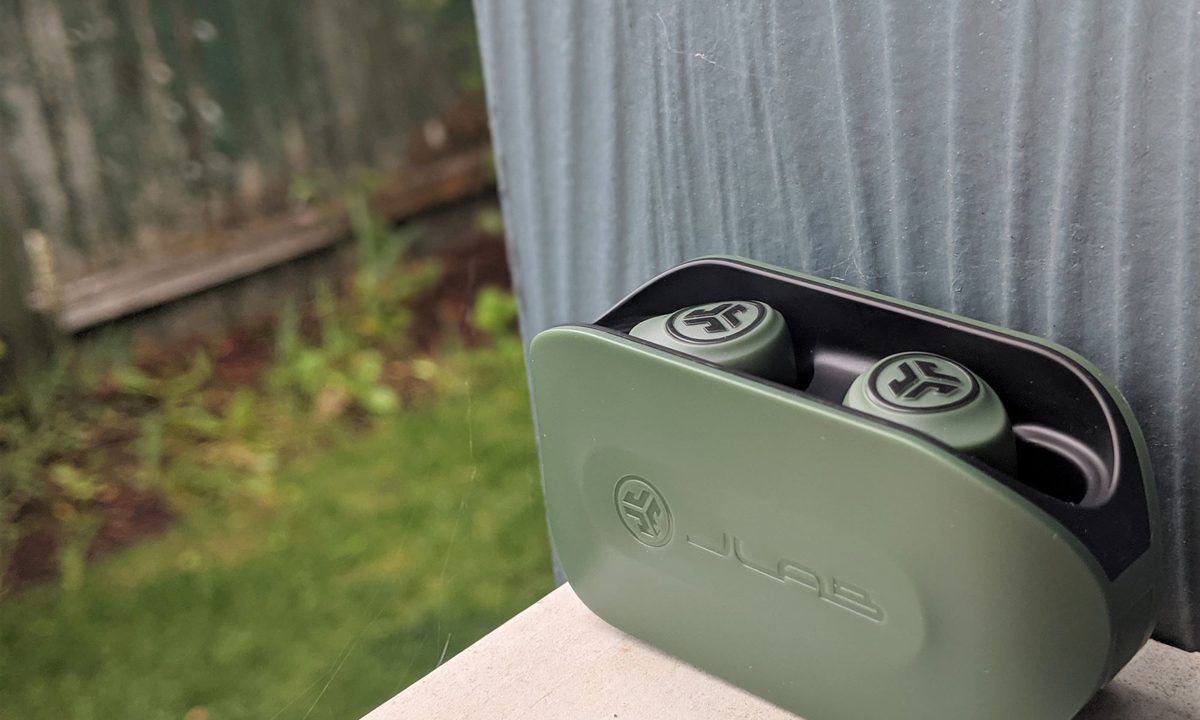

“The Go Air are a valuable pair of true wireless commuter buds”
- IP44 waterproof rating
- Comfortable design
- Affordable
- Short charging cable
- Mediocre sound quality
“Why you can trust Digital Trends – We have a 20-year history of testing, reviewing, and rating products, services and apps to help you make a sound buying decision. Find out more about how we test and score products.“
Admittedly, it’s a little unordinary to review an audio product priced as conservatively as JLab’s new earbuds. The circumstances must be just right to justify it. That is to say, the product has to be from a reputable brand, filled with intriguing features, and in demand.
Allow JLab to check off all three boxes with the $30 Go Air true wireless earbuds. The incredibly affordable buds boast 20 hours of total battery life with their included charging case, an IP44 waterproof rating, and have glowing customer reviews on Amazon. Surely these buds are too good to be true, right?
Out of the box
The Go Air’s packaging is as compact as the buds themselves, encased in JLab’s standard shade of light blue. The box opens like a book, revealing a quick guide to the controls on the inside cover and the earbuds sitting beneath a plastic casing on the right.
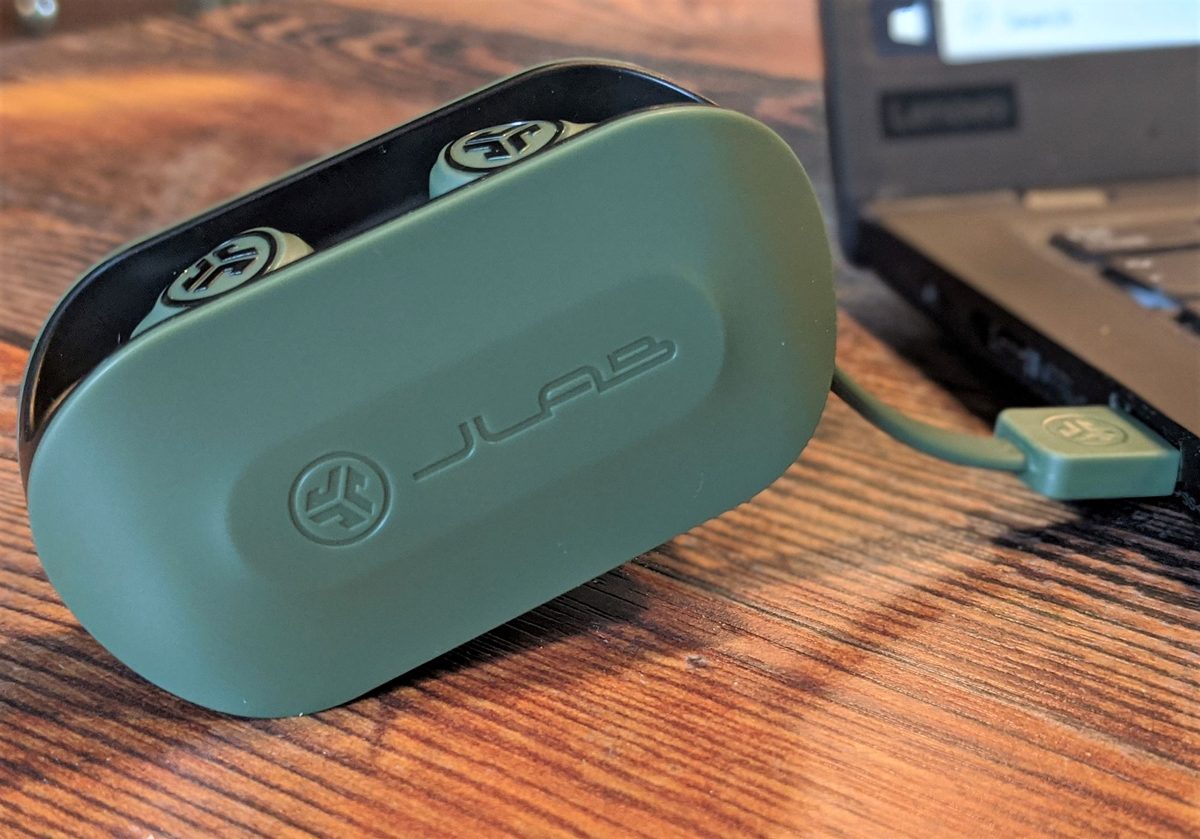
Aside from the buds and the case, JLab tosses in two extra pairs of gel cushion tips. There’s no separate charging cable here because the case has its own comically short cable built-in; it’s one that doesn’t lend itself to much else besides turning the case into an inconvenient dongle for whatever USB port it’s plugged into.
There’s a pull tab on the charging case, which is something I haven’t seen since I activated the remote for my old car stereo. But getting connected with the Go Air is easy beyond that, with JLab even providing a roughly five-minute video guiding you through the entire process.
The connection of these buds has been a delightful surprise. It’s common practice to not expect much from cheap buds, but I haven’t had any dropouts of note. The weather has been a little too inclement for extensive testing, but moving through my backyard with my phone still inside the house showcased solid Bluetooth range as well.
Design
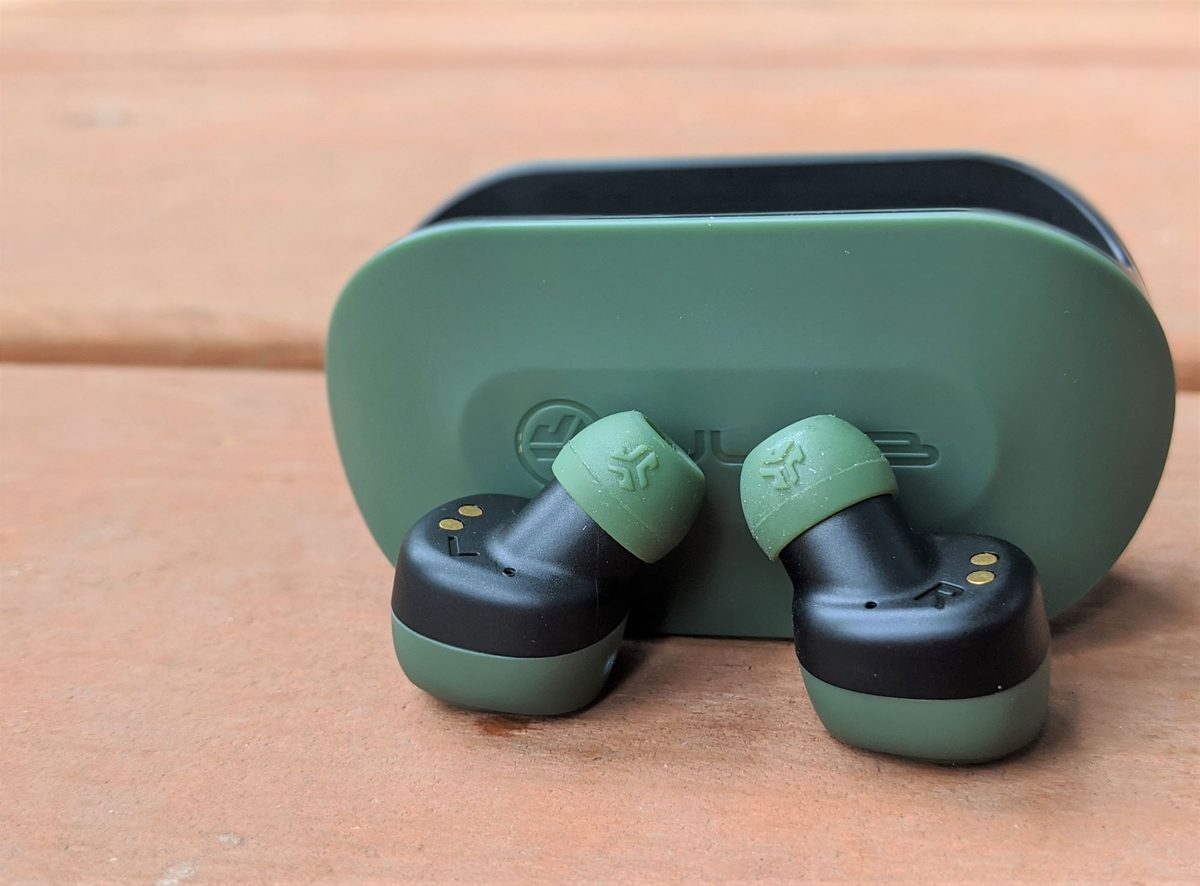
The structure of the Go Air seems to be one of their biggest selling points. In a few words, they’re lightweight, small, and comfy.
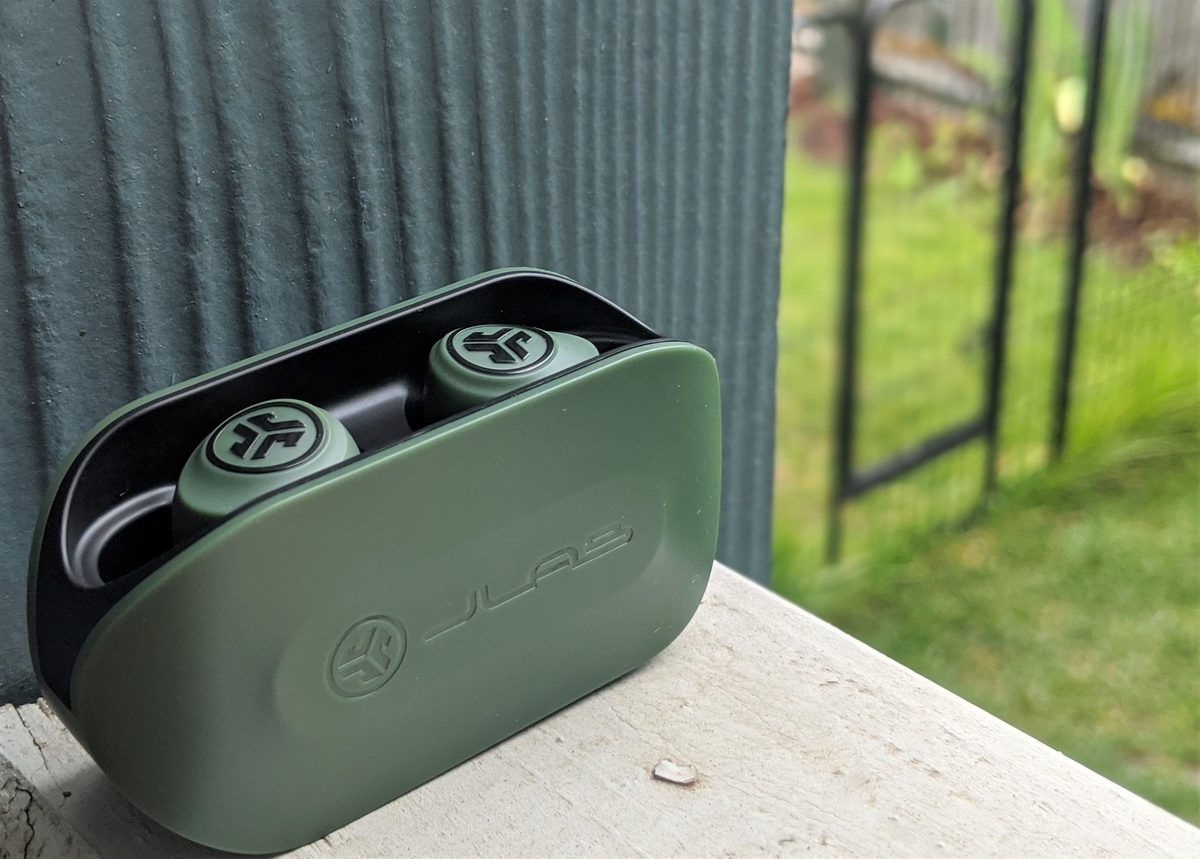
To provide a bit more context, each bud weighs about 5 grams, which is on par with the Samsung Galaxy Buds+ and just a gram heavier than the Apple AirPods. At 50 grams, JLab’s charging case is significantly bulkier than Apple’s 38-gram featherweight, but that’s hardly a concern worth holding against the Go Air.
They come in four different colors: Black, white, green, and navy blue. My review unit was the green which, while not notable in terms of aesthetics, was helpful in keeping dust and dirt from showing.
The included case has an open-air design, meaning there’s no lid to protect the buds when you’re traveling with them. The buds themselves are secure inside the case, but the open structure of the case makes me wary of them being scuffed or damaged in transit.
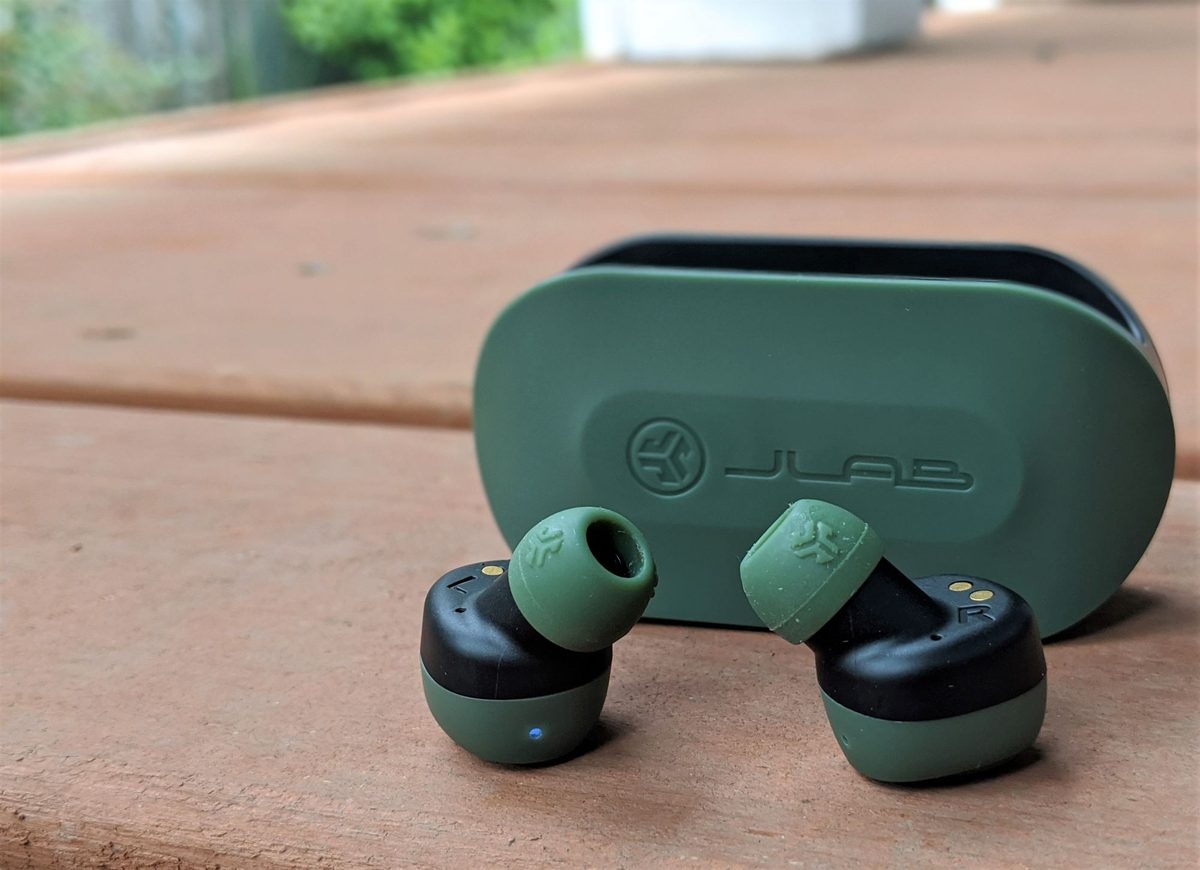
The Go Air have a design that reminds me of a bargain bin Google Pixel Buds 2 — that is, though slightly bulkier, these buds still fit flush in your ear. I don’t think they are completely impervious to the classic “hoodie test,” but I do appreciate their relative slimness.
There are no buttons on the Go Air, just touchpads on the JLab logo of each bud — more on that below.
Features
Most of the features built into the Go Air aren’t mind-blowing on their own, but when you put everything together, the bigger picture becomes a bit more impressive, particularly for such inexpensive buds.
Let’s start with the battery life, which JLab claims is five hours of playback per charge with three extra charges inside the Go Air’s case. Plus, JLab says 15 minutes of charging nets you an hour of playback. From my testing, I found JLab’s battery stats to be accurate.
Those numbers, while not incredible by any stretch of the imagination, still stack up to much more expensive products like the AirPods (five hours) or Amazon Echo Buds (five hours). Apple gives you slightly more listening time overall at 24 hours, but the Echo Buds tap out at 20, just like JLab, for roughly $100 more.
The Go Air come with an IP44 waterproof rating, protecting the buds from water splashes at any angle. That’s significant for buds at this price, considering the Echo Buds carry an IPX4 rating and the AirPods don’t have any waterproof rating at all.
The touch controls on the Go Air aren’t as intuitive as I would have liked them to be. There were a handful of instances where I touched the buds only to be greeted with no action from them in return. But for the most part, they are functional in allowing you to skip or pause tracks, adjust volume, call up a voice assistant, or toggle between one of JLab’s three EQ modes. They work, but the experience was inconsistent.
Audio quality
The Achilles’ heel of most headphones and earbuds in this price range is sound. For whatever reason, audio companies seemed to have cracked the code on affordable features but have left vast room for improvement in audio quality.
Unfortunately, I have to report that the Go Air fit that mediocre mold. On a positive note, these buds are suited well for light listening of content like podcasts or the occasional TikTok video. Additionally, they have serviceable call quality that made it possible to hear and be heard well enough while I braved windy conditions to take my dogs on a walk. They just lack the clarity and range often found in higher-priced counterparts to be considered suitable for quality music-listening sessions. Then again, that comes with the territory of $30 buds.
There are three different EQ settings available to help tune the 8mm drivers in the Go Air, with three taps on either bud letting you switch between JLab Signature, Balanced, and Bass Boost sound modes. I found the JLab Signature mode to be the most palatable, but even that mode lacked low end and sounded distant in general. Bass Boost helped that low end, but it didn’t totally erase the deficit. Balanced mode dampened the entire frequency range, which isn’t always a bad thing. Unfortunately, when you don’t start with great sound at the outset, flattening the EQ won’t magically make things better.
If you can accept that $30 earbuds with great sound isn’t realistic, it can soften the sting with the Go Air. They simply can’t compete with the sound of buds that have better components, but the only way that should stop you from considering them is if you somehow expected them to.
Our take
The JLab Go Air possess the feature set and the price tag to be a valuable pair of true wireless commuter buds. Unfortunately, they just lack the sound quality to be your main listening apparatus for music.
Are there better alternatives?
There aren’t many buds in the Go Air’s weight class with these kinds of features, but there are options worth spending a bit more for. The $120 Edifier TWS NB are our best budget true wireless earbuds for their active noise cancellation and solid battery life. If you can handle a wire, the $100 1More Triple Drivers are our favorite budget earbuds, period.
How long will they last?
At this price, longevity won’t be a concern for most customers. But JLab does offer a two-year warranty on the Go Air.
Should you buy them?
Yeah. They may not sound like a winner, but the JLab Go Air cost $30 and come with similar battery life and better water resistance than the Apple AirPods. Essentially, they’re the low-risk, high-reward pair of buds that you should take a chance on.