Looking for a really big Ultra HD TV? Well, if you live in South Korea – and money is no object – you can grab one of Samsung’s outrageously humongous 110-inch Ultra HD TVs. The price? Just over $150,000.
The 110-inch behemoth, first shown off at CES 2013, has now been unleashed on the public. The move is just the latest in a litany of Ultra HD one-up competitions between Korean electronics powerhouses Samsung and LG. LG revealed a similarly sized 105-inch curved 4K TV in mid-December, while Samsung followed the very next day with its own eerily similar model. This time Samsung struck first, marking a new era in monster-sized home Ultra HD viewing with its regally priced new set.
Apart from South Korea, the new 110-inch TVs will be available in China, Europe, and the Middle East. CBS reports that residents of the latter region have already put in 10 orders for the new TVs. Pricing and availability for the US market have not yet been officially announced and will likely be revealed at the International CES 2014 show in Las Vegas next week.
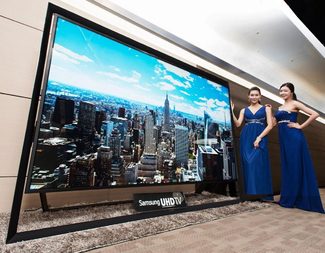
As Digital Trends recently reported, Ultra HD TVs (also known as 4K TVs) have become the leading new television technology and shipments are predicted to grow ten fold in 2014, with prices dropping rapidly. Meanwhile OLED displays, often touted as the future of HD, continue to tread water, evidenced most recently by news that Panasonic and Sony will be pulling out of a joint venture to develop cost-effective OLEDs for mass production.
Ultra HD TVs have some advantages, including a resolution that is 4 times that of 1080p HD displays, but the TVs are plagued with both a lack of viable content, and content delivery challenges. OLED, on the other hand, uses organic light emitting diodes situated between two electrodes to display regular 1080p content with astonishing black levels, and vividly rich color saturation, dazzling the eye without needing to alter the content source.
Still, even with new printing technologies that promise to lower the cost, and raise stability of OLED TV technology substantially, the displays continue to elude the grasp of the viewing public. Samsung and LG may talk a good OLED game, with several OLED showcases at trade shows, but as the events of the last few weeks leading up to CES can attest, the proof is in the pudding: for now Ultra HD remains the big kahuna of HD displays.
Hopefully, the same folks who can afford Samsung’s new behemoth can also afford to put some money into pushing for more 4K content, as well as a better infrastructure for delivery of the bandwidth-intensive content. For now, we’re just excited to get a look at all these new Ultra HD wonders in a few short days in Las Vegas. Follow along with us next week to find out just how crazy a UHD TV that measures around 8.5 by 6 feet looks in person.