

CES is exactly the place where you expect companies to show up and absolutely wow you with bleeding-edge tech. We’re talking about a tantalizing view of the future, the kind of stuff that might not reach the mainstream for a few years. At CES 2024, that sort of futuristic TV technology almost didn’t get that moment. And then, literally as he was packing his bags to head home, Digital Trends’ Caleb Denison heard a rumor that Sharp Display Technology Corporation was quietly showing the future of TV to a very small number of people.
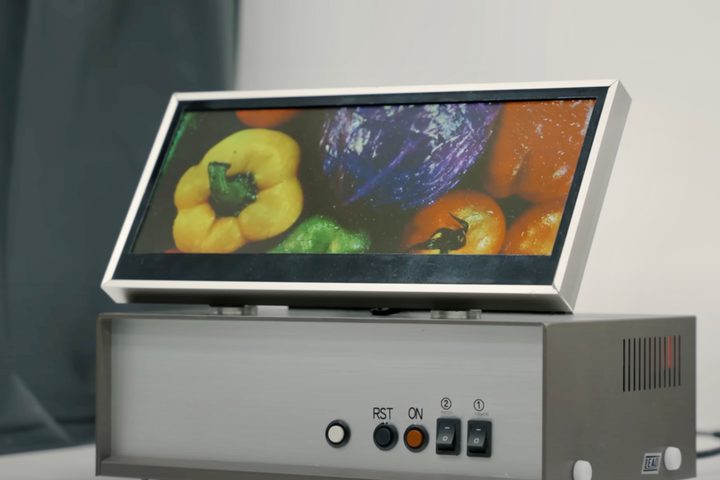
That rumor proved to be accurate, and Denison was among the first people to see not just one, but two working prototypes of a QDEL TV.
OK, let’s back up for a moment. What is QDEL, and why does it look like someone was trying to type “QLED” while holding a coffee in their other hand?
QDEL stands for Quantum Dot Electroluminescent. For several years, it has represented a holy grail of sorts for the TV world, because a QDEL TV theoretically possesses all of the benefits of OLED TV (like gorgeous color, perfect black levels, incredible contrast, and lightning-fast response times) and none of its weaknesses (lower brightness, pixel material that ages over time, and the risk of burn-in). In short, a QDEL TV could be a perfect TV.

As the name suggests, a QDEL TV uses quantum dots. They’re pretty much the same quantum dots that have been used for years in QLED TVs and more recently in QD-OLED TVs, but with two major differences.
First, quantum dots — which emit different wavelengths (color) of light depending on their size — typically receive their energy via light. They absorb light from an LED or OLED light source (usually a blue light) and then convert that light at near perfect efficiency into their native color. So a red quantum dot converts blue light into red light and a green quantum dot converts blue light into green. In a QDEL TV, however, quantum dots receive their energy via electricity. They still emit the same color of light, but they don’t need a separate light source to do so.
Second, QDEL TVs create their color and brightness exclusively with quantum dots — no LED (or mini-LED) backlight and no OLED material. To do that, each QDEL pixel needs a red, green, and blue quantum dot subpixel. While the quantum dot industry has mastered the science of creating red and green quantum dots that can emit light at the needed brightness to be used in TV displays, formulating equally bright blue quantum dots has proven much harder. But that puzzle appears to have been finally solved.
Sharp’s demo proves that QDEL TV has moved from theory to reality. We saw a small, 12-inch display (pictured above), as well as a 30-inch prototype that the company was unwilling to let us capture on camera.
The larger size is key — it means that QDEL technology, even at the prototype stage, can scale up to the kinds of sizes today’s TV buyers expect. For comparison, the very first OLED TV you could buy was Sony’s gorgeous, but tiny 11-inch XEL-1.
But what’s remarkable is Sharp’s claim that the process for making QDEL TVs is very similar to how LED TVs are manufactured. Unlike OLED technology, which requires special vacuum chambers and other exotic industrial elements, LED TVs can be built using simpler techniques. That bodes well for the cost of QDEL TVs when they finally emerge as something we can buy.
Speaking of which: Sharp was unsurprisingly tight-lipped about mass manufacturing timelines. In fact, company representatives hinted that TVs might not be the first priority for QDEL development. Small-scale smartphone and smartwatch displays may come first, followed by computer monitors.
Still, now that Sharp has proven it can be done, the race to produce the first generation of household-ready QDEL TVs is now on, and we’re very excited to see how it plays out.


