When it comes to affordable indoor cameras, the Blink Mini Pan-Tilt Mount and the Wyze Cam Pan v3 are at the top of the class. Both offer high-quality footage, along with a bevy of other useful features that make them stand out in a crowded market. The Blink Mini Pan-Tilt Mount is a bit more expensive (it costs $60, compared to $34 for the Wyze Pan v3), but which one is better for your smart home? Here’s a comprehensive look at the Wyze Pan v3 and Blink Mini Pan-Tilt Mount to help you decide.
Video quality

Both the Wyze Pan v3 and Blink Mini Pan-Tilt Mount capture 1080p footage. They also both work in the dark, with Blink featuring infrared night vision and Wyze using color night vision, which allows them to function around the clock. Both look great when viewed on your smartphone, and it’s hard to go wrong with either if you’re worried about video quality.
Winner: Tie
Feature and spec list

Customers expect indoor cameras to be loaded with auxiliary features that complement the standard video feed, and both the Wyze and Blink products deliver a robust spec sheet. From two-way audio and motion detection to video history and smartphone notifications, the Wyze Cam Pan v3 and Blink Mini Pan-Tilt Mount don’t leave much out. However, the Wyze Cam Pan v3 does offer a built-in Privacy Mode that angles the camera directly at the ground — blocking its view of your home. That’s a big selling point, and one that gives it an edge over the competition.
They are also capable of panning and tilting to cover all corners of your room, as 360-degree coverage is offered by both products.
It’s also worth noting that the Blink Mini Pan-Tilt Mount is technically two separate products (the standard Blink Mini camera, which costs $35 separately, and the Pan-Tilt Mount add-on, which costs $30). This means you can remove the camera from the Pan-Tilt Mount if desired, whereas the Wyze Cam Pan v3 is a single product that cannot be detached from its base.
Winner: Wyze Cam Pan v3
Monthly fees and what you get
Both products can be used without a subscription, but opting for a monthly plan unlocks heaps of useful features. Blink’s entry-level plan costs $3 per month and gives you a 60-day video history, motion-activated smartphone notifications, video sharing, and photo captures. There’s also a Blink Plus Plan for $10 per month that gives you an extended warranty and discounts on other Blink devices.
With Wyze, you can sign up for Cam Plus — which provides you with cloud video recording, person detection, smart event reports, and Wyze Web View (allowing you to watch your video feed on a web browser or tablet). This costs just $2 per month, and since it’s comparable to Blink’s offering, its lower price makes it a better option.
Winner: Wyze Cam Pan v3
Ease of use

Smart indoor cameras are almost always accompanied by intuitive smartphone apps, and that’s no exception for the Blink Mini Pan-Tilt Mount and Wyze Cam Pan v3. Both are remarkably easy to use, give you instant access to all available features, and play nicely with Amazon Alexa and other smart home ecosystems. Rest assured that regardless of which you choose, you’ll be able to use it without having to fiddle with a clunky interface or dig through thousands of menus.
Winner: Tie
Which is best?
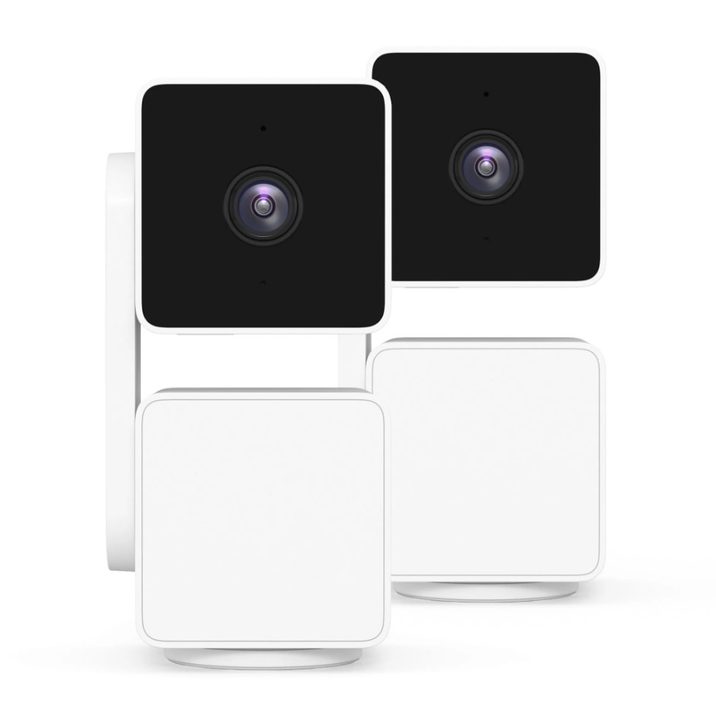
If you’re looking for the best value for your money, the Wyze Cam Pan v3 is an easy recommendation. It goes toe-to-toe with the Blink Mini Pan-Tilt Mount, yet clocks in at nearly half the price. Its dual-cube design is a bit awkward, but it does allow for the inclusion of a Privacy Mode.
The Blink Mini Pan-Tilt Mount, meanwhile, offers a design that’s easier on the eyes. And since Blink is owned by Amazon, you’re guaranteed to get a high-quality product that integrates seamlessly with Alexa. This makes it a great choice if you have tons of other Alexa products in your smart home and are already a fan of their performance. But since Wyze also works with Alexa, it’s the better pick for shoppers on a budget.