
For tech junkies, the infotainment system is the heart of every new car. Like every other aspect of a car, each manufacturer does things a little bit differently, both to engineer the best system and to create a brand-specific experience for the user.
So which carmaker has the best infotainment system? Quite frankly, it’s best not to dive into any of these systems and expect a flawless experience. Infotainment still represents a fairly new frontier for automakers, and the demands of driving mean that doing anything else besides paying attention to the road can be cumbersome and awkward — no matter how slick the infotainment interface is. Keeping your eyes on the road and your hands on the wheel should always be the highest priority, but most current infotainment systems don’t allow this.
That being said, these 10 infotainment systems represent the best of the best. They come from a wide variety of automakers and are available in cars at a wide variety of price points. Keep in mind that not all features on a given system are standard, but otherwise be sure to check these systems out when shopping for your next car.
Audi MMI
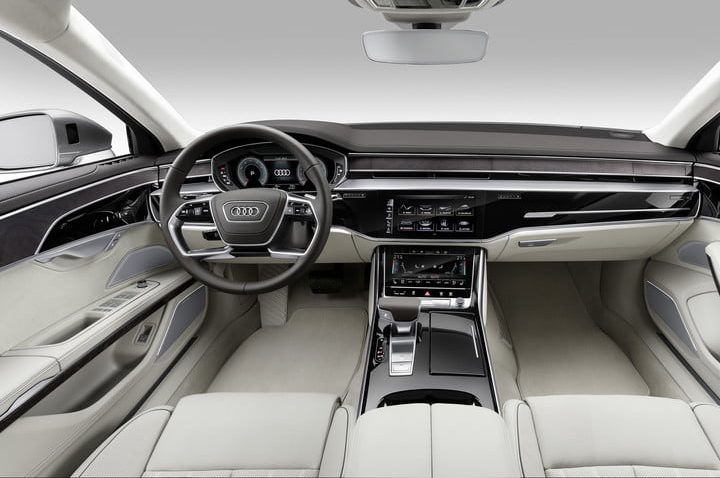
Like everything else about Audi’s cars, MMI is sharp and well designed. It features a rotary controller—always a plus—and a touchpad that can recognize handwriting in some models. What really sets MMI apart, however, is the available “Virtual Cockpit” display. It replaces the instrument cluster that can display everything from a digital speedometer to Google Maps satellite images. Apple CarPlay and Android Auto are available on most new Audi models.
More recently, with models like the Q8 and all-electric E-Tron, Audi adopted a dual-screen setup, with a lower screen taking the place of most analog controls. That could have been a disaster, but works quite well.
BMW iDrive

BMW was one of the first automakers to launch a comprehensive infotainment system, and its iDrive system remains one of the best. It uses a rotary controller to help the driver navigate the various menus and submenus, which is a bit easier than continuously tapping a touchscreen. All BMW models offer Apple CarPlay, although it is not standard on every model. The automaker has offered wireless CarPlay since 2016, first with an annual fee, but more recently without charge.
BMW has dragged its feet on offering Android Auto, but will finally make a wireless version available on 2021 models with the new iDrive 7 infotainment system.
Some BMW models also offer gesture control, which allows you to do things like adjust audio volume and answer the phone with the wave of a hand. We’ve found it to be more of a gimmick than a true breakthrough, however. 5G connectivity is scheduled to debut in 2021.
Chevrolet MyLink

MyLink features large, easy-to-read icons and text, and a decent amount of analog controls. The same basic setup is used in the IntelliLink systems from fellow General Motors brands Buick and GMC. The intuitive user interface is something GM’s flagship brand, Cadillac, has struggled to match with its more complex CUE (short for Cadillac User Experience) systems. Apple CarPlay and Android Auto are available across all brands, and virtually all GM vehicles come standard with a built-in Wi-Fi hot spot that can support up to seven devices. GM also recently began adding Amazon Alexa compatibility to its vehicles. MyLink-equipped vehicles can also use GM Marketplace, a service that allows you to order food and pay for gas from your dashboard.
Chrysler Uconnect

Chrysler’s Uconnect is one of the best systems available in non-luxury vehicles, although you really need to get the top version for the best experience. That usually includes an 8.4-inch touchscreen, although Ram pickup trucks get a massive 12.0-inch, portrait-oriented screen. Uconnect masters the fundamentals with easy-to-read graphics, logical voice controls, a responsive touchscreen, and available Apple CarPlay and Android Auto. But Chrysler also excels at finding model-specific features, such as the “Performance Pages” app in Dodge muscle cars, or the ability to integrate a rear-seat entertainment system in the Chrysler Pacifica minivan.
Ford Sync 3
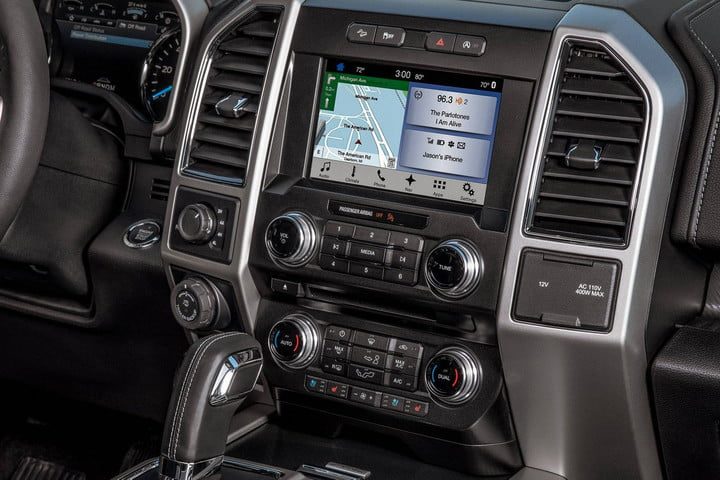
When it comes to infotainment, Ford deserves a “most improved” award. Its old MyFord Touch systems were legendarily bad, but the current Sync 3 system has addressed their faults. It features responsive touchscreens, intuitive menus, and a voice-command system that allows the user to speak more naturally. Building on that solid foundation, Ford is adding Apple CarPlay and Android Auto, Wi-Fi hot spots, and an Amazon Alexa skill for certain vehicles. Sync 3 will soon be replaced by Sync 4, which will add wireless versions of CarPlay and Android Auto, as well as over-the-air software updates. Sync 4 will debut on the ridiculously oversized touchscreen of the Mustang Mach-E electric car.
Hyundai BlueLink

Hyundai’s infotainment system isn’t the most sophisticated, but they master the fundamentals. BlueLink features fast processors, a sensible menu layout, and a decent amount of backup analog controls. The larger available touchscreens offer good resolution, although the smaller screens that are standard issue in most Hyundais don’t impress as much. Hyundai also has a reputation as an early adopter of new tech. It was one of the first automakers to roll out Apple CarPlay/Android Auto, Amazon Alexa compatibility, and a mobile app that lets the driver lock and unlock the doors or start the engine. The 2020 Sonata takes things a bit further with a feature that lets the car autonomously pull out of parking spaces with a few clicks of the key fob.
Kia UVO

Like corporate parent Hyundai, Kia takes a sensible approach to infotainment. The automaker’s UVO system strikes a good balance between touchscreen and analog controls, making it easy for drivers of any level of tech aptitude to use. Apple CarPlay and Android Auto are available, as is Amazon Alexa compatibility, in certain models.
Mercedes-Benz MBUX

The name Mercedes-Benz may invoke images of limitless luxury, but the automaker’s best infotainment system yet originated with more humble, entry-level models. Called MBUX (short for Mercedes-Benz User eXperience), it debuted in the A-Class before migrating to the related CLA and GLB compacts, and more expensive models. Past Mercedes infotainment systems were decent, but MBUX nails usability like never before. It employs a voice assistant that, in a first for this tech in an automotive application, actually responds reliably to naturalistic speech. Whether it’s one of the entry-level models or something fancier, screen graphics are well designed, looking both sharp and distinctive. Mercedes also offers both Apple CarPlay and Android Auto compatibility.
Tesla

The infotainment setup in the Tesla Model S and Model X is the equivalent of stuffing a massive V8 engine under the hood of a muscle car: the operative theory is that bigger is better. Both vehicles rely on a 17-inch touchscreen for nearly all control functions. Even though not all features require such a big screen, it’s undoubtedly an impressive piece of tech that prioritizes the drive with regard to controls and speciality technology. Tesla claims the sound dynamics are comparable to that of a recording studio and uses advanced noise engineering to do so. With the Model 3, Tesla upped the ante by eliminating the traditional gauge cluster too, and using a central screen for everything. Tesla also uses over-the-air software updates to add new features, including video games. As if tech nerds needed another reason to love the automaker from Silicon Valley.
Volvo Sensus
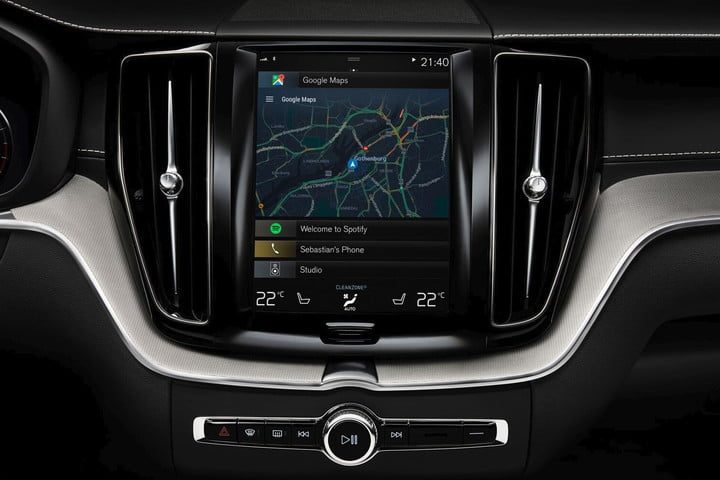
The Volvo Sensus allows you to control your car and all its media systems easily. The latest generation of this infotainment system uses a tablet-like touch screen, which, unlike most car systems, is orientated in portrait mode. It’s full of crisp, high-quality graphics – no blurriness here – and it blends seamlessly into the dashboard of any Volvo it’s installed in.
The Volvo Sensus brings sophisticated high-tech functionality to a user-friendly interface. Since the design looks something like your phone’s touchpad, the user experience is relatively intuitive. Use your smartphone or the vehicle’s built-in touchpad to control nearly everything in your car, including air and heat, locking system, directions, and more.
Volvo was one of the first to the game in terms of installing Apple CarPlay and Android Auto. Because these installations required internal WiFi hotspots, Volvo was already prepared for the age of infotainment.
Volvo is continually evolving and improving its tech offerings. In the coming years, Volvo owners can expect a new Android-based design and other new features. Polestar, also owned by Volvo, is introducing the same system.


