
Apple’s September 2022 “Far Out” event is over, and it was packed full of announcements. The 90-minute show saw updates to a wide range of Apple products, including iPhones and the Apple Watch, as well as a few software features that could make using your Apple products more seamless than ever. Here’s everything Apple announced during its September 2022 event.
There were some announcements missing, though, so make sure to pull up our roundup of everything Apple didn’t announce, as well.
Apple Watch Series 8


Starting off the show, we got a look at the Apple Watch Series 8. It’s launching on September 16, and pre-orders are already live on Apple’s website. You’ll spend $399 for the base model with GPS, and you can spend up to $499 on the variant with a cellular connection. It’s a new Apple Watch, and it comes with a ton of new features.
Crash detection is the most impressive, utilizing a built-in gyroscope to detect a car crash and immediately call emergency services and pin down your location. The Apple Watch Series 8 also includes two built-in temperature sensors, which can help monitor your sleep and ovulation cycles with a sensitivity of 0.1 degrees Celsius for the most accurate temperature data.
These features come from a combination of the hardware inside the Apple Watch Series 8 and WatchOS 9, which will debut with Apple’s latest wearable.
Apple Watch SE 2
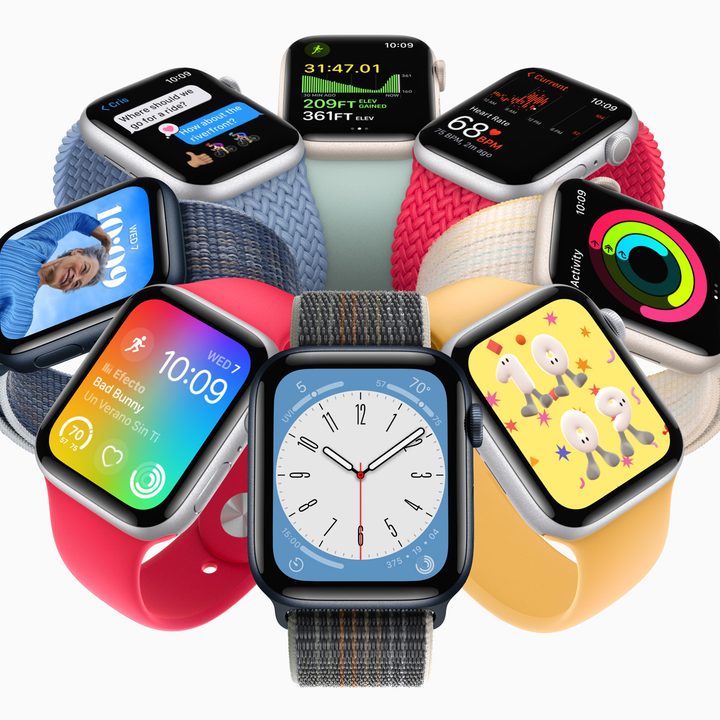
WatchOS 9 will also be available in the $250 Apple Watch SE 2. Apple revealed this cheaper option during its September showcase, as well, clocking in at $249 and $299 for the GPS and cellular versions, respectively. It will be available on September 16 alongside Apple Watch Series 8.
Although it doesn’t come with the same tech under the hood, the SE 2 looks like a big improvement over the original. It’s 20% faster than the previous model with the new S8 processor, according to Apple, and it comes with the same crash detection features as its more expensive sibling.
Apple Watch Ultra
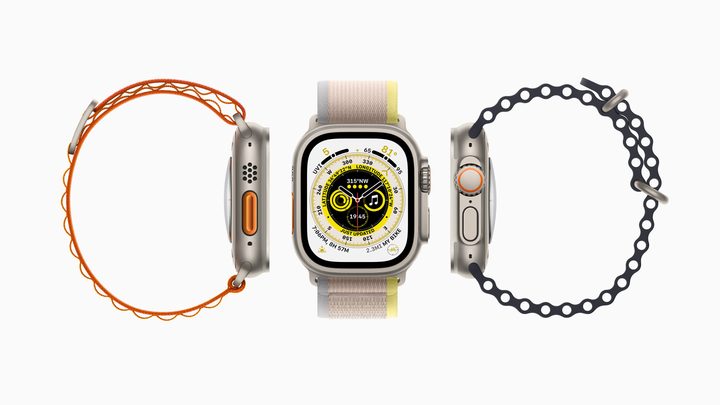
Going into the event, rumors pointed to Apple launching a Pro version of its Apple Watch, which we got in the form of the Apple Watch Ultra. It’s targeted at fitness enthusiasts and clocks in at $799 regardless of the model you choose. It’s launching slightly later than the other wearables on September 23.
The two new bands are interesting, but the Apple Watch Ultra earns its price with the build quality. Apple says the battery can last through a long-distance triathlon without losing its GPS or heart rate capabilities, and it comes with a titanium casing with water resistance up to 100 meters. It’s larger to accommodate a bigger battery, but more room means Apple was able to design the Digital Crown for users wearing gloves.


Perhaps the most exciting addition is the Action Button, which allows you to track a race while you’re running, set waypoints on a hike, and even use GPS data to retrace your steps.
AirPods Pro 2


We’ve been waiting for the AirPods Pro 2 for a while, and Apple finally showed them off during its September 2022 event. They look largely similar to the original version, still sporting active noise-cancellation (ANC) and Bluetooth, but they come with the new H2 processor. This updated processor enables personalized spatial audio, which is a feature that allows iPhones to use their True Depth cameras to look into your ears and build a personalized spatial audio profile.
Other improvements include a redesigned audio driver and up to six hours of battery life without the case (with the case, you get a total of 30 hours). The case is seeing an upgrade outside of battery life, too, with the addition of Apple’s popular Find My feature.
The AirPods Pro 2 will launch on September 23 for $249. Pre-orders start on September 9.
iPhone 14 and iPhone 14 Plus

Apple focused the back half of its event on the upcoming iPhone 14 range, kicking off its announcements with the iPhone 14 and iPhone 14 Plus. The base model retains the 6.1-inch screen, while the new Plus model offers a slightly larger option at 6.7 inches. The iPhone 14 will set you back $799, the Plus will run $899, and they’ll be available on September 16 and October 7, respectively.
Both feature Apple’s A15 Bionic processor, which was the chip behind the iPhone 13 Pro last generation. They also both come with an upgraded 12-megapixel camera and an aluminum body with Ceramic Shield glass over the screen.
iPhone 14 Pro and iPhone 14 Pro Max


For flagship chasers, Apple also introduced the iPhone 14 Pro and iPhone 14 Pro Max. These two phones come with the upgraded A16 Bionic processor, which is the first to use a 4nm manufacturing process for much more power in a smaller package. Prices remain unchanged compared to the previous generation at $999 for the Pro and $1,099 for the Pro Max, and they’ll both be available on September 16.
More power is welcome, but Apple made other improvements, as well. The new 48MP camera sensor is 65% larger than the previous model for better lowlight performance. You also get a set of 12MP cameras for telephoto and ultrawide shots, as well as the motion sensors inside the Apple Watch Series 8 for crash detection and reporting.
These phones also feature thinner bezels compared to the base models, as well as the Super Retina XDR display, which Apple says can top out at 2,000 nits of peak brightness. In addition, the Pro models come with an always-on display feature, which allows the screen to dim and go down to as little as a 1Hz refresh rate.
No more SIM cards for iPhone

Apple didn’t make a big deal about it, but we learned that the iPhone 14 won’t support SIM cards in the U.S., instead relying exclusively on eSIM technology. eSIMs are virtual SIM cards that have been optional in phones for several years, but Apple is forcing the hand of the rest of the market by attempting to kill off SIM cards with the launch of the iPhone 14.
Goodbye notch, hello Dynamic Island!

Rounding out the show was the announcement of Dynamic Island. The iPhone 14 Pro and Pro Max no longer feature a notch and instead come with a small pill-shaped cutout that Apple is calling Dynamic Island. Apple says it’s meant to make the marriage between software and hardware more seamless, and it acts as a small hub for your background apps.
You can access a slew of controls with Dynamic Island, like answering calls, checking on sports scores, and tracking the progress of ride-sharing services. It may not be as revolutionary as Apple is billing it, but Dynamic Island seems like a key feature of the iPhone 14 Pro and Pro Max that makes multi-tasking much easier.


