For all its noise just before the IFA tech show last month, Archos did a good job at not really announcing very much. Since then, we’ve heard a little more about the Gamepad 2, but up until today, its other new hardware remained elusive. That’s now all changed with the announcement of three new Platinum series Android tablets, the 97b Platinum HD, the the 101 Platinum, and the 80b Platinum.
So, Archos hasn’t altered its ridiculous naming system, but thankfully, it’s much easier to distinguish between them than the name suggests, as the primary difference is in the screen. The smallest of the three is the 80b Platinum (seen below), which has an 8-inch screen with a 1024 x 768 pixel resolution. Next is the 97b Platinum HD, which you can see in the main picture, and is equipped with a 9.7-inch display boasting an impressive 2048 x 1536 resolution. FInally, the 101 Platinum has a 10.1-inch screen and a more traditional 1280 x 800 resolution.
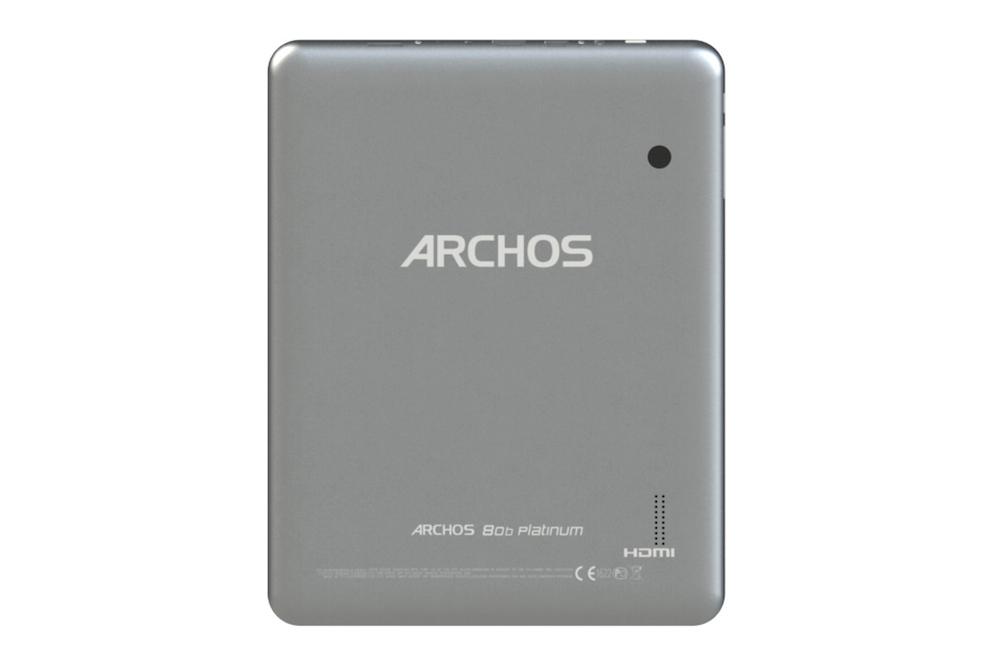 All three use an unnamed quad-core ARM Cortex A9 processor with a clock speed of 1.6GHz, and except for the 80b Platinum each has 2GB of RAM. The 80b makes do with 1GB. Android 4.2 Jelly Bean is the operating system across the board, and all have 8GB of internal storage, dual-band Wi-Fi, Bluetooth, a microSD card slot, and a mini HDMI out. The high-end 97b Platinum HD gets a 2-megapixel camera on both the front and rear of the tablet, while the other two have a 2-megapixel camera on the rear and a basic VGA video call cam above the screen. Just to confuse everyone, the mid-level 101 Platinum is the only one to have GPS.
As for the price, the 80b Platinum is $200, the 101 Platinum is $270, and the top-of-the-range 97b Platinum HD is $300. The new tablets will be on sale during October, and are already listed on Archos’ website.