1. Home
  2. Computing
  3. Emerging Tech
  4. Gaming
  5. Mobile
  6. Legacy Archives

Intel and Micron crunch flash memory down to 20nm

Add as a preferred source on Google

Chipmaking giant Intel and memory developer Micron have announced they have produced a new 20 nm process for producing 20 nm NAND flash memory. Most flash storage on the market today uses either 32nm or 25nm processes: the 20nm process means the folks who make everything from smartphones to tablets to portable game systems to solid-state drives can put more storage capacity in less space inside the device—and tap into it all using less power.
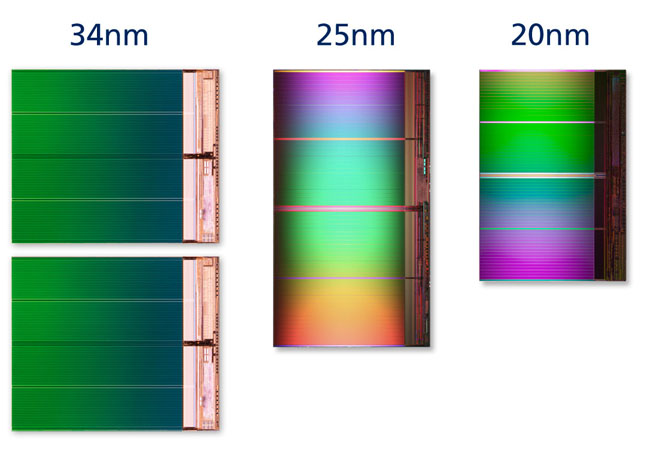
Intel Micron Flash die size comparison
Image used with permission by copyright holder

“Industry-leading NAND gives Intel the ability to provide the highest quality and most cost-effective solutions to our customers, generation after generation,” said Intel’s VP and general manager for non-volatile memory solutions Tom Rampone, in a statement. “The Intel-Micron joint venture is a model for the manufacturing industry as we continue to lead the industry in process technology and make quick transitions of our entire fab network to smaller and smaller lithographies.”

Recommended Videos

The modules are being produced by a joint venture between Intel and Micron, dubbed IM Flash Technologies.

Intel and Micron have produced an 8 GB sample device that measures just 118mm², is a 30 to 40 percent reduction in board space required for storage compared to current 8 GB 25nm modules. The 8 GB modules also cost about one third less to manufacturer compared to 25nm modules.

The companies are sampling the 8 GB modules now and expect to take the components to mass production in the second half of 2011. Around the same time, Micron and Intel expect to begin sampling 16GB modules built on the same 20nm process—all told, the companies say those 16 GB modules could combine together to put 128 GB of storage capacity in an area smaller than a typical U.S. postage stamp. And the shrinkage won’t stop there: IM Flash Technologies is already working on a 16nm process for flash storage.

Geoff Duncan
Former Contributor
Geoff Duncan writes, programs, edits, plays music, and delights in making software misbehave. He's probably the only member…
Claude just got a scam detector, and it could save you from a costly mistake
Claude can now tell a scam from the real thing, even when you can't.
diagram representing Claude and Malwarebytes

Thanks to AI's content generation capabilities, scams are getting harder to detect. According to Malwarebytes' research, 66% of people say it's hard to tell a scam from the real thing. AI-generated scams are becoming so good that even tech-savvy people are getting caught off guard.

The problem is compounded as more and more people start relying on AI for the answers to all their questions. People are increasingly turning to AI browsers and tools like Claude for everyday questions, from what to wear to a function, to which restaurant to try on a trip. It won't be long before those same people ask their AI tools how to stay safe online.

Read more
Asus puts the outrageous dual-screen ROG Zephyrus Duo on the shelf at an eye-watering price
The ROG Zephyrus Duo isn't just a gaming laptop with two screens, it's the company’s most serious attempt yet to add more ambition to a "portable workstation" that’s capable of gaming.
Asus dual-screen laptop America.

Asus has decided that one screen isn’t simply enough on a laptop. The ROG Zephyrus Duo has returned to the market with two screens, with pre-orders now live for what the company is calling the world’s first 16-inch dual-screen gaming laptop.

Starting at $4,499.99 and going up to $5,499.99 for the top configuration, this is undoubtedly a machine that is built for people measuring their laptops with ambition, either for innovation or the desire to game on a dual-screen laptop. 

Read more
Nvidia quietly released a new version of GeForce RTX 5070 GPU inside a driver blog post
And more VRAM doesn't always mean more performance, and the pricing could make the RTX 5070 Ti a better value depending on final configurations.
The RTX 5070 in a graphic.

Nvidia just announced a new GPU variant in the weirdest way possible: buried it in a game driver update blog post. 

Alongside the release of its Game Ready 596.36 WHQL driver, the company also confirmed the launch of a 12GB GDDR7 configuration of the GeForce RTX 5070 laptop GPU. 

Read more