Sony has started the week in style with the introduction of two new Android smartphones, the Xperia SP and the Xperia L. While it’s promoting both of them as, “Premium designed,” phones, they’re actually solid mid-range entries, with the specs of the former matching top-of-the-range hardware from last year.
It makes sense to start with the Xperia SP, then, as it not only has the highest spec, but also several of the design elements seen on the Xperia Z and Tablet Z, such as the prominent on/off button on the side of an aluminum chassis. It also incorporates a light bar which can act as a notification alert, as well as be used to pulse in time with your music, or match the color in a photograph. Abandoned for phones such as the Xperia T, Sony has used customizable light elements on several devices in the past, including the Xperia S, Xperia P and Xperia J.
Powered by a 1.7GHz, dual core Snapdragon S4 Pro chip, the Xperia SP has a 4.6-inch touchscreen with a 1280 x 720 pixel resolution, and Sony’s Bravia Engine 2 for improved brightness and sharpness. An 8 megapixel camera sits centrally on the rear panel, and has Sony’s Exmor RS sensor and the ability to shoot HDR images and panorama shots.
There’s a forward facing video call camera, but with a disappointing VGA resolution; plus NFC, Bluetooth 4.0, GPS, DLNA, 8GB of storage memory, a microSD card slot and 4G LTE connectivity. The battery is a 2370mAh cell, and a Stamina mode aims to make the most of its energy reserves.
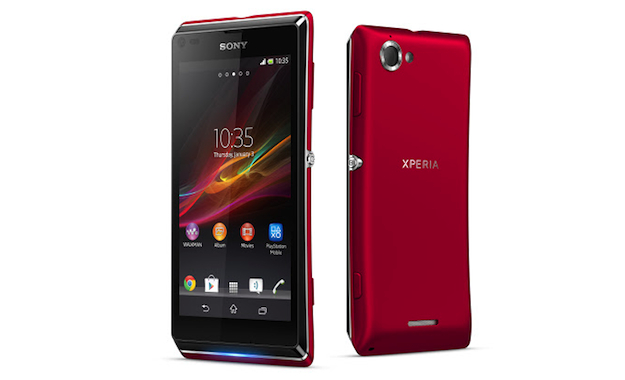
Moving on to the Xperia L, which spec-wise, is the Xperia SP’s little brother. With Xperia T-like curves, it looks more funky than the Xperia SP, particularly in red, so provided its well-priced could do well with younger smartphone buyers. It has a 4.3-inch screen with a 854 x 480 pixel resolution, but goes without the Bravia Engine 2, and the processor is a more ordinary 1GHz dual-core Snapdragon chip. The camera remains at 8-megapixels though, and comes with the Exmor RS sensor and HDR capabilities, but it only shoots 720p video instead of the Xperia SP’s 1080p.
It’s also lacks 4G LTE, so makes do with 3G and HSPA+, however it still has 8GB of storage, a microSD card slot, NFC, GPS and DLNA, while the battery is smaller at 1750mAh. It’s lighter than the 155 gram Xperia SP at 137 grams, and both devices use Android 4.1 Jelly Bean as the operating system.
Both phones will be sold in either white, black or red color schemes, and according to the press release, they’ll go on sale sometime between April and June this year. Europe and Asia will be the first continents to see the Xperia SP and Xperia L, but Sony has not spoken out about pricing or further availability yet.