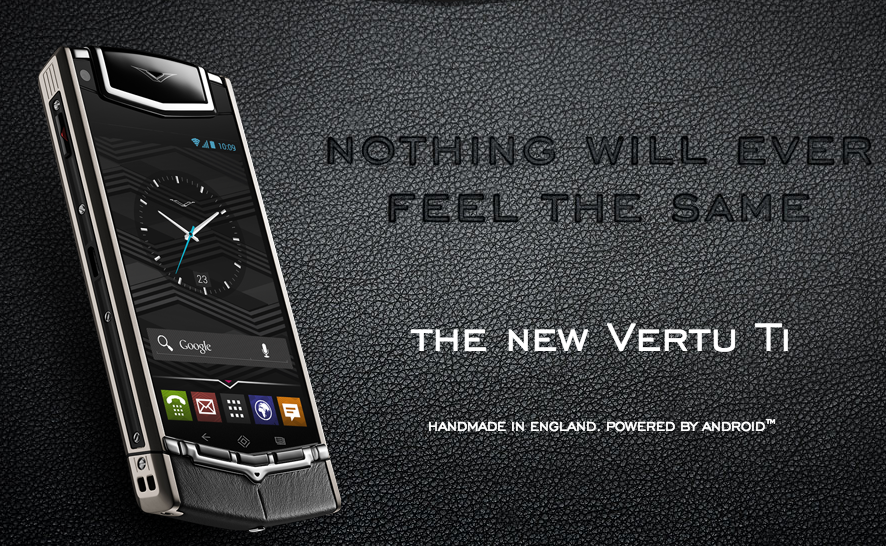
Vertu, the British firm behind a variety of expensive smartphones released over the past decade or so, has just revealed a new phone, the Vertu TI (read our Vertu TI hands on). It’s made of titanium, sapphire crystal and should you so desire, alligator skin, plus it uses Google Android as its OS. It’s a luxury product and as such, has a luxury price tag: at least 7,900 euros or roughly, $11,000. Bizarrely, its arrival has met with considerable animosity, which makes us ask, what’s wrong with a luxury smartphone?
The comments on our news story ranged from the phone being, “A waste of money,” and someone else saying an HTC Evo 4G was, “better.” Reviews of the phone from around the Web question the Vertu TI’s value, its technical specifications, and many seem stumped at who would buy such a device.
It’s as if nobody has ever seen a needlessly expensive product before. Yes, the Vertu TI is ridiculously priced, but it’s hardly alone in the world. We recently ran a news story on the Lotus Evora Sports Racer, a $95,000 two-seat sports car that’s $20,000 more than already pricey base model. Someone left a comment saying, “I would love to put one in my garage.” And where are the comments about the Mazda MX-5? It’s $70,000 less expensive and will probably be just as fast in the real world. Or what about an Ariel Atom? It’s lip-quiveringly fast, provides an equal amount of thrills and starts at $56,000, so why isn’t the Evora labelled a waste of money?

How about home theater? The complete Sonos PlayBar system costs $2,000. Why isn’t that shot down in flames when you can buy a soundbar from a decent brand for $500? Instead a commenter calls it, “Pretty great.” We could go on and on, but you get the picture; in every other product category, luxury, high-price items are revered, admired, and lusted after.
Double standards
So, this weird double standard seems to be limited to the world of computing and mobile. To be fair, it’s partially understandable, because almost every luxury tech product has either been some awful piece of cross-brand marketing like the Asus Lamborghini laptop, or vulgar nonsense from Goldvish beloved only by the terminally tasteless. With hateful filth like that, it’s no surprise consumers are skeptical. However, this problem is compounded by our obsession with spec sheets.
Yes, there are many phones with “better” specifications than the Vertu TI, but anyone who points it out as a reason the TI isn’t “good” is being deliberately annoying or is an idiot. Its specs match up to many high-end phones in the market today. It’s like saying fuel consumption as a reason the new Corvette Stingray isn’t a good car (another example of the double standard, as the tawdry C7 seems to be universally adored), or deriding the IWC Aquatimer Chronograph watch for not having a calculator. How do we put this bluntly? It. Doesn’t. Matter.
 Now, if you consider the Vertu TI a waste of money or unattractive, that’s fine. Such products aren’t for everyone, and it’s at least provoking an emotion inside you. But like every other luxury product, value and specification are utterly irrelevant.
Vertu’s Chief Marketing Officer, Massimiliano Pogliani, said true luxury is about subtly, individualism and elegance; like a meal prepared by a two-star Michelin chef. When judged nutritionally, or as a meal for satisfying a deep hunger, there will be other, better options; but as an experience, it’ll probably be second to none. When you buy a Vertu TI, the very first call you receive will be from your concierge, who’ll introduce themselves and make sure your happy with the phone and everything is as it should be. Was Samsung calling you on the phone minutes after you stuck the SIM card in your Galaxy S3?
Built to last
The Vertu TI is hand built and signed by the engineer who did so. It’s made from high tech, expensive materials (each tiny screw holding the titanium side plates in position cost at least 9 euros), all of which are carefully selected and take months to prepare.
The phone comes with your very own personal assistant built in, and it’s not some electronic Siri-like slave relegated to searching Wolfram Alpha or Yelp either; it’s a real, live person. The phone weighs 180 grams because it’s built to last, not to be replaced each year, during which time the leather will a chance to mature and instill the device with some character.
The Vertu TI shuns the increasingly tedious race to be the fastest, thinnest, and lightest smartphone available, rising above the talk of clock speeds and screen resolutions; yet it’s still quite capable of keeping up with the competition.
We need to get over this preoccupation with specs and embrace the Vertu TI. It’s the first truly luxurious, price-is-no-object smartphone, and that’s OK.