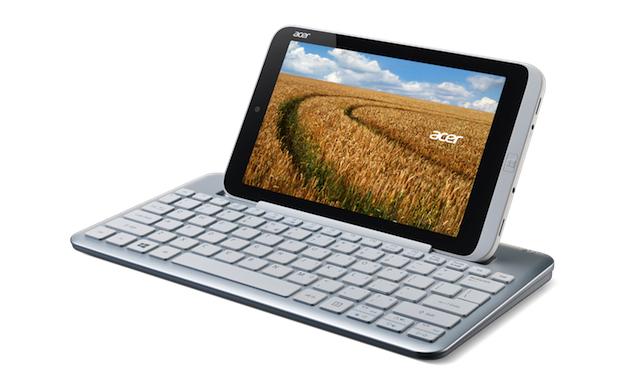
 Acer has partially revealed its first 8-inch tablet to run Microsoft Windows 8, and it’s the full version instead of the cut-down Windows RT software, which Acer is known for disliking. The Iconia W3 is billed as a device which puts desktop computing into a highly portable tablet form factor, thanks to its convenient 8-inch screen and optional keyboard dock. The tablet has shown up on the company’s Finnish website, but not its U.S. or UK sites just yet.
If all this is causing little bells to ring inside your head, it’s because this is the same tablet which was leaked by Amazon at the beginning of the month, then tipped for release on June 4 by an Acer executive. Like the leaked tablet, the W3-810 runs Windows 8 Pro and has an 8-inch screen with a 1280 x 768 pixel resolution, while it’s powered by an Intel Atom Z2760 processor, complete with 2GB of RAM. Intel’s Atom chip has also been seen in other Windows 8 tablets, including Acer’s own Iconia W510, along with others such as the Asus VivoTab and HP’s Elitepad 900.
The W3’s spec list continues with 32GB of memory, Wi-Fi, Bluetooth 4.0, a microHDMI port, and a battery which should last eight hours. A keyboard dock is also pictured, which as you can see above is wider than the tablet itself, plus a second W3-810 tablet, this time with 64GB of memory will also be sold. As for the cost, the W3 tablet leaked by Amazon was priced at $380, but this would be without the keyboard dock.
There’s no option to buy the W3-810 through Acer’s website yet, nor are there any retailers which show up as stocking the tablet. However, as someone in Finland appears to have pushed the button on the W3-810 earlier than they should have, there’s a good chance the June 4 announcement date will hold true.