“DJI has a hit on their hands with the Power 2000 portable power station”
- Reliable
- Simple to use
- Plenty of accessories
- Poor AC outlet placement
- Lacks built-in wheels
- Expansion battery uses SDC port
We’ve had a lot of power stations come in our labs for testing over the past couple years from brands like Bluetti, Jackery, Dabsson, Ecoflow, Geneverse, Anker etc, but this would be the first DJI power station that I’ve personally tested. And I was a little surprised when I saw that DJI made power stations as I had not seen them advertised or promoted before. DJI is known for specializing in consumer drones and adventure cameras, so of course when people are out in the wilderness or parks with their DJI devices, having a portable power station with you to keep your gadgets charged, makes sense.
The DJI 2000 is the company’s third power station, and largest, holding twice the capacity of the brands previously largest power station, the DJI 1000 which was a hit among people.
How much does the DJI Power 2000 Cost?
The DJI 2000 is launching with an MSRP of $1,299 USD which is very close to the same price that their smaller Power 1000 power station had when it first launched, so I consider the price very reasonable considering the extra ports, power capacity and features. I took a glance at the DJI website while writing this review to see if the prices have changes on DJI’s 1000 and 500 power stations, and they have. The DJI 1000 is now on sale for $699 and the 500 a respective $359 sale price, so if the DJI 2000 is more than you need, I would consider the previous gen power stations from the company. When compared side-by-side with the competition, the Power2000’s price is on par with others in the space with no price advantage.
What’s in the box of the DJI Power 2000?
Included in the box with the DJI 2000 is the unit itself, the power cable and a couple guidelines documentation. There are no printed instructions that were included but I was assured by DJI that the final production units would come with a printed instruction manual.
For my review sample, DJI also included a Zignes 100W Solar Panel ($209) for testing and the DJI Power solar panel adapter module ($59)
How does the app work and setup
The DJI app works almost identically to other power station apps on the market in that you can see the current battery level, turn on and off the AC ports, and update the firmware. What bothered me was that I was not able to connect to the Power2000 remotely over Wi-Fi, only thru Bluetooth while standing next to it. Hopefully DJI can fix this in the future. To get the Power 2000 up and running, I connected my phone to the unit via Bluetooth and then programmed my home’s Wi-Fi into the Power 2000. Very simple and standard for all of the power stations I have reviewed.


DJI Power 2000: features, design and specifications
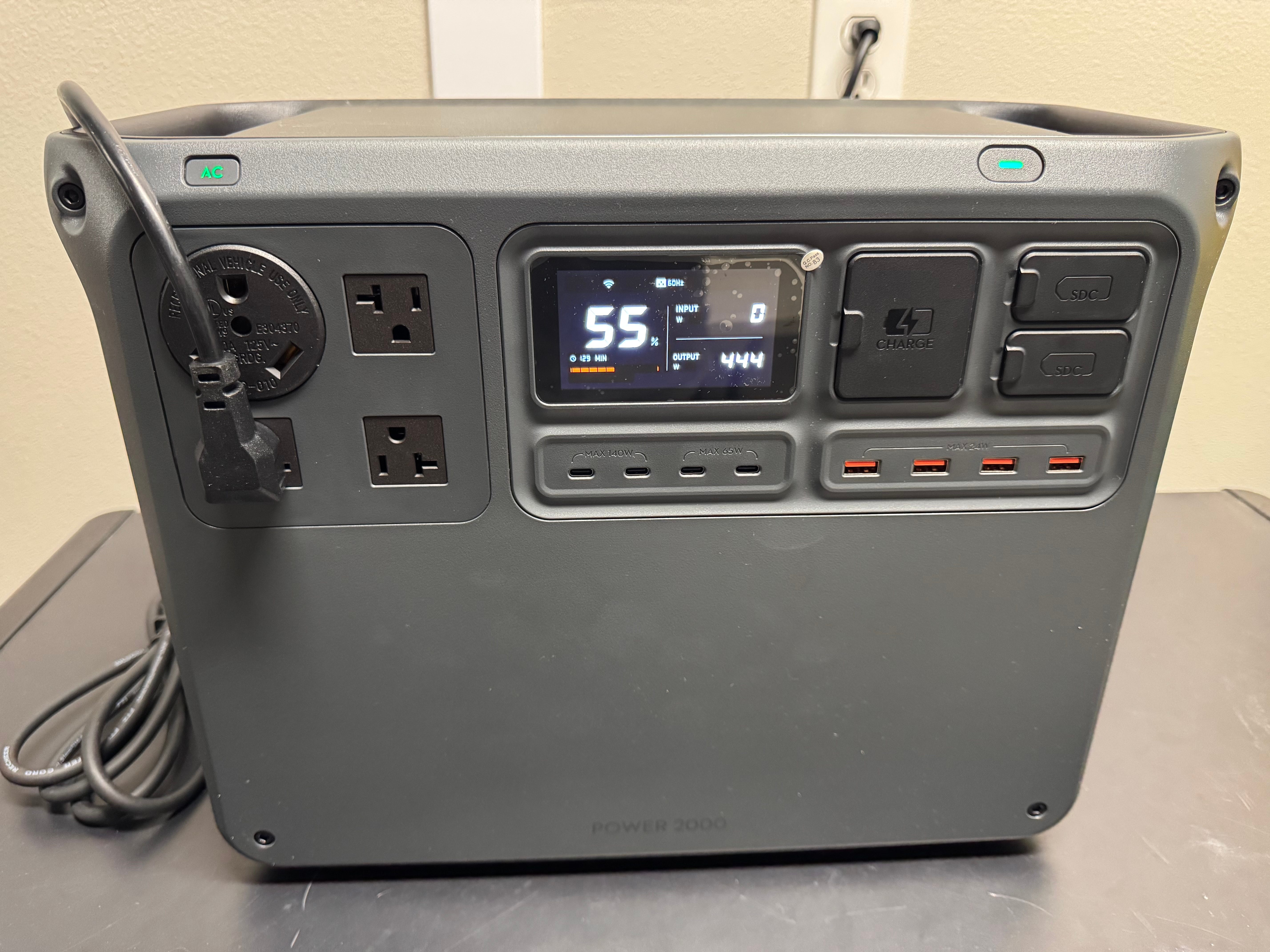
From a design perspective, the DJI 2000 matches the look of most power stations in this price range and capacity – there are two handles on the end for carrying and all of the ports are only on the front of the unit, including the main A/C port to power the unit itself. In total, here is how many ports the DJI 2000 comes with:
- 4 x AC output ports (in various arrangements which is nice)
- 4 x USB-C ports (2 x 140W and 2 x 65W ports)
- 4 x USB-A ports
- 2 x SDC bi-directional ports for solar charging & accessories
- 1 x Car adapter port to charge the unit from your car
- Built in Bluetooth (to pair with the app and potentially future features)
- Built-in Wi-Fi to connect so you can connect to the DJI 2000 remotely
DJI did an impressive job of doubling the battery capacity of the Power 1000 while keeping the overall unit dimensions pretty similar – only 4-inches taller, but still the same width and depth.
There are some features that DJI has incorporated into the Power 2000 which stand out to me. The first being how quiet it is. The company claims a 30dB noise rating (I tested it at about 31).
I do not like the orientation of the AC outlets; they are not side-by-side but crammed next to each other in a box group to the left of the unit, and when most of them are being used, one is likely to be covered up and unusable when the others have cords plugged into them. You can check out complete specs here on the DJI website.
DJI Power 2000 vs the competition: Jackery, Anker and EcoFlow
There are literally around 10-15 portable power stations that I think would compare to the DJI Power 2000 on the market. I tried to think of the ones that I liked best that you should consider looking at.
They are below:
| Feature | DJI Power 2000 | Jackery 2000 v2 | Jackery 2000 Plus | Anker SOLIX C1000 | EcoFlow DELTA 2 Max |
|---|---|---|---|---|---|
| Capacity (Wh) | 2 048 | ~2 042 | 2 000 (+ ext) | 1 056 | 2 000 (+ ext) |
| Output (W) | 3 000 | 2 200 | 6 000 surge | 2 400 | 3 400 (X‑Boost) |
| Recharge Speed | 55 min AC | Fast-charge 1.7 hr | AC: ~2 hr; solar fast | AC <1 hr; solar 600 W | Fast solar & AC |
| Weight | ~22 kg/48 lb | ~18 kg | ~28 kg with wheel | Mid-range | Mid-range |
| Portability | Carry‑on, no wheels | Compact handles | Wheels + handle | Compact | Portable |
| Expansion Capacity | Up to ~22 kWh | Not modular | Up to ~24 kWh | Limited | Up to ~6 kWh |
| Price (deal/MSRP) | ~$1 299/1 899 | $849–1 499 | $799–2 199 | ~$1 328 | $949–1 769 |
What I like about the Anker Solix F2000 and the Jackery Explorer 2000 Plus is that they both have wheels and an expandable handle so you can roll these power stations without lifting them and putting strain on your back. The Jackery Explorer plus does weight about 12lbs more than the Power 2000 at 61lbs and the Anker comes in even heavier at 67lbs – so it makes sense that they have a built-in wheels and handle. Just keep in mind that their battery capacity are all the same at 2048Wh with similar connectivity and all the products in the chart support expansion batteries and solar chargers.
Accessories
DJI has several accessories available for the Power 2000 which I always love seeing – it proves to me that the brand is invested in their products and making their customers happy. I always love it when a product has an ecosystem of accessories both from the manufacturer and third party companies that allow you to build upon the base system. Some of the more notable accessories include:
- Expansion battery
- Expansion battery with hand truck combo (IYKYK – these get heavy)
- Solar and car fast chargers
- Various cables
- Solar panels
I’m sure that more accessories will pop up for the Power 2000 in the next few weeks as there are only a base amount available it looks like on launch day.
DJI Power 2000 Battery Life and Durability Test
Like every power station I review, I tested the Power 2000 by plugging my Danby garage freezer into the unit, charging electric bikes, and a portable outdoor electric heater. The Power 2000 was able to power my freezer for 18.4 hours on a single charge, highlighting the capacity of the power station (and the efficiency of my freezer of course) – perfect for a power outage. With the outdoor electric heater plugged in however, the Power 2000 was only able to provide 71 minutes of use before being completely drained. So if you have plans to use a heater while camping, or if the power goes out in your home and you want to use a heater, I would seriously consider using a larger power station.

DJI Power 2000 solar charging
Using AC Power from my home, I was able to fully charge the Power 2000 in only 92 minutes which is very impressive. Most power stations of this capacity take up to 2-2.5 hours to fully charge. Using the Zignes 100W solar panels that DJI included with the DJI Power 2000, I wasn’t able to get a full charge in the 10 hours I had it plugged in – this was likely due to weather conditions (always cloudy in Oregon) and I just don’t think these solar panels are meant to charge any power station quickly. They trickle charge at a rate of about 5% per hour.

I was confused as to why you needed to buy an adapter to use the solar panels, rather than being able to plug them directly into the power station. The adapter isn’t small (see the picture above), and you have the option to mount it to the side of the power station if you don’t want it flopping around – not a great design in my opinion.
How long will the DJI Power 2000’s LFP battery last?
One of the most important factors for me when determining whether a batter operated product will last, is the battery quality itself. The DJI Power 2000 uses an LFP (lithium ferro phosphate) battery which DJI claims should provide over 80% capacity after 4000 cycles. There are pros and cons to using this type of battery, but over I like the use of LFP batteries in a power station because they are less likely to overheat and catch fire version regular Lithium-Ion batteries. And if you’re likely to use the Power 2000 outdoors, heat is a big deal.
What is the warranty of the DJI Power 2000?
DJI provides a 3-year warranty standard which is great, but they also will extend the warranty to 5 years once you download and install the DJI home app, connect to the unit and register it, for a total of 5-years which is very impressive. In doing my research, power station warranties are all over the place, ranging from 1 to 5 years depending on the brand and battery type in the power station. LiFePO4 (lithium ion) battery power power stations tend to be on the longer 5-year warranty side.
Warranty comparison:
| Brand | Warranty Period Details |
| Renogy | 1-year material and workmanship warranty |
| BLUETTI | 24 to 72 months for portable power stations |
| Anker | 5-year warranty for LiFePO4 battery models, 1.5-year for NMC battery models |
| Jackery | 3-year warranty + 2-year extended warranty on some models |
| EcoFlow | 24 months standard; extended warranty available with registration |
| ALLPOWERS | 24 months standard; extended warranty available with registration |
| EGO Power | 3-year limited battery warranty |
| ALLWEI | 5-year warranty |
| ATGepower | 3-year warranty |
Should you buy it?
I like that the DJI Power 2000 is designed primarily for those already bought into their eco-system of products, although I am not a drone enthusiast myself so that’s not why I would be using the Power 2000. I like the portability of the Power 2000 with the handles; how relatively cool and quiet the unit is while charging and the ease of the phone app. If you want a power station that is on the lighter side when it comes to weight, the Power 2000 fits the bill. And if you are already a DJI fan and love their other products, the Power 2000 shouldn’t disappoint. Personally, I like the features of the Anker Solix F2000 and the Jackery Explorer 2000 Plus more and would recommend one of those over the Power 2000. Having wheels and a handle built into the unit is a luxury I’d like, even if the units are heavier overall.