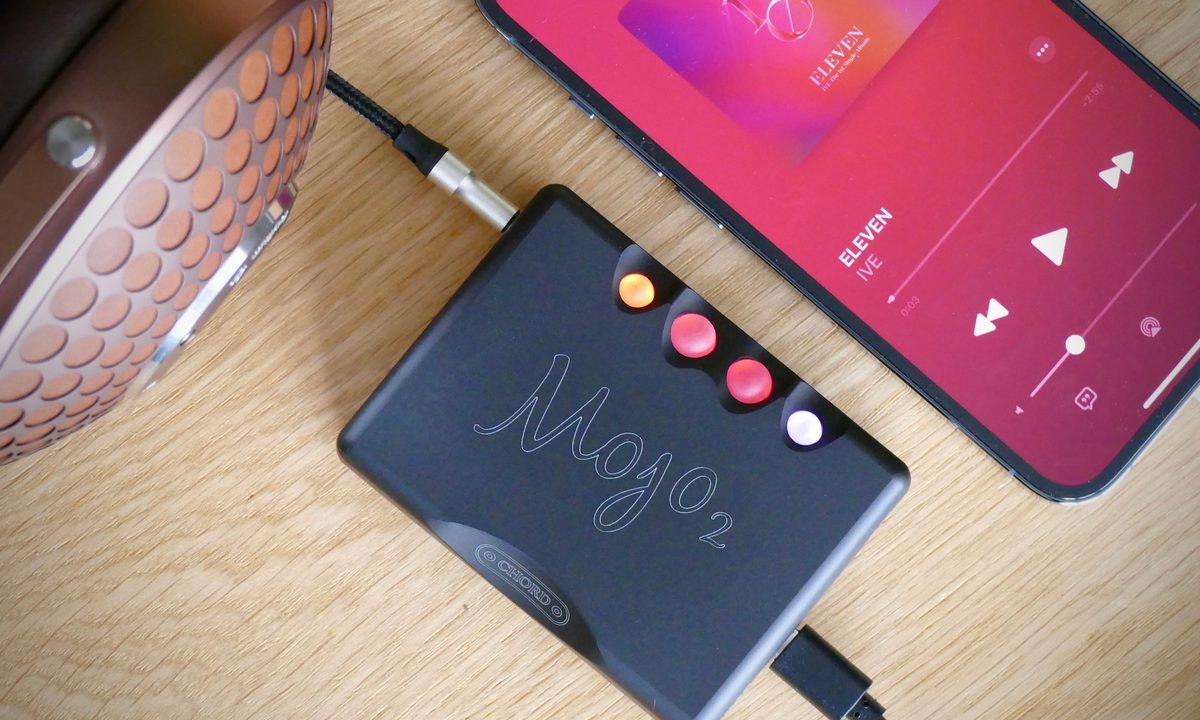

“The Chord Mojo 2 takes your smartphone or computer and turns it into an incredible-sounding, astonishingly capable music machine.”
- Incredible sound
- Powerful enough to drive most headphones
- Multiple device connection options
- Customizable lossless equalizer
- Long battery life
- The equalizer is complicated
- MicroUSB charging is outdated
- No MQA file playback
“Why you can trust Digital Trends – We have a 20-year history of testing, reviewing, and rating products, services and apps to help you make a sound buying decision. Find out more about how we test and score products.“
I’ve let a few people listen to the Mojo 2 DAC (digital-to-analog converter) with a pair of very special headphones, and one person really did shed a tear as a particularly emotional song came to an end. That’s the Mojo 2 effect. Using it will make you search for some new, likely ridiculously expensive headphones, happily pay for Hi-Res streaming services, and take time out of your day just to relax and listen to fabulous-sounding music. The Chord Mojo 2 is something very special indeed, and I’ve been listening to it for about a month.
Design and connections
If you’ve seen the first Chord Mojo, then you’ll see that not much has changed. There are now four buttons on the front and a new USB Type-C connector, but otherwise, the little box is pretty much identical. There’s also an optical/coax out and a pair of Micro USB connectors, one for charging and the other for the USB Type-A adapter that comes in the box. On the opposite end of the aluminum box, you find dual 3.5mm headphone jacks, so you can listen with a friend.

It’s not what I’d call a pocketable DAC — although it is a little smaller than the first Chord Mojo — at least compared to many of the USB stick-sized affairs most people will think of. But it’ll slide into a bag if you really must take it out with you, plus there’s a battery inside that’s good enough for about eight hours use. I don’t really see it as an out-and-about product, though. It’s best enjoyed at home, but the anodized black finish should prove hardwearing if you do carry it about in a bag.
Fire the Mojo 2 into life, and the four buttons all light up in different colors, and they all dynamically change when you press them to activate different functions, too. That’s it for flashy design elements, though. This is a small black box that you will buy because of what’s inside, not what it looks like on the outside.
To get the sound from the Mojo 2 to your phone, you use a USB Type-C-to-Type-C cable if you have an Android phone — it worked instantly with my Galaxy S21 Ultra and OnePlus 9 Pro. If you have an iPhone, you need the Lighting-to-USB Camera Adapter, which costs $29 and connects to the Mojo 2’s USB Type-A-to-Micro USB adapter. It’s a bit messy and may require additional expense if you don’t have the right adapter already, but you’ll get over it when you listen.
Living with Mojo
Fair warning here, there’s going to be some talk that makes me sound like an audiophile. It’s the effect the Mojo 2 has on you. Before we get into how the Mojo 2 works and sounds, we should get into how it fits into your life. The Chord Mojo 2 turns your smartphone into an incredibly powerful music machine, but to fully appreciate its talents, you’ve got to commit to it.

Chord says the Mojo 2 is designed to work with any pair of headphones, and while this is factually true, it’s really wasted on a pair of average headphones. If you’re planning to use the EarPods that came with a long-retired iPhone 6, don’t bother. The Mojo 2 deserves a great pair of headphones, and so do your ears. It’s not really suitable for listening to music on the go either. It’s not overly heavy at 185 grams, but the many cables you have to deal with make it annoying, as well as an accident waiting to happen. There’s no Bluetooth connection, so if you can’t give up your wireless headphones, it won’t be for you.
What is the Chord Mojo 2, then? If, like me, you’ve often daydreamed about building a really capable music system at home with massive speakers, amps, a mega set of headphones, and all the rest of the high-tech add-ons, but then woke up and realized you don’t have the space or the money, the Mojo 2 is the answer.
During my month with the Mojo 2, I’ve been spoiling myself by plugging in some amazing headphones, and it has been worth it. I’ve used the Chord Mojo 2 with Sennheiser HD660S headphones, Jays Q-Jays, Audeze iSine 20, Grado GS3000e, and a pair of (dreamy) Focal Stellia. I’ve used Tidal, YouTube Music, Apple Music, and my own collection for music, mostly with an iPhone 13 Pro, but also with my Mac Mini M1 and Samsung Galaxy S21 Ultra.
The Chord Mojo 2 turns your smartphone into an incredibly powerful music machine.
The fact I’m using the Focal Stellia headphones — which cost $3,000 — may surprise you, but it goes to the heart of what makes the Mojo 2 so special. Much like Focal, Chord has pedigree and exclusivity, and the Mojo 2 is hand-built in the U.K. by an audio brand with more than 35 years experience. The Mojo 2 drives the Stellia without a problem, using only the iPhone as a source, so it returns a high percentage of that dream home setup experience, at a far lower price, and without any of the space requirements.
Listening to the Mojo 2
The Mojo 2 delivers sound you can almost grab on to,with a delightful fullness that’s hard to descriptively pin down. There’s depth and clarity, but never any unpleasant richness or harshness, no matter the music. You feel the instruments and voices, and hear all the emotion that can sometimes be lost through poor-quality devices and headphones. I’ve demoed the iPhone/Mojo 2/Stellia combination to a few people, and all have been blown away by how it makes their favorite music sound. One person was genuinely moved to tears, underlining the power of the Mojo 2 when combined with a fabulous pair of headphones and your favorite piece of music.

I’ve yet to listen to something that didn’t sound superb. The glorious soundstage in Stravinsky’s The Firebird Suite (specifically, Infernal Dance of King Kaschei) is wonderful, with the brass instruments above your head, the percussion down somewhere to the right, and every other instrument whipping around you in a wonderful, dizzying fashion. It’s perfectly controlled, exciting, and totally immersive.
The guitar-driven crescendo of Sky’s Carillon is perfectly realized and Richard Burton’s emotive voice draws you into Jeff Gordon’s Eve of the War, which again shows off the Mojo 2 and Stellia’s wide soundstage. The bass thump in Ive’s Eleven and Iz*One’s Sequence never overpowers the vocals — an essential part of K-pop and J-pop — while the snares in both have a whip-like crack, and the highs of each performer’s voice are sharp and devoid of distortion.
While the Focal Stellia are sublime, I understand they may be a financial stretch, but the Mojo 2 made all the headphones I tested it with sound fantastic. It gives them guts and depth, a solidity that’s missing when headphones aren’t given the power they want. Yes there’s more volume, but it always comes with clarity and sharpness. I have listened for hours on end because everything sounds exactly how I want it to, and there’s no hint of distortion or unpleasantness.
The enjoyment I’ve got from listening to the Mojo 2 cannot be overstated.
What about when you put it up against the original Mojo? Listening with the Audeze iSine in-ears, the Mojo’s similar full-bodied sound is immediately obvious, but the Mojo 2 has masses more power, considerably more bass response, vastly improved clarity and precision, and no hint of distortion at all. If you’ve got a Mojo, it’s absolutely worth upgrading. I also compared it to the cheaper iFi iDSD Nano Black Label, and while I like the sound and it was happy when paired with the Sennheiser HD660S, it didn’t really have the power to drive the Focal Stellia headphones, and was missing the wonderful, full sound of the Mojo 2.
The enjoyment I’ve got from listening to the Mojo 2 cannot be overstated, and I don’t think I’ve really explored the breadth of its ability yet.
Customization
The big tech update over the original Chord Mojo, and the secret to its incredible sound, is the custom 104-bit, 705/768kHz UHD DSP. It’s a world’s first, according to Chord, as it provides a way to adjust the tone across the frequency range without any loss of quality. While it can do this, you will need the instruction manual, a decent understanding of how to set up an equalizer, and a fair amount of patience to get it right.

Adjustment of the low and high treble, and low and mid-bass are possible, and each has 18 steps. Enter the equalizer and press the glowing buttons to change the frequencies, and the levels are then depicted by different button colors. The downside here is you must refer to the manual when doing this to understand the frequency you’ve changed and the new value, plus you need a very good visual memory, as you don’t get a clear representation of the levels as a whole on the device. It’s very difficult to keep track, and I reset it many (many) times before pretty much just settling for the flat equalizer with a touch more midbass.
If you’re still happy to play around with the Mojo 2’s sound further, the UHD DSP adds a cross-feed function to change the imaging. It’s less bothersome than the frequency adjustment because there are only three levels, but again, you need to remember what the color of the button means to understand the setting.

One handy feature is how the power button shows you the sample rate of the file that’s playing. For example, it glows red for a simple 44Hz file, green for 96kHz, light purple for a 32-bit 768kHz sample rate, and white for DSD 256. The Mojo 2 is not MQA-certified, which is unfortunate and would have made it practically unbeatable in terms of file compatibility. It’s surprising when several far cheaper DACs offer MQA file playback.
Battery and charging
Despite a USB Type-C connection being added for devices, it does not charge the Mojo 2, and you have to go back to the Dark Ages with a MicroUSB connector. Yes, you get a cable in the box, but that’s not the point. I want to charge the Mojo 2 up with the cable I use for my smartphone, my tablet, my Kindle, and pretty much every other device in my possession today, and not the type of cable I’d consigned to the bottom of a drawer years ago.

I’ve found Chord’s estimation of eight hoursof battery life between charges to be accurate. It’s about the same as the original Mojo, which is a little disappointing, but still more than enough for multiple sessions per week. Better news is the Mojo 2 doesn’t get hot when you recharge it, something that seriously afflicted the original model.
Price and availability
The Chord Mojo 2 is available to buy globally now. In the U.S., it costs $725, while in the U.K., it costs 449 British pounds. You can purchase it online from dealers in Chord’s network, and some may offer the Mojo 2 through Amazon, too, so it’s worth checking.
Our take
The Chord Mojo 2 is an extravagance, and it’s a purchase that will likely lead to buying other extravagances, as its huge ability encourages you to seek out better headphones. It’s not the prettiest piece of audio kit you’ll buy, the battery and charging technology is light-years behind the phone it’ll likely be connected to, and you’ll have to be pretty experienced (and patient) to extract the best from the UHD DSP’s equalizer feature.
However, these are relatively minor points when you consider how much it adds to the enjoyment of your music. Like an excellent wine, the sound delivered is pure and full-bodied, and at almost any volume and from any source. It encourages you to take time to settle down and listen to music. Unlike Bluetooth headphones that force their way into a life on the go, the Mojo 2 is about taking time away from all that.
It’s the sprawling, high-quality, multi-component home audio system you’ve always promised yourself, just in a small, convenient, and comparatively reasonably priced box.
Is there a better alternative?
There are plenty of DACs available, with prices varying considerably. If you’re new to DAC/amplifiers, then starting out with a cheaper model may be advisable, such as the $99 Helm Bolt DAC, which performed well in our recent group test, or the $330 AudioQuest DragonFly Cobalt. Both can play MQA files, and neither requires charging.
How long will it last?
The battery is probably the only limiting factor in the Mojo 2’s technical longevity, which means you can safely splurge and not expect to feel the need to upgrade for many years. For some perspective, up until the Mojo 2 arrived, I still regularly used the original Mojo, which is now more than six years old. The strong aluminum casing and anodized finish should keep it looking good and relatively well protected, although there’s no water resistance. You can purchase a leather case if you want to give it that little more protection.
Should you buy it?
Yes. It’s not a sensible purchase at all, but the same can be said for any piece of high-quality audio equipment, and it’s instead defined by the enjoyment you’ll get from it, and how fantastic it’ll make your favorite music sound.