  1. Home
  2. Phones
  3. Mobile
  4. Social Media
  5. Web
  6. News

Facebook Messenger gains new ways to start chats and add contacts

Add as a preferred source on Google

Streaming video may be Facebook’s latest preoccupation, but that doesn’t mean the social network’s abandoning its older, more established services. Today, it announced an update for Messenger that brings the chat platform’s offerings in line with its fiercest rivals.

First up: a dedicated chat link for every Messenger account. Presumably for those situations when sending an invite sounds far more arduous than opening a Web browser and typing a link, starting a chat’s now as easy as pecking out the URL m.me/[insert username here] and hitting enter on your keyboard. Messenger will do the rest, automatically opening and starting a session with your chosen participant. Chat links work on the Web and mobile, Facebook says, and are “rolling out gradually.”

Recommended Videos

Messenger’s gaining another convenience: Messenger Codes. The codes, very much in the spirit of Snachat’s snapcodes, include your Facebook profile picture and an encircling series of blue dots and dashes. Let another Messenger user scan it with their smartphone camera and you’ll be added to their list of chat contacts. Codes, like chat links, will debut in the coming weeks.
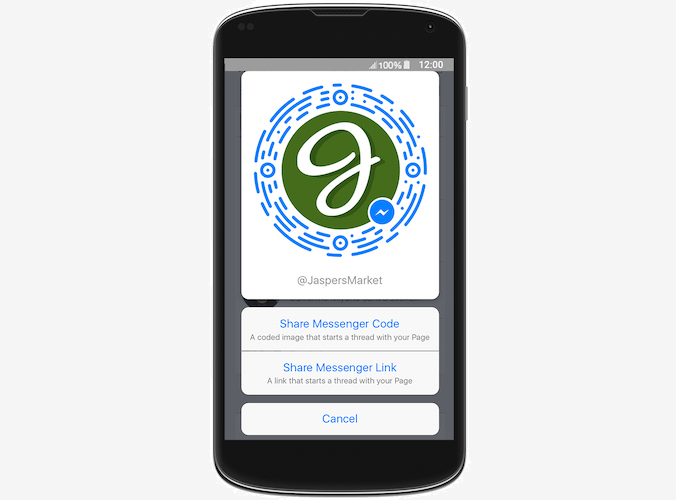
12481743_220453861675538_1119022713_n
Image used with permission by copyright holder

Alongside the new features, Facebook announced that Messenger has 900 million active users — just shy of the 1 billion threshold that WhatsApp crossed in February. That makes it far and away more popular than chat competitors such as Skype and SnapChat, which have 300 million users and 100 million users, respectively. And it further secures Facebook’s place in the pantheon of social networks –in August of last year, Facebook’s core site hit 1 billion users in a single day.

The attention to Messenger comes as the service undergoes a concerted transformation from chat app to veritable platform. In March, Facebook partnered with Lyft to offer the ride-hailing app’s services on Messenger (it joined Uber, which gained similar integration in December of last year). That same month marked the launch of a new Spotify playlist-sharing app for Messenger. And more recently, Facebook’s turned its attention to businesses: it launched a tool by KLM Royal Dutch Airlines that sends flight updates to passengers through Messenger, and announced an agreement with Newegg that’ll see the electronics retailer offer customer support through Messenger.

Facebook’s not the only one attempting to build its messaging platform into something greater than a virtual water cooler. At Microsoft’s annual BUILD conference in San Francisco, Microsoft demonstrated new Skype capabilities that’ll allow users to perform such tasks as booking flights and coordinating vacations. But Facebook’s got critical mass in its favor, a factor which will no doubt play a role in the company’s efforts.

Kyle Wiggers
Kyle Wiggers is a writer, Web designer, and podcaster with an acute interest in all things tech. When not reviewing gadgets…
iOS 27 could fix a huge frustration with the Shortcuts app and I can’t wait for it
"Hey Siri, create a shortcut for me that snaps a picture of my food, logs the nutritional value, and then reminds me to burn calories after six hours. Please?"
iPhone showing shortcuts app

For years, the Shortcuts app on the iPhone has remained one of the most frustrating parts of the user experience. On one hand, it's an utterly powerful app to create automations and perform multi-step tasks in a jiffy. However, the process of creating a shortcut has been pretty complicated and almost a test of patience. 

It appears that Apple has finally listened to the feedback of iPhone users and is planning to give a major functional overhaul to the Shortcuts app with the release of iOS 2027. As per  Bloomberg, Apple will finally let users describe the exact shortcut they want, in natural language, and the AI will create it for them.

Read more
Samsung Galaxy Z Fold 8 could finally fix the biggest problem with foldables
Galaxy Z Fold 8 could finally address Samsung’s foldable battery problem
Samsung Galaxy Z Fold7 deal

Samsung’s foldables have consistently led the market in polish and software, but one complaint has followed the Galaxy Z Fold series for years: battery life. Now, a new leak suggests Samsung may finally be addressing that issue with the upcoming Galaxy Z Fold 8, alongside camera improvements and a thinner design.

According to a report from Greek publication TechManiacs, the Galaxy Z Fold 8 could pack a larger 5,000mAh battery - a notable jump from the 4,400mAh cell used in the Galaxy Z Fold 7. If accurate, this would mark one of the most significant hardware upgrades to Samsung’s book-style foldable lineup in years.

Read more
Samsung’s Exynos 2800 chip could keep more AI chores locked to future Galaxy S phones
Your Galaxy flagship may get new software, but not every AI upgrade
Camera sensors on the Galaxy S26

Major smartphone brands are racing to turn phones into agentic AI assistants that can do more than answer prompts. Google gave a clear preview of that future at its recent Android show, and Samsung has been moving in the same direction with Galaxy AI. Now, a new leak suggests Samsung may be planning a hardware upgrade that could push more AI tasks directly onto future Galaxy phones.

That sounds useful on paper. More on-device AI could mean faster responses, stronger privacy, and fewer features that need to reach out to the cloud. There is also a possible downside. If Samsung ties its next wave of AI tools to newer Exynos hardware, some of those features could stay locked to future phones such as the Galaxy S28 series, while recent flagships are left with a lighter version of the same software experience.

Read more