If this last year felt a little more apocalypse-y than others past, it’s not without good reason. And as with every industry, tech is starting to take notice. As such, many of the new Google Maps features announced this week preview a tone shift within the industry. As technology plateaus, rather than shallow convenience, the focus appears to be transitioning to quality-of-life improvements, and hopefully, sustainability.
One element of our day-to-day lives that has undergone a begrudging transformation is grocery shopping. Once a universally beloved pastime (sarcasm), picking up the necessities in-person has been made even less convenient, and in some areas entirely inadvisable. For this reason, many of us have grown accustomed to picking up online orders or scheduling them to be delivered, and Google Maps hopes to further alleviate the new challenges this presents in a couple of ways.
For one, you will soon receive much more thorough and specific information including delivery providers, pickup and delivery windows, order minimums, and fees all within the app.
Further, starting with select Kroger-owned Fred Meyer locations in Portland, Oregon, Maps will notify you when it’s time to leave for your pick-up and give the signal to the providing store that you’ll be arriving shortly. It remains unclear how Google will encourage employees to spend as much time squeezing avocados to find the “best one” as you might personally, but the new features will be appreciated, nonetheless.
Google Maps seems to be transitioning from shallow convenience to improving quality-of-life.
Air quality is another luxury we can no longer take for granted. Warmer temperatures beget fires and fires beget smoke. Last year, historically poor levels prompted many people to pay attention to their area’s AQI for perhaps the first time in their lives.
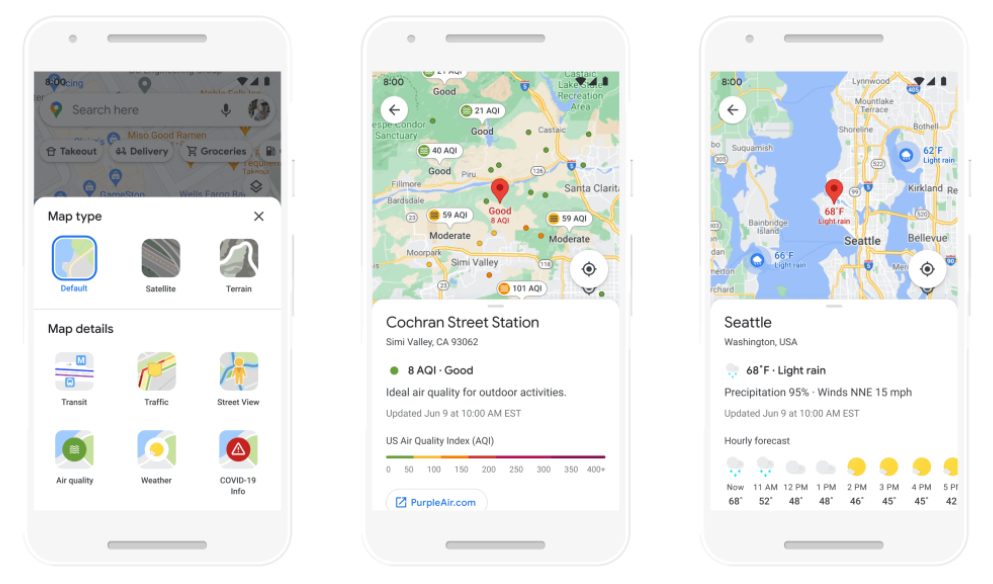
Seemingly in response to this, Google Maps will soon pull data from The Weather Company, AirNow.gov, and the Central Pollution Board in order to outfit your map with an optional Air Quality layer. On the worst of days, this could mean taking an alternate route to minimize smoke exposure. However, taking off the doom cap for a moment, it could just as easily offer respite to anyone suffering from seasonal allergies, making your day a bit more enjoyable at the expense of a few added minutes of travel time.
Speaking of travel time, it’s no secret that transportation is a major contributor to carbon emissions and one with the need for severe and imminent reduction. If left to continue at its current pace, scientists believe we could cross a climate change threshold beyond that of a possible return in as few as five years.
While the onus is on everyone at every level to do their part (looking at you, corporations), individuals are more conscious every day of their personal impacts, as well. In the near future, Google will help you easily make environmentally responsible travel choices by offering multiple ways to get from Point A to Point B.
With the scale of Google Maps, even a small change can make a big difference.
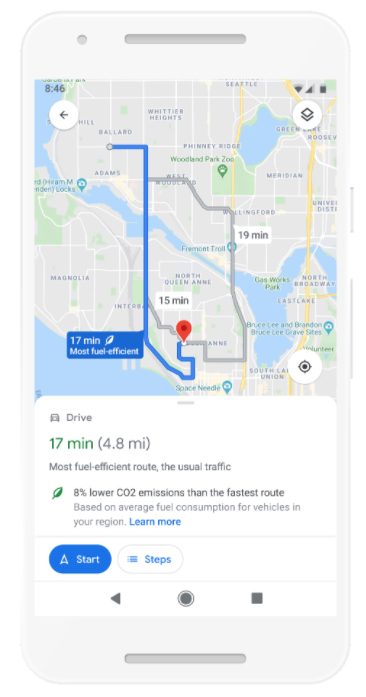
In the U.S., through a partnership with the U.S. Department of Energy’s National Renewable Energy Lab, your default route will soon be the one with the smallest carbon footprint when it has a similar enough ETA to the others, taking into consideration factors such as fuel consumption, road incline, and traffic congestion to start. If you want the fastest route possible, you’ll have to manually opt-out in Settings. You’ll also be able to compare the CO2 impact across various routes. This and other features like notifications about low emissions zones in select countries may not help you get home faster, but will make it easier to take the environmentally-conscious high road, metaphorically speaking.
We can likely expect a lot of these types of reactionary tech advancements in the coming months and years. A decade and a half of smartphone evolution has already granted humans with an abundance of convenience. Now, it would seem, tech must face the increasingly dark aspects of our existence, offering solutions for living in, well, I wouldn’t call it a hellscape just yet. But we’re getting there.