
Android phones have a bit of a reputation for slow updates. One reason is that silicon manufacturers, the companies that make the chips that power Android devices, have to work closely with phone makers every time Google’s Android team makes a change, which does not always happen expeditiously. But thanks to Project Treble, it won’t be necessary for much longer.
Project Treble, which Google announced on Friday, is a re-engineered update framework that lets device manufacturers modify Android incrementally. Effectively, Google is separating the device-specific, low-level firmware maintained by chip makers from the broader Android codebase — the “biggest change to the low-level system architecture of Android to date,” Iliyan Malchev, Project Treble’s team lead, said in a blog post.
Currently, Android updates published by Google have to be modified by silicon manufacturers. Then, those silicon manufacturers have to pass the modified update to device makers like HTC and LG, which adapt it to their devices.
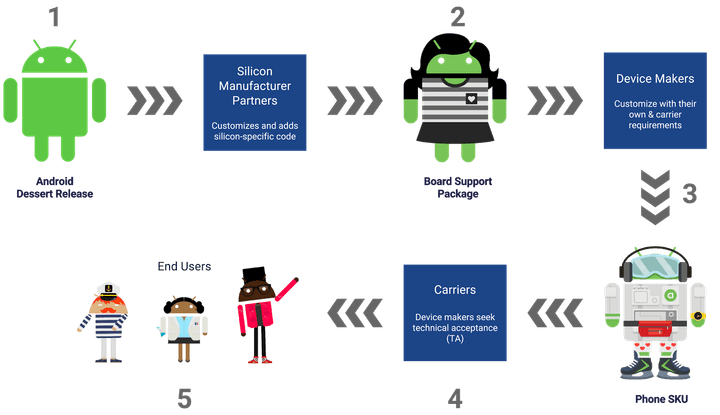
With Project Treble, that is no longer the case.
“[The separation] is achieved by the introduction of a new vendor interface between the Android OS framework and the vendor implementation,” Malchev said in a blog post. “With Project Treble, we’re re-architecting Android to make it easier, faster and less costly for manufacturers to update devices to a new version of Android.”
Project Treble introduces a “vendor interface” (VI) which sits between Android’s core operating system and manufacturer-specific customizations. When a phone maker like HTC makes software changes, the VI acts as a protective buffer against any hardware-specific code.
It’s akin to Android’s Compatibility Test Suite (CTS), a set of tools that makes it easier for developers to ensure their apps work across the thousands of different hardware configurations in Android’s ecosystem. “Project Treble aims to do what CTS did for apps, for the Android OS framework.”

Google gave Sony and Qualcomm as an example. “[They’ve] contributed dozens of features and hundreds of bugfixes to Android O,” Malchev said, “so they no longer need to rework these patches with each new release of Android.”
Project Treble’s architecture shipped in Android O’s first Developer Preview which became available in April, Malchev said. Later this year, the search giant will work with its silicon and device partners to move major code changes — like features for a carrier in a specific country, for example — into Android’s core code.
In real-world terms, Project Treble means faster — and more frequent — updates to Android-based phones and tablets. But there is a drawback: Based on Malchev’s language, it seems that Android O-based devices will be the first to benefit — meaning phones running older versions of Android are out of luck.
Luckily, we will not have to wait much longer for confirmation. Google is likely to talk about Project Treble at I/O, its annual developer conference, next week.


