Look up in the sky, as you soon may start to see pigs flying overhead. Intel said on Monday, November 6 that it teamed up with processor rival AMD to create an all-in-one package for OEMs to use in thin-and-light PCs. This package contains eighth-generation Intel Core H processor cores, custom AMD discrete Radeon graphics cores, dedicated HBM2 graphics memory, and a special “highway” connecting the three components together called an embedded multi-die interconnect bridge, or EMIB.
There are several benefits in using this all-in-one chip. First, the resulting thin-and-light device will have equal if not better performance than bulky laptops because of the fast, dedicated connection between Intel’s CPU cores and AMD’s graphics cores. The use on HBM2 graphics memory also means more space for OEMs to use because HBM2 stacks vertically instead of horizontally like GDDR5. Intel says this new all-in-one solution provides a unique power-sharing feature, too, to maximize performance without gobbling up the battery like candy.
“We’ve added unique software drivers and interfaces to this semi-custom discrete GPU that coordinate information among all three elements of the platform,” the company said. “Not only does it help manage temperature, [and] power delivery and performance state in real time, it also enables system designers to adjust the ratio of power sharing between the processor and graphics based on workloads and usages, like performance gaming. Balancing power between our high-performing processor and the graphics subsystem is critical to achieve great performance across both processors as systems get thinner.”
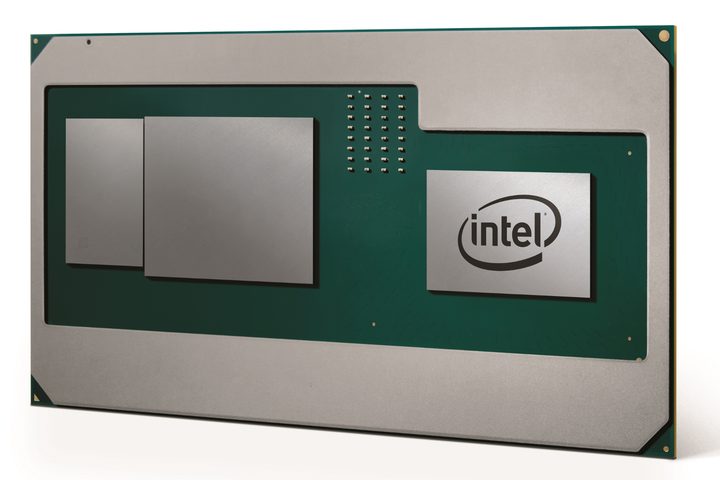
Typically, Intel is no competition in the mainstream discrete graphics space — that’s solely fought between Nvidia (GeForce) and AMD (Radeon). But in the mainstream processor space, Intel and AMD fight hard for your hard-earned dollars. Intel just launched its eighth-generation Core processor family, and AMD recently announced its new Ryzen processors for desktops and laptops. The collaboration is indeed a surprise.
To get high graphics performance in a laptop, you typically need a stand-alone, discrete graphics chip despite the integrated component in Intel’s CPUs. But throwing a discrete graphics chip into the mix typically means a bulkier form factor, a higher power requirement, additional cooling requirements, and a larger price tag.
Understanding this, Intel apparently approached AMD with the idea of providing high-performance graphics in super-thin laptops using a single optimized package. But the duo isn’t stopping at thin-and-light notebooks. OEM’s can use this device to create standard notebooks, 2-in-1s, and miniature desktops as well.
At the very heart of Intel’s new all-in-one chip is the EMIB technology. First revealed in 2014, Intel said in April of this year during its Technology and Manufacturing conference that this platform enables Intel to throw in components from any manufacturer, not just AMD. It’s a “mix and match” heterogeneous design, and AMD appears to be the first participant in Intel’s EMIB roadmap. The resulting chip won’t include Intel’s own integrated graphics cores typically found in its mobile and desktop processors.
This new all-in-one chip from Intel and AMD will be made available to OEMs in the first quarter of 2018.