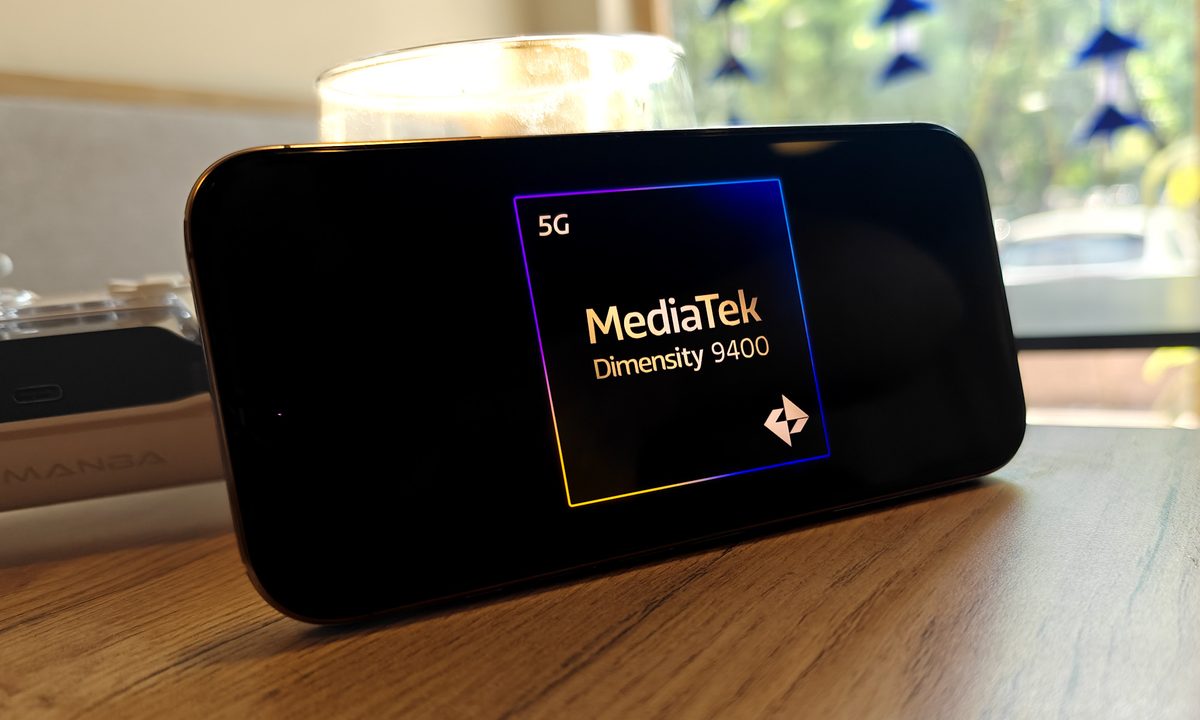
MediaTek is opening the floodgates of next-generation flagship Android phones and tablets with its new silicon. The latest from the Taiwanese company is the Dimensity 9400 chip, which will start appearing inside Android devices in the last quarter of 2024.
The list of upgrades is quite comprehensive for this one and across the board. To start things off, the Dimensity 9400 shifts to TSMC’s second-generation 3nm process node, marking a generational upgrade over its 4nm-based predecessor.
Thanks to the aforementioned shift, the Dimensity 9400 is claimed to deliver a 40% higher energy efficiency while also boosting single-core CPU output by 35% and multicore performance by 28%.
Once again, we are getting an all-big-core design with no efficiency cores. Leading the charge is a prime Arm Cortex-X925 core buzzing at up to 3.62GHz, a trio of Cortex-X4 cores (3.3GHz), and a quartet of Arm Cortex-A720 cores with a peak clock speed of 2.4GHz.
The more impressive set of improvements appears to have been made in the graphics department. The new 12-core Immortalis G925 GPU delivers 41% higher raw performance output and also enhances the ray tracing output by an impressive 40%. At the same time, the new graphics engine is touted to be 44% more frugal at power draw.

MediaTek has also upgraded the memory interface to the LPDD5X standard, which provides roughly 25% improvement in raw performance and power efficiency. On the imaging side, the upgraded Imaqiq 1090 ISP supports 8K video capture at 60 frames per second and HDR support across the entire zoom pipeline for video and photo capture.
Taking a leaf out of the Google Pixel playbook, the imaging engine also introduces support for AI-assisted super zoom while reducing the power uptake by 14% for shooting 4K 60 fps videos. It seems Dimensity 9400 will also take some inspiration from Apple’s new audio mixing system on the iPhone 16 series.
MediaTek says its latest silicon will bring support for AI-backed audio focusing that will help remove unwanted noise from videos. To that end, the silicon will support signal capture from up to six mics on a device.
Of course, AI is once again a key driver for MediaTek in its flagship silicon strategy. This time around, MediaTek’s 8th generation neural processing unit (NPU) adds support for what the company calls Agentic AI.

Despite consuming 35% less power, the AI engine delivers a 2X bump in diffusion performance and an 80% improvement in processes driven by large language models (LLM). More importantly, the Dimensity 9400 is claimed to be the first mobile chip capable of on-device video generation and LoRA training.
The former sounds ambitious at this stage, and even more so when one considers that AI video generation is a massively resource-intensive task. So much so that the likes of Sora are yet to arrive in the public domain owing to the raw firepower it requires (and the costs associated with it).
OpenAI, the leader in the generative AI race, is yet to release Sora even for its paid customers. Meta also released its own video generation AI model called Movie Gen earlier this month, but once again, it isn’t releasing anytime soon.
“We aren’t ready to release this as a product anytime soon — it’s still expensive and generation time is too long,” Meta’s chief product officer Chris Cox wrote on Threads. It would be interesting to see which company is brave enough to put their trust in on-device video generation, and that too, on a mobile device, driven by next-gen mobile silicon like MediaTek’s Dimensity 9400 processor.