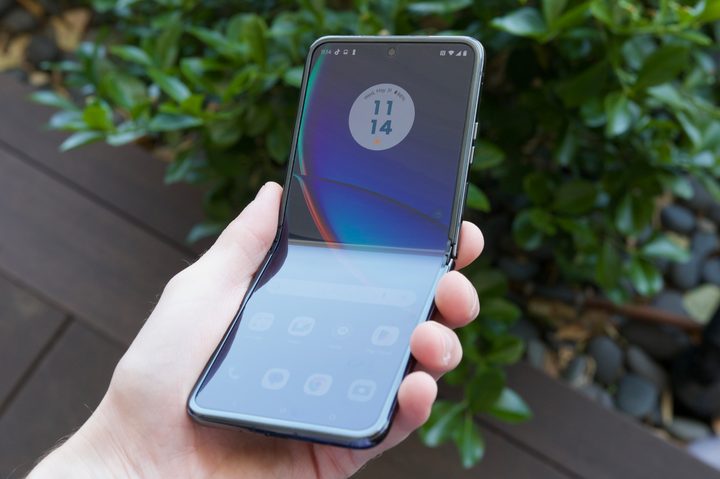
Is it too early to say that the Motorola Razr Plus is my favorite phone of 2023? Yes — especially since I’ve only used the thing for a little over an hour. But after getting a hands-on look at Motorola’s flagship foldable phone for this year, all I can think about is when I’ll get to spend more time with it.
Today, Motorola announced two new folding phones: the Razr Plus and the Razr. These are the first folding phones Motorola is launching in the U.S. since the Razr 5G in 2020, and they could very well be two of the most important foldables we see in 2023. Here’s a first look.
We have to talk about that cover screen

There’s a lot that sticks out about the Razr Plus, but perhaps the most impressive is its cover display. On a technical level, Motorola hits all the right notes. It’s a 3.6-inch pOLED panel, making it the largest cover screen currently available of a flip-phone style foldable. It features a 1:1 aspect ratio, has a 1066 x 1056 resolution, and even touts an HDR10+ certification with a 144Hz refresh rate. It’s really impressive stuff.
But Motorola isn’t just slapping on a load of impressive hardware and calling it a day. What makes the cover screen shine is its software. Pressing the power button shows you a customizable clock face, and once you swipe up on that, you’re taken to your home screen. The top shows the time, date, and weather, while a row of icons toward the bottom offer quick access to things like your contacts, calendar, and more. You can swipe down from the top of the screen to adjust numerous quick settings, swipe up from the bottom to view your notifications and tap the battery icon to see your remaining battery.


Additionally, you can swipe left and right on the home screen to view different “panels” you’ve set up. These include things like contact shortcuts, Google News, a Spotify player, and others. Motorola says more are coming soon, and you can add/remove and reorder them however you like.


It’s all very intuitive and works quite well, but if you find yourself wanting to do more, you can. The cover screen on the Motorola Razr Plus can run any application you want. Whether you want to open YouTube, Google Maps, Instagram, Twitter, TikTok, or anything else, any app installed on the phone can be used on the cover screen. By default, apps open with a virtual black border on the bottom to prevent the cameras from cutting into it. But if you want to use the whole display for your app, you can force it to take over the entirety of the screen by pressing and holding the navigation buttons/bar at the bottom. Oh, and you can use a full-size keyboard (specifically, Gboard) to respond to texts, emails, etc.
It goes without saying that this is a far more practical implementation than cover screens on competing foldables like the Galaxy Z Flip 4 and Oppo Find N2 Flip. It’s huge, looks outstanding, and has a proper set of software tools to take full advantage of it. Motorola absolutely killed it here.
A gorgeous design (and promising specs)

Just as eye-catching is the Motorola Razr Plus’s design. The cover screen is Gorilla Glass Victus, there’s an IP52 rating for water and dust resistance, and Motorola’s using a new hinge mechanism that’s touted to be more durable and feature a less noticeable crease. It remains to be seen how the hinge holds up after months of regular use, but at least during my brief time with the Razr Plus, opening/closing the phone felt fantastic (and the crease was barely noticeable). And, yes, the phone shuts completely flat when you close it. No gap to see here.


Motorola also nailed it with the colors. The two standard options are Infinite Black and Glacier Blue, both of which have matte glass finishes and will be available at all retailers/carriers. But if you buy the Razr Plus from Motorola’s website or via T-Mobile, you can also get the gorgeous Viva Magenta seen in the photos above.
Not only is the magenta color incredibly bright and saturated, but it also ditches the glass finish for vegan leather. It’s soft, has a nice texture to it, and brings me back to the days of the Moto X. I wish Motorola had also used leather for the black and blue hues, but just having it as an option at all is a delight.

And even when you go beyond the Razr Plus’s good looks, the internal specs also appear quite promising. The main display is a 6.9-inch pOLED screen with a Full HD+ resolution, HDR10+, and a 165Hz refresh rate that can go down to 1Hz depending on what you’re doing (like reading an e-book).
Powering the Razr Plus is last year’s Snapdragon 8+ Gen 1 processor, 8GB of LPDDR5 RAM, and 256GB of UFS 3.1 storage.

What about cameras? The two primary sensors include a 12MP main camera with an f/1.5 aperture and OIS (optical image stabilization), plus a 13MP ultrawide camera that doubles as a macro lens. On the inside of the Razr Plus is a 32MP selfie camera. And since this is a foldable, you can use the Razr Plus’s cover screen to take selfies with the two primary cameras. Motorola recently proved with the Edge Plus (2023) that it is capable of creating a solid camera system, so it’ll be interesting to see how the Razr Plus fares on this front.
Finally, there’s the battery situation. Keeping the Razr Plus alive is a 3,800mAh battery — which Motorola claims is capable of “all day and all night battery on one charge.” You get 30W wired charging to refuel the battery when it dies, and if you prefer wireless charging, the Razr Plus also supports 5W wireless charging.
Motorola announced another Razr, too

While the Razr Plus is the most exciting foldable that Motorola announced, it isn’t the only one. The company has also revealed a new baseline Razr for 2023. It shares a lot of the Razr Plus’s DNA — including the same hardware design, IP52 rating, and 6.9-inch inner display.


But there are a few key differences, the most noticeable being the cover screen. The Razr (2023) swaps out the large 3.6-inch panel for a more compact 1.5-inch one. You can’t run apps on it as the Razr Plus allows, but you do still have helpful widgets/panels to look at the weather, your calendar, quickly call contacts, see notifications, etc. It’s not completely unlike the cover screen on the Galaxy Z Flip 4, so if you’ve used that before, you’re roughly getting the same experience here.
The other visual difference is Motorola’s choice of materials for the Razr (2023). All three of the available colors — Sage Green, Vanilla Cream, and Summer Lilac — come in the same vegan leather finish. The leather feels just as nice as it does on the magenta Razr Plus, and the green and lilac shades are particularly eye-catching.

The Razr (2023) also has a few internal spec differences. The processor is a Snapdragon 7 Gen 1, there’s only 128GB of storage, the 64MP main camera has a smaller f/1.7 aperture, and you get a larger 4,2000mAh battery (with the same 30W wired and 5W wireless charging options. The main display is also limited to 144Hz instead of the 165Hz you get on the Razr Plus, though I’d be shocked if anyone can actually discern any real difference between the two.
What makes the Razr (2023) slightly difficult/exciting to talk about is its price — or, rather, the lack thereof. Motorola has only said that the Razr (2023) will be “meaningfully cheaper” than the Razr Plus’s $999 asking price. A “meaningfully cheaper” price could mean anything, though it strongly suggests we’re looking at more than a $100 price difference. If Motorola ends up selling the Razr (2023) for $699 or even $799, that would make it one of the cheapest folding phones we’ve ever seen.
You can preorder the Razr Plus soon

If you’re interested in the Razr Plus, Motorola is beginning preorders for the phone on June 16, followed by regular sales on June 23. It’s available for $999 and can be purchased via Motorola’s website, Amazon, Best Buy, and select carriers (AT&T, T-Mobile, Spectrum Mobile, Google Fi Wireless, and Optimum Mobile).
Similar to its secrecy around the price of the Razr (2023), Motorola also isn’t disclosing a proper release date — instead saying that the Razr (2023) is launching “in the coming months.”
Although an hour-long hands-on session isn’t nearly enough time to form a full opinion on a phone (let alone two), I’m really optimistic about what Motorola’s bringing to the table with the Razr and Razr Plus. The hardware looks and feels great, the software is smart, the spec sheets for both phones don’t raise any major red flags, and Motorola’s pricing strategy could seal the deal completely.
Motorola already proved it can make a non-folding Android phone that puts my iPhone to shame, and it looks like it’s getting ready to do that again with this year’s Razrs — and I can’t wait.