
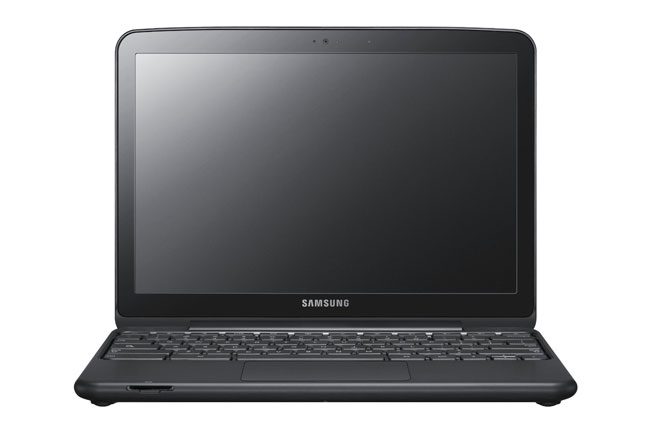
“Samsung’s Series 5 Chromebook comes with the price tag, weight and occasional unreliability of a true PC, but none of the power or flexibility.”
- Quick boot speeds
- Long battery life
- Attractive design
- Comfortable keyboard, large trackpad
- Respectably loud speakers
- Extraordinarily limited functionality
- Nearly useless offline
- Dismal Wi-Fi reliability
- Overpriced
- No smaller than a netbook
- Minimal inputs and outputs
- Can’t handle HD video playback
- Poor multitouch performance
“Why you can trust Digital Trends – We have a 20-year history of testing, reviewing, and rating products, services and apps to help you make a sound buying decision. Find out more about how we test and score products.“
You watch all your TV through Netflix. Check your email through the Web. Pump out those pesky TPS reports in Google Docs. So why do you need anything but a browser, again?
Google says you don’t. The company’s custom-built Chrome OS sheds the pleasantries of Word, Photoshop and yes, even Solitaire in favor of just a browser. But with Internet service less than ubiquitous and many cloud-based services less than reliable, is a world ready for a machine that’s truly nothing but ‘net?
Features and design
Operating system aside, Samsung’s Series 5 is, when you poke around in the guts, a netbook. With an Atom N570 processor running at 1.66GHz, 2GB of DDR3 RAM, 16GB of solid-state storage, and a 12.1-inch LED-backlit screen, it shares much of its silicon in common with most of the netbooks already floating around on retailer shelves. Samsung sells both a $430 Wi-Fi version, and a $500 version with built-in 3G and two years of “free” 3G from Verizon, provided you don’t use more than 100MB per month.

Still, the form factor may be a step above. Samsung has opted to keep the Series 5 as simple as possible: clean white “Arctic White” lid, smooth matte black plastics everywhere else, and a Chiclet-style keyboard paired with a buttonless, oversized touchpad. Taper the edges a little more and you could call it a plastic version of the MacBook Air. The only real nod to its oddball OS comes in the form of “Chrome” and the accompanying logo emblazoned on the lid.
At 3.3 pounds and 10mm thick, you could call the Series 5 compact, but it doesn’t feel as radically thin or lightweight as you might expect from a machine that will only access the Web. Google has pruned the software, for sure, but with the same processor as a netbook and the same battery constraints, there weren’t really any miracles Samsung could pull to make the Series 5 much thinner than a comparable Windows machine.
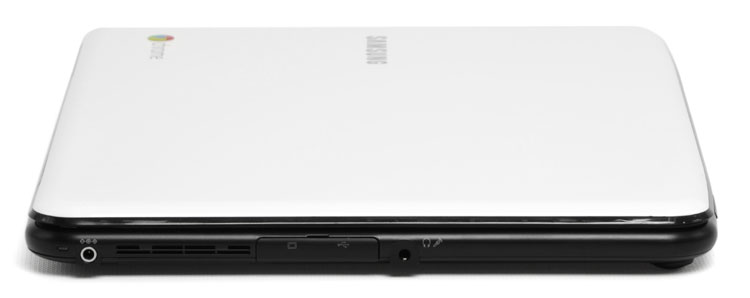 Considering its netbook price tag, it shouldn’t be any huge surprise, either, to hear that the Series 5 just feels cheap. The screen flops around with the slightest provocation thanks to weak hinges and parts of the plastic base flex and “crackle” as you handle them. Our production model even suffered from a loose LCD cable out of the box that left the screen plastered in pink and green until we massaged the cheap chase enough to get it to stick back in place.
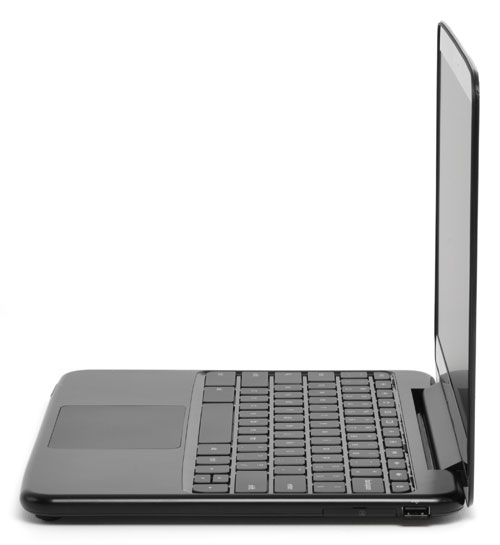
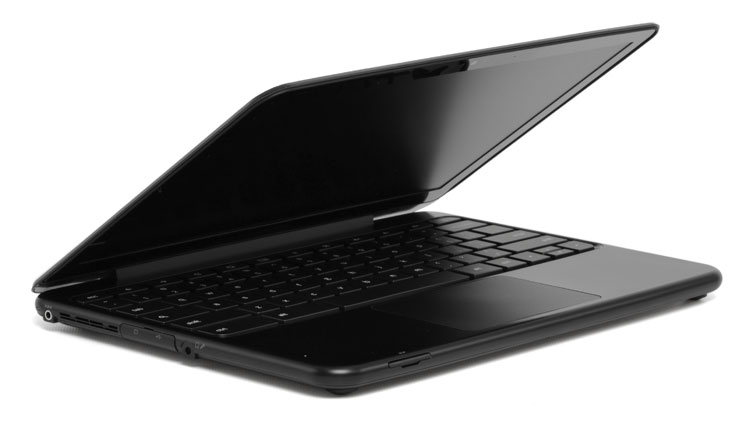 In terms of input and output, the Series 5 is a bit scant. Power connects on the left, where you’ll also find a shared headphone and audio output jack, plus a USB port and VGA output hiding under a plastic door. Keep in mind you’ll need an adapter for the VGA output. On the opposite side, Samsung includes only one extra USB slot and a SIM card slot, again under a plastic door. On the front, there’s a standard SD card reader, and that’s it. So little connectivity would ruffle our feathers a bit more on a PC, but with such a limited array of functions, it honestly doesn’t make much sense to outfit it with anything more.
Chrome OS
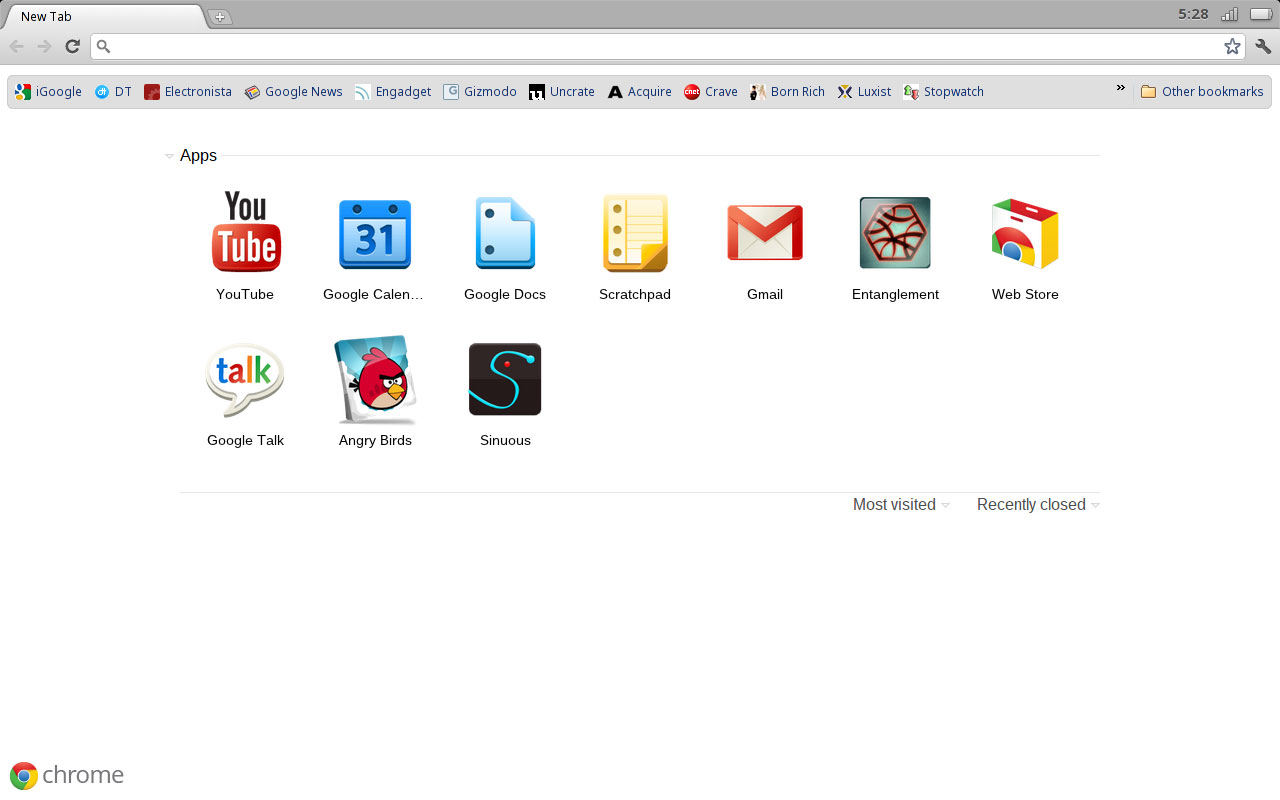
After quickly entering your Google user name and password on first boot, and letting Chrome OS update itself, you’re greeted with… a browser. It works just like Chrome on any other platform, but it’s quite literally all there is. No desktop, no toolbars, no start menus. Just Chrome.
At first, it’s cozy. No need to switch between apps, only tabs. Nothing to download. Nothing to distract. It’s like moving to a studio apartment after growing up in a suburban McMansion. Suddenly, everything is within reach, there’s no more lawn to mow, and all the amenities you need are blocks from your door. Sweet.
Until you need a garage to work on your car. Or room for a friend to stay the night. Or just want a quiet place to work that isn’t the same 500 square feet you sleep, eat and watch TV in. Just like our friend the studio apartment, the same lack of options that make Chrome OS initially feel comfortable and ultra-efficient start to make it feel claustrophobic later on.
Want to unzip a file? Uh, sorry. Want to browse two pages side by side? Out of luck again. Want to make a call with Skype? Yea, no. If you thought the iPad was a neutered netbook, wait until you get your hands on a Chromebook, which makes the iPad look herculean in comparison.
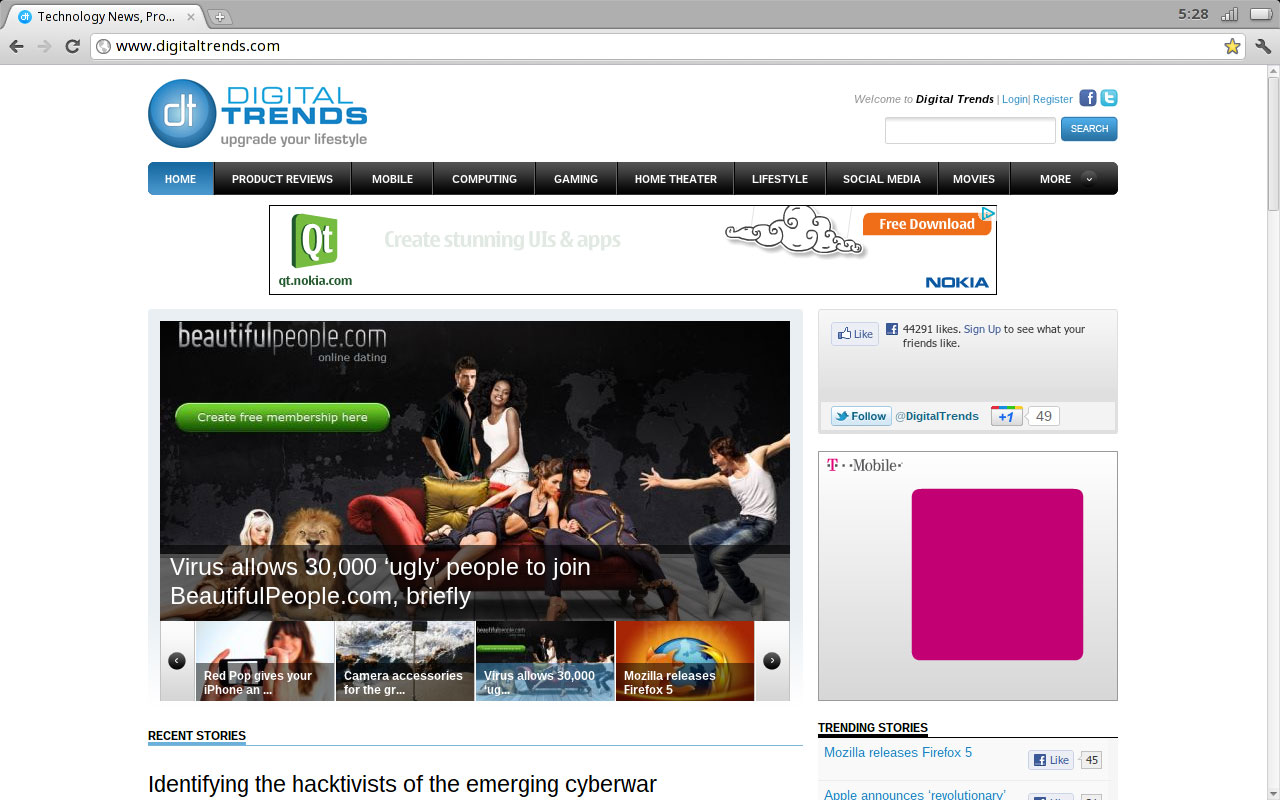
What can you do with Chrome OS? Besides browsing the Web, you can install apps, which aren’t really apps so much as supercharged websites that act more like applications that live on the Web — Google Docs, for instance. Every time you open a new tab, Chrome OS presents you with a grid of your apps, which are as close as it actually gets to looking like any other OS. If you’ve spent any time with the Chrome browser, they’re already familiar to you.
You can never minimize the Chrome browser — there is no desktop to minimize to — but Chrome OS does let you open multiple browser windows and cycle through them with a dedicated key on the keyboard. IMs and other alerts will also pop over on the bottom right-hand side of the screen, similar to the way they do in Gmail. Tweaking the most basic computer settings, like touchpad sensitivity and and time zone, can be accomplished by looking under the same “settings” option used for the Chrome browser. There is quite literally zero wall between browser and operating system here — one is the other.
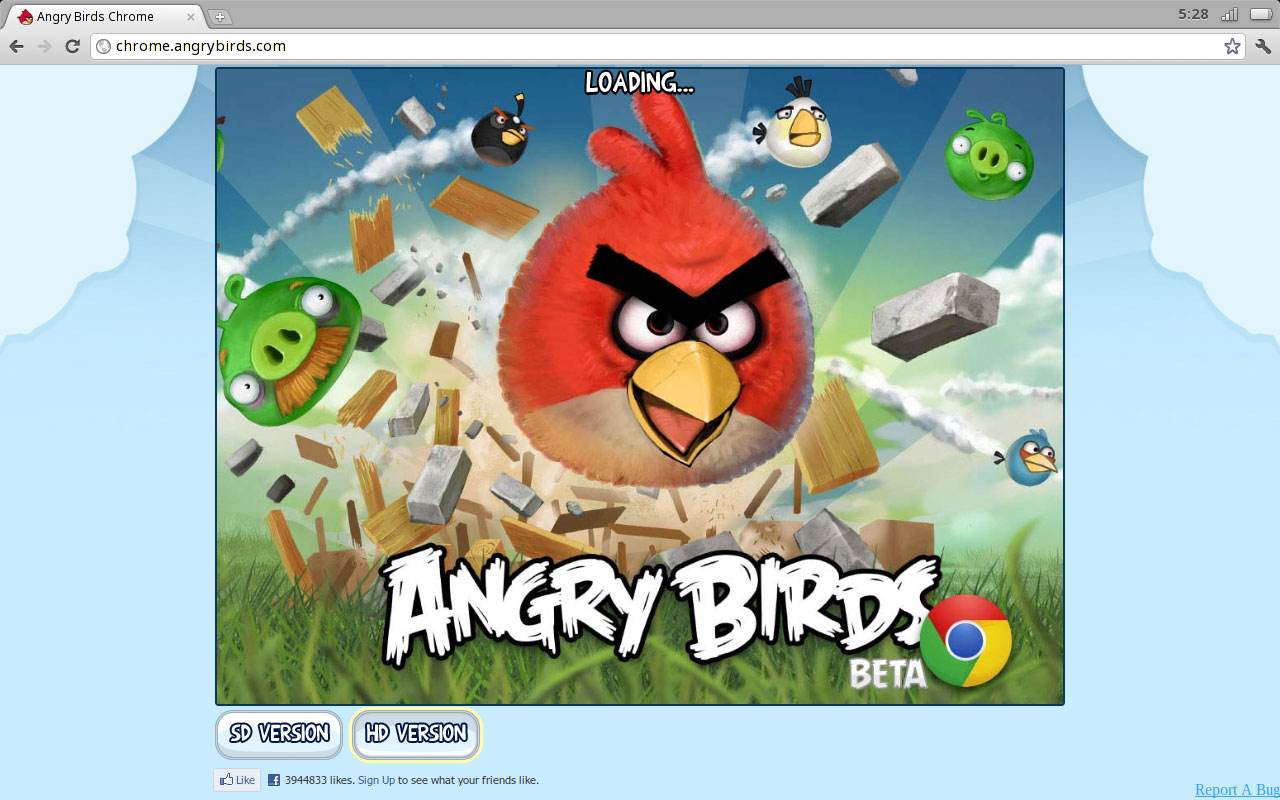
Chrome OS does include a rudimentary media player that can handle all the usual video and audio types, but the file system used for local content is clearly meant as a concession more than a feature. It’s not even easy to find — you need to use the shortcut Ctrl-O to open files, which you’ll learn only after poring through the affiliated help file.
Although you can skin Chrome OS and add extensions the same way you can in the Chrome browser, not everything that would work in Chrome works on a Chromebook. Critical case and point: Netflix. Although the Microsoft Silverlight extension used for Netflix playback installs just fine on Chrome for Windows, visiting Netflix.com on Chrome OS produces an error message explaining that compatibility is coming soon.
Online or out of business
Google claims that many apps will eventually run on or offline, but at present, the Chromebook always clings tenuously to the nearest Wi-Fi signal for even the most basic functionality. Without signal, you can quite literally sign in and play a handful of shoddy games that support offline functionality — it’s just a browser, remember? Google Docs would seem to be the number one priority for offline use, but even that won’t arrive until later this summer — and that’s if Google pulls through on it at all.
 A crippling reliance on the Web for everything wouldn’t be quite so crippling if the Chromebook would actually stay connected, which it won’t. Our Series 5 machine dropped connectivity every 10 to 15 minutes without fail, even after moving just feet away from the Wi-Fi access point. Often, we had to log back out then back in before it would reconnect. Sometimes, that didn’t work either. Whether this is Google’s fault or Samsung’s, we’re not sure, but in practice in made the Series next to useless for everyday computing, even around the office.
The 3G model of the Chromebook retails for $500 and comes with free” Verizon service for two years, with a 100MB monthly data cap. Not a bad deal. But you’ll still need to punch in a credit card number to “confirm your identity” prior to activating you free service. Verizon’s activation service once entirely failed to load, then repeatedly rejected our credit card without telling us what field was to wrong to reenter it (CVV code, we got it after reentering several times).
Performance
Limited capabilities aside, Chrome OS delivers on one pivotal promise of riding on a lightweight Gentoo Linux build: It boots lightning fast. Even with the same hardware as a netbook, our Series 5 Chromebook went from cold to ready-to-surf in a little over 10 seconds, and booting up from sleep was instant: As soon as the lid is up, it’s ready to roll.
Despite the limited capabilities of an Atom processor, Web surfing isn’t able to present much of a problem. Your day-to-day page visits won’t seem any slower on a Chromebook than they will on a $2,000 notebook. That said, we did manage to bump into the limits of its capabilities in video playback: Even 480p video files sometimes refused to load or stuttered during playback, and anything hi-def (even 720p) played back too slowly to be acceptable. The same was true for HD footage captured from a Kodak Zi8 and transferred via USB, then played locally.
Despite Google’s promise of reliability thanks to an operating system that can’t really get bloated from too many programs, Chrome OS seemed plenty unstable out of the box. As we mentioned early, Wi-Fi rarely stayed connected, but Chrome also had to kill pages at times, and at others pages simply stopped responding to input. YouTube often told us “an error has occurred” when we tried to play videos, even in low resolution, at full screen.
Touchpad and keyboard
We had nothing but applause for Apple’s supersized multitouch trackpads on its unibody MacBooks, so we were pleasantly surprised to see something similar show up on the Chromebook… sort of. Samsung successfully duped the size and buttonless design of Apple’s class-leading MacBook trackpads, but the surface is plastic instead of glass, and just doesn’t perform nearly as well. To perform a hard click on the surface, you need to be toward the very bottom of the pad for it to depress, and multi-touch gestures like using two-fingered swipes to the left and right for forward and back don’t exist in Chrome OS. The pad also performs poorly with two fingers worth of input: holding down a click with one finger while moving the other to drag and drop rarely works properly.
 The Series 5 keyboard is more or less the standard Chiclet style, but Chromified. You’ll find dedicated keys for search, forward, back, reload, full-screen and a dedicated key for cycling through different Chrome windows. For a 12-inch notebook, we found the Chromebook surprisingly comfortable to type on, if a little underwhelming in terms of key feedback.
Display
The Series 5 uses a 1280 x 800 LED-backlit LCD that delivers about 300 nits of brightness. Combined with a matte coating that shrugs off glare quite effectively, that makes the Chromebook pretty easy to use in a variety of circumstances, even if images and video tend to look a bit blown out at times as a consequence. That said, it’s a smart choice of screen for a notebook specially adapted to Web usage, and it never let us down.
Battery life
As with boot speeds, the Series 5 delivers on Google’s promise of better battery life by hitting a legitimate 8.5 hours of computing. Even with Wi-Fi on and brightness up, our Chromebook had no issues running for the entire workday on a single charge, which is an impressive feat for a notebook in this size range.
Sound
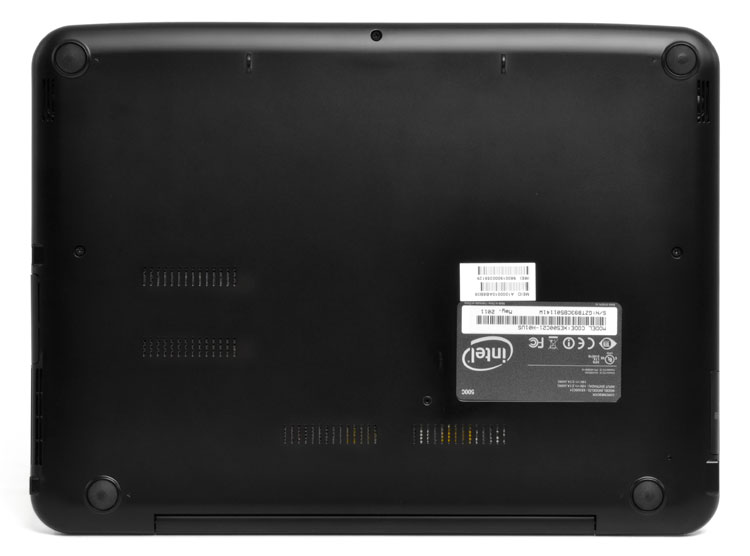
The Series 5 only has one tiny speaker embedded in each side, each with just three tiny slits for sound, but it manages sound far above what we would expect for a notebook this size. Sitting with it the wrong way can tend to muffle sound, but it holds its own on hard surfaces, delivering plenty of volume for TV shows and dialogue-driven movies, even if (like all laptop speakers) it’s too tinny for most music.
Conclusion
Is the world ready for a computer that relies entirely on the Internet for every function? We approached the first Chromebook full of optimism, but the answer is a definitive “no.” Samsung’s Series 5 comes with the price tag, weight and occasional unreliability of a true PC, but none of the power or flexibility. Even cloud pioneers who would gladly spend all day in Chrome on a Windows or Mac notebook will find Chrome OS’ lack of offline support dumbfounding and the notebook’s flaky Wi-Fi infuriating. Unless Google can vastly improve Chrome OS’ utility by adding more offline functionality and vendors can cheapen up their Chromebooks, Google’s cloud experiment remains a pipe dream.
Highs:
- Quick boot speeds
- Long battery life
- Attractive design
- Comfortable keyboard, large trackpad
- Respectably loud speakers
Lows:
- Extraordinarily limited functionality
- Nearly useless offline
- Dismal Wi-Fi reliability
- Overpriced
- No smaller than a netbook
- Minimal inputs and outputs
- Can’t handle HD video playback
- Poor multitouch performance


