
Verizon plans to expand its faster 5G Ultra Wideband network to reach beyond urban and suburban centers later this year, helping to drive up performance for folks in rural areas and spearhead the growth of its fixed wireless access (FWA) broadband services.
Verizon CEO Hans Vestburg touched on these details this week in the company’s quarterly earnings call, where he lauded the rapid expansion of the carrier’s C-band coverage to reach 200 million people in just over a year “since we lit up the first site.”

While that’s cost the carrier an additional $10 billion in capital expenditures — on top of the $45 billion it paid to license the spectrum in the first place — Vestburg notes that it’s paying off in “new sources of revenue growth” as customers upgrade to the latest 5G-capable phones to take advantage of the faster 5G Ultra Wideband network.
Vestburg also shared that customers on Verizon’s 4G/LTE network are also seeing improved speeds as more traffic shifts to the newer C-band spectrum, freeing up the airwaves for those older phones that don’t yet support 5G.
“Where we offer C-band […] we see 4G customers benefiting as we offload traffic in some markets to our 5G Ultra Wideband network. The performance improvements will continue as 5G penetration expands market by market,” Vestburg said.
Bringing fast 5G to the countryside
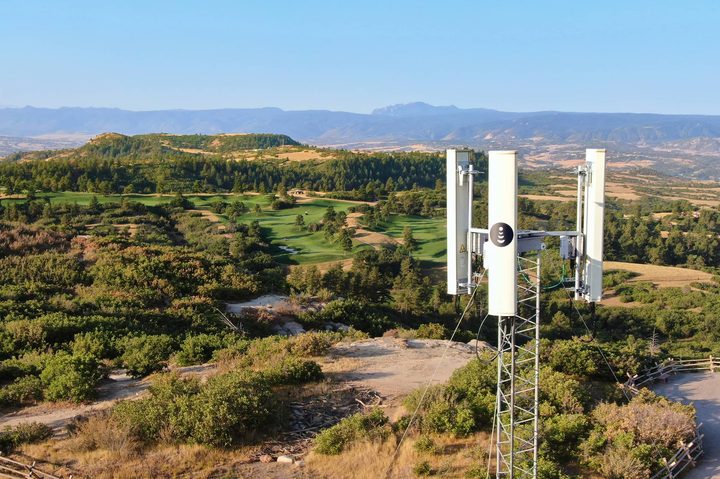
While Verizon still lags behind T-Mobile in mid-band 5G coverage, it’s not sitting still. Responding to a question about the carrier’s fixed wireless 5G services during the Q&A portion of the call, Vestburg noted that as things stand now, Verizon’s C-band spectrum only covers “70 markets out of over 400.”
While those 70 markets account for 60% of the U.S. population, the carrier sees a lot of untapped potential in the remaining 330 markets that have yet to get C-band. At this stage, Vestburg says Verizon is waiting until later this year when it’s expected to get its “next chunk of C-band” from the Federal Communications Commission (FCC). It’s also expected to ramp up its current C-band deployments to full power after coming to terms with the Federal Aviation Administration (FAA) earlier this year on ways to avoid interference with aircraft instruments.
Vestburg says it’s simply a matter of “waiting for clearance by year-end to get even more” C-band spectrum. That new spectrum is being allocated for suburban and rural areas, although he adds, “We’ll also get more urban spectrum as we’re only deploying 60, maybe 80 Megahertz.”
While Vestburg didn’t say how many of the additional 330 markets Verizon plans to cover by the end of this year, the carrier has its work cut out for it if it wants to catch up to rival T-Mobile, which has promised that its 5G Ultra Capacity network will reach 300 million people by that time.
More 5G in your home

Verizon also hopes to use the rural C-band expansion to increase its footprint for fixed wireless 5G services to those areas where it’s most necessary. That is, 5G service you can use for your home internet.
Presently, Verizon’s 5G broadband services are available to only 40 million households, or about 20% of people covered by its 5G Ultra Wideband network. However, the company only has around 2 million FWA subscribers.
However, since Verizon’s 5G FWA coverage is still limited to urban areas, where Verizon’s own fiber-optic Fios services are widely available, it’s not surprising that there hasn’t been much uptake in those areas. While 5G fixed wireless access is rapidly improving, it still can’t compete on performance with top-tier fiber and cable broadband services.
Although Vestburg was a bit vague about exactly how Verizon plans to build out its 5G FWA services, it seems it’s enough of a priority for the carrier that it’s likely to begin its new C-band spectrum push into suburban and rural areas that are presently underserved by traditional wired broadband providers. This will give 5G FWA a clear advantage over the incumbent services in hopes of encouraging more customers to cut the cord and opt for home or business internet delivered over 5G.


