“Why you can trust Digital Trends – We have a 20-year history of testing, reviewing, and rating products, services and apps to help you make a sound buying decision. Find out more about how we test and score products.“
Handheld gimbals have evolved considerably since Freefly first introduced the $15,000 Movi in 2013. In a relatively short period of time, we’ve seen the number of companies making such devices multiply, as gimbals have grown smaller, lighter, and much cheaper in order to appeal to a broader user base. FeiyuTech entered the market a few years ago with a focus on small gimbals for action cameras, but its new Alpha series of three-axis gimbals is aimed at DSLR and mirrorless camera shooters. In our FeiyuTech A2000 gimbal review, we take a look at the largest model in the series.
Design
Starting at $640, the A2000 is one of the less expensive options for a pistol-grip gimbal of this size, coming in just $10 below the $650 Zhiyun Crane V2. It can support camera and lens combinations weighing up to 4.4 pounds, enough to handle full-frame DSLRs — provided you don’t go too crazy with a huge lens.
If you’re a mirrorless or DSLR videographer, we wouldn’t hesitate to recommend it.
Despite the relatively low price, it feels like a premium product, with solid, all-metal components. It even comes packaged beautifully, and you’ll likely want to hold onto the box, as it will keep the gimbal snuggled safely into formfitting styrofoam when you need to transport it (never mind that the box resembles a Sony product, down to the font).
A quick-release plate and two sets of 18650 lithium-ion rechargeable batteries (which resemble AA batteries but are larger and higher capacity) are included in the box, as well. (FeiyuTech claims 12 hours of use per charge.)
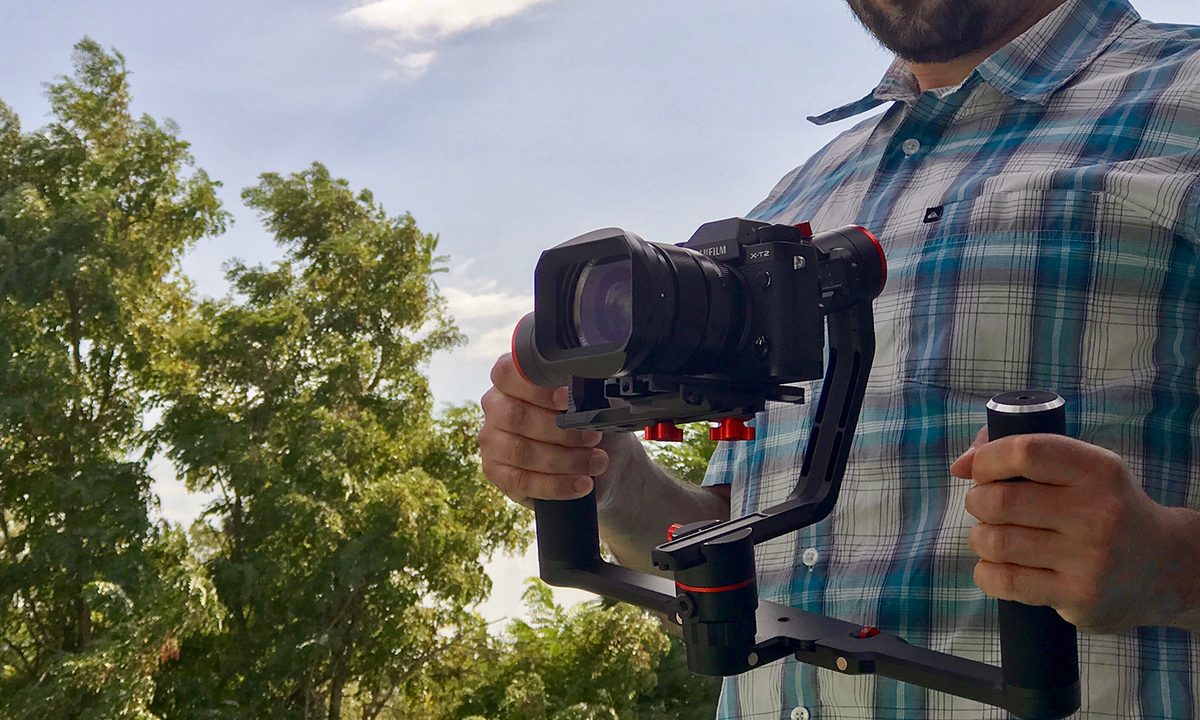
We also tested the dual-handle accessory, which raises the price to $800. This attachment feels equally well made and offers superior ergonomics and stability for two-hand shooting.
It also adds nine 1/4-inch attachment points for screwing on lights, monitors, microphones, or other accessories (you’ll need to factor the weight of the add-ons into the overall weight of the setup).


Three brushless electric motors stabilize the gimbal’s pan, vertical tilt, and horizontal tilt (or yaw, pitch, and roll). Each axis has complete freedom to rotate 360-degrees. If using the dual-handle attachment, this allows the gimbal to easily be used either on top of the handles or in an underslung position by flipping the handles over, without having to rebalance anything.
Usability and performance
If you’re new to the world of camera stabilizers, the balancing process may feel a bit complicated, but if you have experience working with passive stabilizers like a Steadicam or Glidecam, balancing the A2000 is much easier. The three support arms can each be adjusted by hand without the need for any tools. Even the quick-release plate uses a butterfly screw to attach to the bottom of the camera. The entire thing can be set up and balanced in the field without so much as a screwdriver.
The only problem comes from the poorly translated manual. If this is your first gimbal, be ready to re-read each step of the balancing process a few times. The illustrations are easy enough to follow, but the manual may still be a source of frustration for some.
Once you’ve got the camera balanced, the FeiyuTech A2000 couldn’t be any easier to use. It automatically centers and levels itself when turned on (provided you’ve dialed in the balance close enough). You can manually adjust pan and tilt with a four-way joystick on the handle, and can even set the tilt angle by adjusting the camera with your hand.
Hold it any position for half a second, and the gimbal will know to maintain that angle when you let go.
We tested the A2000 with a Fujifilm X-T2 and a range of lenses including a 16mm, 35mm, and 56mm. (Don’t forget to turn off the image stabilization in the camera and lens.) The heaviest combination was about two pounds, so we were well within the limitations of the gimbal. Still, prolonged use will definitely lead to muscle fatigue. Give your back a rest by setting the gimbal down on the included tripod-style foot in between shots.
The real value of a gimbal is in the freedom of motion it allows you. The A2000 has multiple modes that control how it responds to movement. It starts up in pan mode, which locks the pitch and roll axes but automatically pans the camera as you rotate the handle. This smoothes out any inconsistencies in your motion and is the perfect mode for tracking a moving subject while you remain stationary, or for “orbiting” a subject.

Tap the mode button twice to enter pan and tilt mode. Here, the camera will both pan and tilt to follow your motions. Tap three times, and the gimbal rotates 180-degrees into a selfie position. Tap four times, and it locks all axes, so no matter how you move the gimbal, the camera remains fixed in its original orientation. Somewhat strangely, after tapping three times to reverse the gimbal, you need to tap twice to return it to its forward-facing position.
Despite the relatively low price, it feels like a premium product.
If you’re in modes one or two, you can use the trigger button on the front of the handle to temporarily lock the axes. This is a nice idea, but in practice, we found this button too easy to press. Over time, you will likely get used to it and learn where to place your fingers to avoid it, but it can be a bit awkward at first.
The A2000 also has a time-lapse mode that uses a USB connection and the Feiyu On app to automate interval shooting while panning the camera slowly over time, similar to that offered on the Freefly Movi. The gimbal must be steady on a flat surface to do this, but it is a nice addition to its functionality that helps the tool be more than a one-trick pony.
Conclusion
The FeiyuTech A2000 brings a lot of value to the table. It is well made, fairly easy to set up, and simply works as advertised. We’d like to see a better translation of the manual, but c’est la vie. If you’re a mirrorless or DSLR videographer and want a relatively affordable way to raise your production value, we wouldn’t hesitate to recommend it.
The A2000 is similar enough to the Zhiyun Crane V2 (the improved, second-gen version of the Buy Now ) that it’s hard to recommend one over the other, as we found operating performance to be good in both products.The A2000 supports a slightly heavier payload and comes in an $800 dual-handle configuration, which makes it ideal for videographers, but the Crane V2 supports third-party dual-handle options as well. In this instance, you won’t go wrong with either, so it’s a matter of finding one at a good price and trying out which feels best in your hand.