  1. Home
  2. Space
  3. Emerging Tech
  4. News

Remains of shallow, briny pools provide further evidence of liquid water on Mars

Add as a preferred source on Google
A Guide to Gale Crater

As the Curiosity rover explores Mars’ Gale Crater, the data it collects tells us more about the history of the planet and in particular about whether liquid water once existed there. Using data collected by Curiosity, a new study has examined the geology of the crater to learn more about the briny ponds which may once have dotted the planet’s surface.

Recommended Videos

“We went to Gale Crater because it preserves this unique record of a changing Mars,” William Rapin, Caltech researcher and lead author of the study, explained in a statement. “Understanding when and how the planet’s climate started evolving is a piece of another puzzle: When and how long was Mars capable of supporting microbial life at the surface?”

By looking at the salts present in rocks in an area of the crater called Sutton Island, the scientists could build up a picture of the environment through time. They already knew that the area went through drier periods, as the mud in a region called Old Soaker was cracked. The cracks form as the mud dries out.

The new evidence shows there were wet periods too though. The presence of minerals salts mixed with sediment suggests that shallow ponds once formed there, before drying to leave the salts behind. The ponds would have been briny due to the concentrated salts.
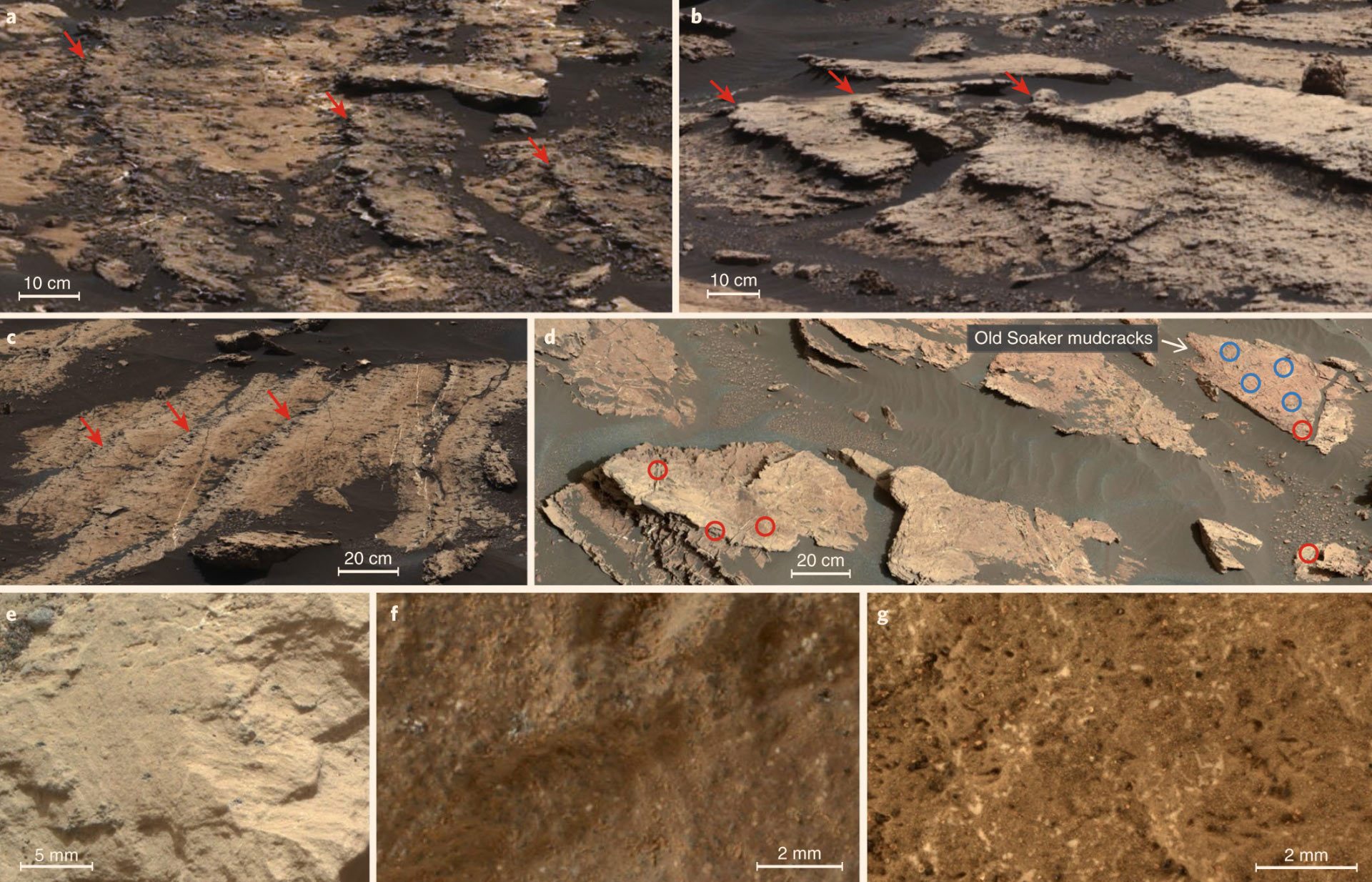
Different sulfate elements found in Mars’ Gale Crater: (a) magnesium sulfate-enriched lithology; (b) calcium sulfate enrichments; (c) euhedral white crystals and heterogeneous calcium sulfate and magnesium sulfate enrichments; (d) areas with calcium sulfate enrichments (red) and without (blue); (e, f) close-up images of a mudstone and a sandstone enriched in calcium sulfate; (g) close-up image of bedrock. Rapin et al, doi: 10.1038/s41561-019-0458-8.

To understand more about the formation of these briny lakes, scientists turned to an environment closer to home: “Given that Earth and Mars were similar in their early days, Sutton Island might have resembled saline lakes on South America’s Altiplano,” Dr. Rapin said.

“Streams and rivers flowing from mountain ranges into this arid, high-altitude plateau lead to closed basins similar to Mars’ ancient Gale Crater… During drier periods, the Altiplano lakes become shallower, and some can dry out completely. The fact that they’re vegetation-free even makes them look a little like Mars.”

The research is published in the journal Nature Geoscience.

Georgina Torbet
Georgina has been the space writer at Digital Trends space writer for six years, covering human space exploration, planetary…
Artemis II crew preps for lunar orbit – and Orion’s cosmic commode
'It's the one place we can go during the mission where we can actually feel like we’re alone.'
The Orion spacecraft's toilet.

Four astronauts are about to embark on a historic voyage that will take them around the moon in a spacecraft about the size of a large camper van.

During the Artemis II mission, NASA astronauts Reid Wiseman, Victor Glover, and Christina Koch, and the Canadian Space Agency’s Jeremy Hansen, will spend 10 days inside the Orion capsule after being blasted to space by the SLS rocket from the Kennedy Space Center in Florida, hopefully next week.

Read more
It’s here! NASA reveals full livestream schedule for crewed moon mission
The coverage starts on Friday.
NASA's SLS lunar rocket on the launchpad at the Kennedy Space Center, with the moon shining brightly in the background.

The excitement is building with NASA now just a few days away from sending four astronauts on a voyage around the moon.

On Wednesday, the space agency shared its schedule for coverage of the final buildup and main event, including a Q&A with the astronauts this Friday, blast off on Wednesday, April 1, and regular updates as the crew make their way to the moon.

Read more
Peek inside NASA’s Mars habitat where humans train for life on the red planet
Four volunteers are staying in isolation for more than a year.
A scene inside NASA's Mars simulation habitat.

NASA has offered a sneak peek inside its Mars simulation habitat where four volunteers have now spent 150 days isolated from the outside world.

By living within the confines of the 1,700-square-foot Mars Dune Alpha habitat at the Johnson Space Center in Houston, Ross Elder, Ellen Ellis, Matthew Montgomery, and James Spicer are helping NASA to better prepare for long-duration missions that will take humans into deep space.

Read more