  1. Home
  2. Space
  3. Emerging Tech
  4. News

New images reveal more about the history of water on Mars

Add as a preferred source on Google

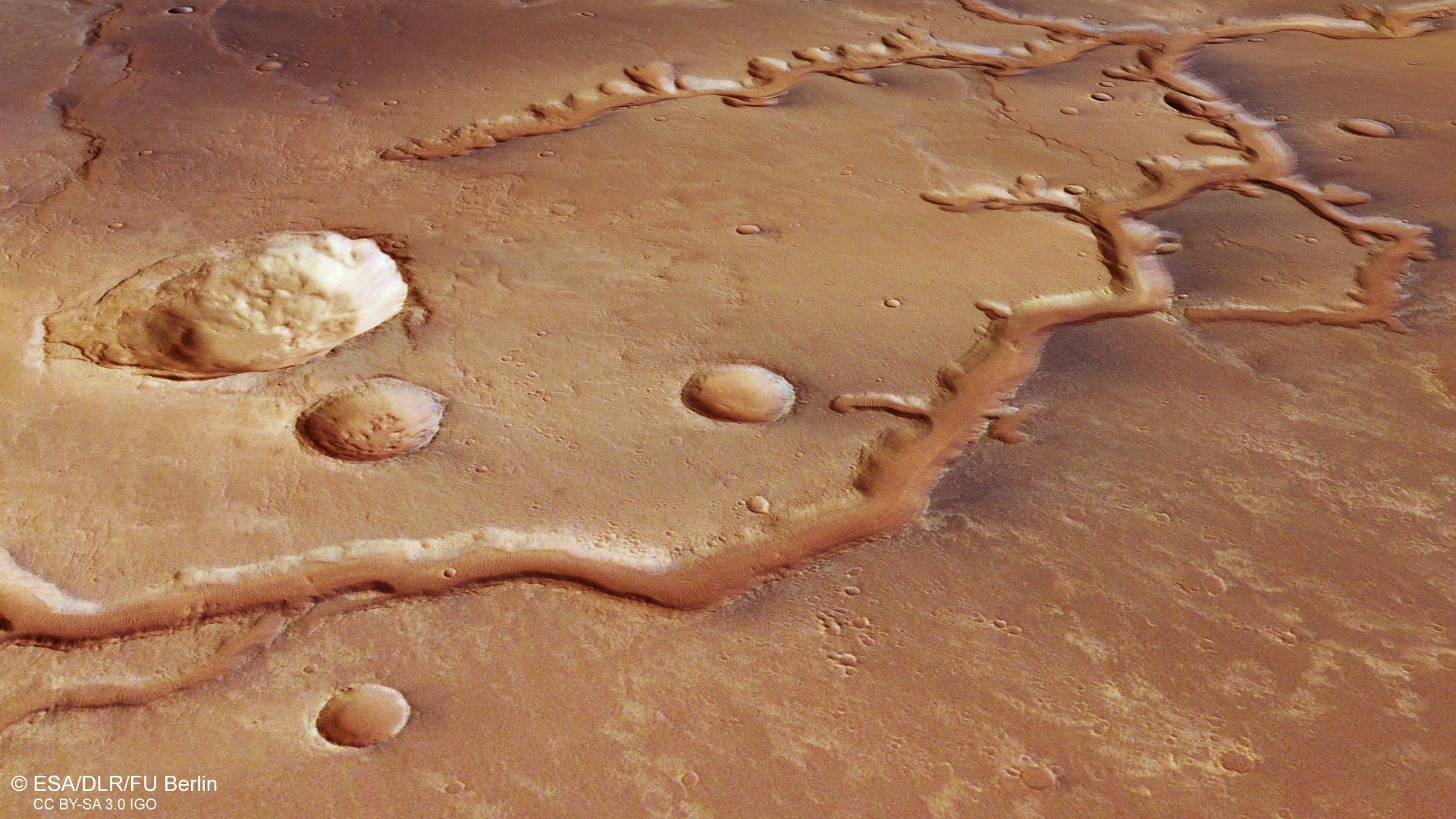
This image from ESA’s Mars Express shows a dried-up river valley on Mars named Nirgal Vallis. This oblique perspective view was generated using a digital terrain model and Mars Express data gathered on November 16, 2018, during Mars Express orbit 18818. ESA/DLR/FU Berlin

Two new sets of images from NASA and the European Space Agency (ESA) have revealed more about the history of water on Mars. Scientists believe that billions of years ago, Mars had a thick, dense atmosphere that trapped heat and allowed liquid water to exist on the surface. They want to learn more about this period to see if there is any way that liquid water might still exist on the planet today.

Recommended Videos

Above is an image that was taken by the ESA’s Mars Express, a spacecraft in orbit around the planet that has captured a dried-up river system called Nirgal Vallis located just south of the equator. The river system stretches for nearly 700 kilometers (435 miles) and was shaped both by the flow of water through the rock and by impacts when meteorites hit the surface. You can see the tree-like branching caused by the river’s flow as well as the round craters caused by the impacts. The system is believed to be between 3.5 and 4 billion years old.

The network of cracks in this Martian rock slab called “Old Soaker” may have formed from the drying of a mud layer more than 3 billion years ago. The view spans about 3 feet (90 centimeters) left-to-right and combines three images taken by the MAHLI camera on the arm of NASA’s Curiosity Mars rover. NASA/JPL-Caltech/MSSS

Around the same time, 3.5 billion years ago, the surface of the Gale Crater was very different too. This crater, also located near the equator, is where the Curiosity rover is currently exploring. The rover has captured this image of a network of cracks in the ground, suggesting there was once mud in this location which cracked as it dried. This provides further evidence that there were once lakes in this area.

Located within the Gale Crater is the massive Mount Sharp, which Curiosity is slowly climbing. The steep sides of the mountain allow scientists to view different layers of bedrock, learning about the Martian environment over time. The rover is currently in an area called the “clay-bearing unit” because of the presence of clay minerals there, but it will soon be moving on to the “sulfate-bearing unit.” There appear to be different layers in this new area, which could have formed in drier conditions which came later in Mars’ history.

In the next few years, Curiosity will make its way through the sulfate-bearing unit to investigate these layers up close, with the hopes of understanding how they fit into the environmental history of Mars.

Georgina Torbet
Georgina has been the space writer at Digital Trends space writer for six years, covering human space exploration, planetary…
Stunning close-up footage shows NASA’s moon rocket roaring to space
On its first crewed flight, NASA's lunar rocket displays its awesome power.
NASA's SLS rocket roars skyward at the start of the Artemis II mission on April 1, 2026.

As NASA’s Artemis II astronauts journey back to Earth following their breathtaking close encounter with the moon earlier this week, the space agency has just shared some stunning footage (below) of the rocket launch that sent the crew on its way on April 1.

The close-up tracking shot shows the awesome power of the Space Launch System (SLS) rocket’s four core RS-25 engines together and its two solid rocket boosters as the 98-meter-tall vehicle roars away from the launchpad at the Kennedy Space Center in Florida.

Read more
How to watch NASA’s moon crew splash down at end of historic mission
The Orion spacecraft's final moments before splashdown will be the most perilous of the entire mission.
Earth and the moon as seen from the Orion spacecraft during the Artemis II mission in April 2026.

The Artemis II astronauts have looped around the moon, captured some extraordinary imagery (above), set a slew of records, and are now on their way back to Earth.

The 10-day mission will reach its climax on Friday, April 10, during a dramatic homecoming that will see the Orion spacecraft enter our planet’s atmosphere at a speed of nearly 25,000 miles per hour.

Read more
Notable firsts of the Artemis II moon mission … so far
The Artemis II crew are now on their way home, so let's take a look at the mission's achievements so far.
The moon as seen from the Orion spacecraft during the Artemis II mission.

Having just looped around the moon in a historic flyby of our nearest neighbor, the Artemis II crew are now on their way back to Earth.

NASA’s Victor Glover, Reid Wiseman, and Christina Koch, along with the Canadian Space Agency’s Jeremy Hansen, launched aboard the Orion spacecraft from the Kennedy Space Center on April 1, lifted to space by the mighty SLS rocket.

Read more