  1. Home
  2. Space
  3. News

This beautiful galaxy is being warped by its hungry supermassive black hole

Add as a preferred source on Google

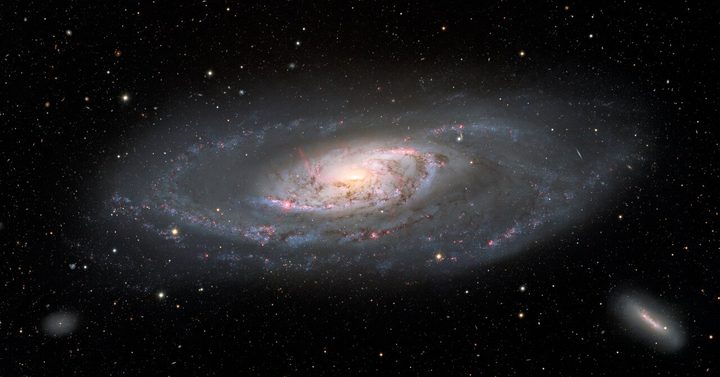
This image of the spiral galaxy Messier 106, or NGC 4258, was taken with the Nicholas U. Mayall 4-meter Telescope at Kitt Peak National Observatory, a Program of NSF’s NOIRLab. A popular target for amateur astronomers, Messier 106 can also be spotted with a small telescope in the constellation Canes Venatici.
This image of the spiral galaxy Messier 106, or NGC 4258, was taken with the Nicholas U. Mayall 4-meter Telescope at Kitt Peak National Observatory, a Program of NSF’s NOIRLab. A popular target for amateur astronomers, Messier 106 can also be spotted with a small telescope in the constellation Canes Venatici. KPNO/NOIRLab/NSF/AURA Acknowledgment: PI: M.T. Patterson (New Mexico State University) Image processing: T.A. Rector (University of Alaska Anchorage), M. Zamani & D. de Martin

This stunning image of a distant galaxy was captured by the ground-based Nicholas U. Mayall 4-meter Telescope in the Arizona-Sonoran Desert. To capture distant objects in such detail, the telescope has a Mosaic camera that combines multiple captures into one image.

Recommended Videos

This spiral galaxy is named Messier 106, or NGC 4258, and despite its apparently tranquil appearance, it is the site of a hungry, hungry black hole. Almost all galaxies have an enormous supermassive black hole at their center, and Messier 106 is no exception.

Its supermassive black hole is 40 million times the mass of our sun, and it is particularly active. It drags in large amounts of dust and gas, chowing down on far more matter than other supermassive black holes like the one at the center of our galaxy. And the black hole in Messier 106 spins as well, rotating with such force that it actually warps the disk of gas that surrounds it.

This warping also created streamers of gas that burst from the center of the galaxy, which you can see as red lines. These appear like extra spiral arms, as most spiral galaxies have just one pair of arms which consist of groups of stars. The red “arms” in Messier 106 are made up of gas rather than stars, but they add to the unusual features of this active galaxy.

This galaxy is very large, at more than 130,000 light-years across. It is similar in terms of both size and brightness to our neighboring galaxy, the Andromeda galaxy, which is visible with the naked eye. But because Messier 106 is 10 times more distant than Andromeda, it appears very small in the night sky. However, it can be spotted using a telescope, which makes it a favorite target for amateur astronomers.

Messier 106 is also of interest to cosmologists, as it is used in measuring the size of the universe as part of a measurement called the cosmic distance ladder.

Georgina Torbet
Georgina has been the space writer at Digital Trends space writer for six years, covering human space exploration, planetary…
Stunning close-up footage shows NASA’s moon rocket roaring to space
On its first crewed flight, NASA's lunar rocket displays its awesome power.
NASA's SLS rocket roars skyward at the start of the Artemis II mission on April 1, 2026.

As NASA’s Artemis II astronauts journey back to Earth following their breathtaking close encounter with the moon earlier this week, the space agency has just shared some stunning footage (below) of the rocket launch that sent the crew on its way on April 1.

The close-up tracking shot shows the awesome power of the Space Launch System (SLS) rocket’s four core RS-25 engines together and its two solid rocket boosters as the 98-meter-tall vehicle roars away from the launchpad at the Kennedy Space Center in Florida.

Read more
How to watch NASA’s moon crew splash down at end of historic mission
The Orion spacecraft's final moments before splashdown will be the most perilous of the entire mission.
Earth and the moon as seen from the Orion spacecraft during the Artemis II mission in April 2026.

The Artemis II astronauts have looped around the moon, captured some extraordinary imagery (above), set a slew of records, and are now on their way back to Earth.

The 10-day mission will reach its climax on Friday, April 10, during a dramatic homecoming that will see the Orion spacecraft enter our planet’s atmosphere at a speed of nearly 25,000 miles per hour.

Read more
Notable firsts of the Artemis II moon mission … so far
The Artemis II crew are now on their way home, so let's take a look at the mission's achievements so far.
The moon as seen from the Orion spacecraft during the Artemis II mission.

Having just looped around the moon in a historic flyby of our nearest neighbor, the Artemis II crew are now on their way back to Earth.

NASA’s Victor Glover, Reid Wiseman, and Christina Koch, along with the Canadian Space Agency’s Jeremy Hansen, launched aboard the Orion spacecraft from the Kennedy Space Center on April 1, lifted to space by the mighty SLS rocket.

Read more