  1. Home
  2. Space
  3. News

Final communications sent to the beloved Ingenuity Mars helicopter

Add as a preferred source on Google

Earlier this year, the beloved Mars helicopter Ingenuity ended its mission after an incredible 72 flights. Originally designed as a technology test intended to perform just five flights, NASA’s helicopter was the first rotorcraft to fly on another planet and was such a success that it has already inspired plans for more exploration of distant planets using rotorcraft. Its mission came to an end, however, when it damaged one of its rotors, leaving it unable to safely fly.

Even then, the helicopter was still able to communicate by sending signals to the nearby Perseverance rover, which acted as its base station. Now, though, Perseverance is traveling away from the helicopter to continue its exploration of Mars. So this week, the NASA team on the ground met for the last time to communicate with Ingenuity, bringing the mission to a final close.
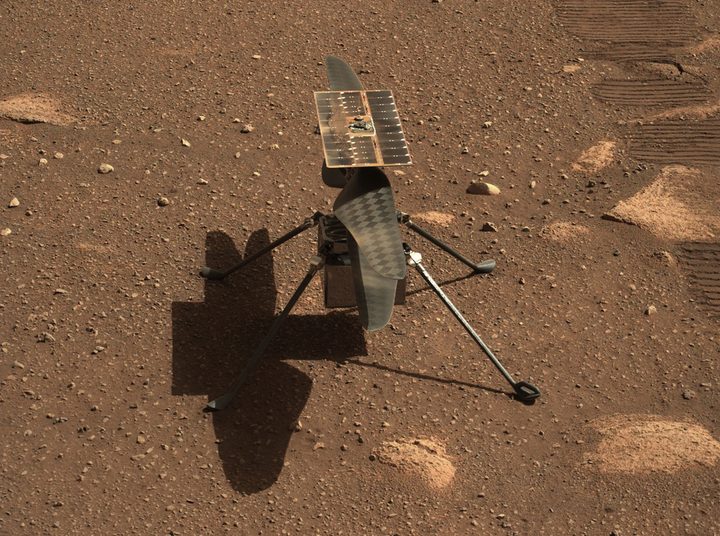
NASA’s Ingenuity Mars helicopter is seen here in a close-up taken by Mastcam-Z, a pair of zoomable cameras aboard the Perseverance rover. This image was taken on April 5, the 45th Martian day, or sol, of the mission.
NASA’s Ingenuity Mars helicopter is seen here in a close-up taken by Mastcam-Z, a pair of zoomable cameras aboard the Perseverance rover. This image was taken on April 5, the 45th Martian day, or sol, of the mission. NASA/JPL-Caltech/ASU

“With apologies to Dylan Thomas, Ingenuity will not be going gently into that good Martian night,” said Josh Anderson, Ingenuity team lead at NASA’s Jet Propulsion Laboratory, in a statement. “It is almost unbelievable that after over 1,000 Martian days on the surface, 72 flights, and one rough landing, she still has something to give. And thanks to the dedication of this amazing team, not only did Ingenuity overachieve beyond our wildest dreams, but also it may teach us new lessons in the years to come.”

Recommended Videos

The Ingenuity team came together at NASA’s Jet Propulsion Laboratory for one last time April 16, overseeing the final transmission of data from the helicopter and sharing the traditional “Final Comms” chocolate cake.

However, Ingenuity won’t be shut down completely and left to sit idle. As its electronics are still operational, the team sent a final software update to Ingenuity instructing it to wake up each day, turn on its computers, check its solar power levels, and take a picture of the surface using its camera and record the temperature. The idea is to save a long-term archive of data showing how conditions change in this region of Mars — called Valinor Hills — and how the helicopter’s systems perform over time.

The helicopter won’t be able to send this data back to Earth, and it will eventually stop working because of power loss or failure, but its data will remain saved on board ready for future collection.

“Whenever humanity revisits Valinor Hills — either with a rover, a new aircraft, or future astronauts — Ingenuity will be waiting with her last gift of data, a final testament to the reason we dare mighty things,” said Ingenuity’s project manager, Teddy Tzanetos of JPL. “Thank you, Ingenuity, for inspiring a small group of people to overcome seemingly insurmountable odds at the frontiers of space.”

Georgina Torbet
Georgina has been the space writer at Digital Trends space writer for six years, covering human space exploration, planetary…
Stunning close-up footage shows NASA’s moon rocket roaring to space
On its first crewed flight, NASA's lunar rocket displays its awesome power.
NASA's SLS rocket roars skyward at the start of the Artemis II mission on April 1, 2026.

As NASA’s Artemis II astronauts journey back to Earth following their breathtaking close encounter with the moon earlier this week, the space agency has just shared some stunning footage (below) of the rocket launch that sent the crew on its way on April 1.

The close-up tracking shot shows the awesome power of the Space Launch System (SLS) rocket’s four core RS-25 engines together and its two solid rocket boosters as the 98-meter-tall vehicle roars away from the launchpad at the Kennedy Space Center in Florida.

Read more
How to watch NASA’s moon crew splash down at end of historic mission
The Orion spacecraft's final moments before splashdown will be the most perilous of the entire mission.
Earth and the moon as seen from the Orion spacecraft during the Artemis II mission in April 2026.

The Artemis II astronauts have looped around the moon, captured some extraordinary imagery (above), set a slew of records, and are now on their way back to Earth.

The 10-day mission will reach its climax on Friday, April 10, during a dramatic homecoming that will see the Orion spacecraft enter our planet’s atmosphere at a speed of nearly 25,000 miles per hour.

Read more
Notable firsts of the Artemis II moon mission … so far
The Artemis II crew are now on their way home, so let's take a look at the mission's achievements so far.
The moon as seen from the Orion spacecraft during the Artemis II mission.

Having just looped around the moon in a historic flyby of our nearest neighbor, the Artemis II crew are now on their way back to Earth.

NASA’s Victor Glover, Reid Wiseman, and Christina Koch, along with the Canadian Space Agency’s Jeremy Hansen, launched aboard the Orion spacecraft from the Kennedy Space Center on April 1, lifted to space by the mighty SLS rocket.

Read more