  1. Home
  2. Space
  3. News

Setting things on fire on the ISS to study flames in space

Add as a preferred source on Google

One of the biggest threats to any space mission, especially those involving astronauts, is fire. Space agencies like NASA create a wide range of fireproof materials for different purposes, but it is still hard to fully protect against fire as differences in airflow and gravity mean fire behaves differently in space than it does on the ground.

Now, a new series of experiments on the International Space Station (ISS) aims to study fire in space to better understand how to protect future space explorers.
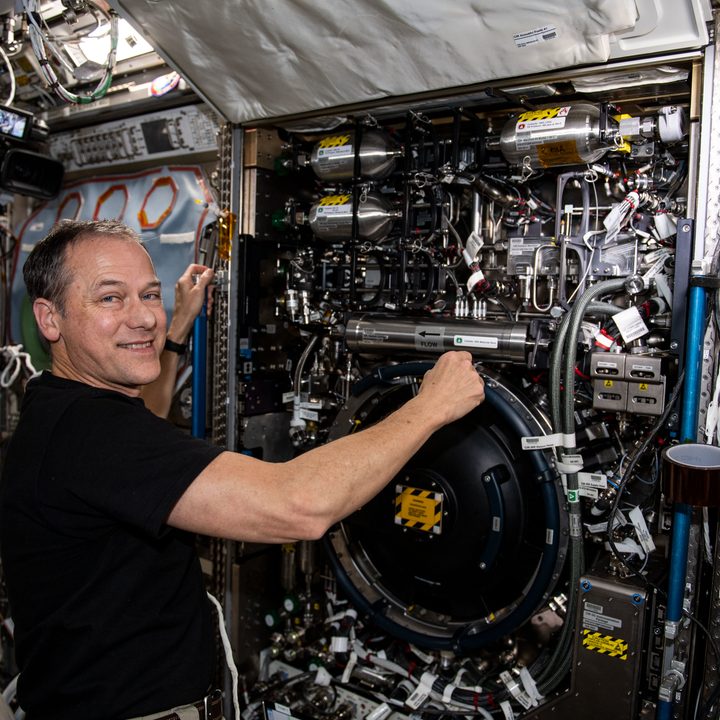
NASA astronaut and Expedition 66 Flight Engineer Thomas Marshburn configures the Combustion Integrated Rack to begin SoFIE operations.
NASA astronaut and Expedition 66 Flight Engineer Thomas Marshburn configures the Combustion Integrated Rack to begin SoFIE operations. NASA

“With NASA planning outposts on other planetary bodies like the Moon and Mars, we need to be able to live there with minimal risk,” said Paul Ferkul, SoFIE project scientist at NASA’s Glenn Research Center in Cleveland, in a statement. “Understanding how flames spread and how materials burn in different environments is crucial for the safety of future astronauts.”

Recommended Videos

A cargo ship launching today, Saturday, February 19, will carry a project called Solid Fuel Ignition and Extinction (SoFIE) to the ISS to be added to the station’s fire research chamber. As well as an experiment into fire suppression and fireproof materials, looking at how flammable materials like plexiglass and cotton-based fabrics are, it will also host experiments into how fire spreads.

“On Earth, gravity has a profound influence on flames, but in the reduced gravity of space, fire can behave unexpectedly and could be more hazardous,” Ferkul said.

The idea is to see how fire behaves when it is in the microgravity environment of the space station, as opposed to the gravity which is present here on Earth. This can then be used to predict how fire might behave in lower gravity environments like the moon or Mars.

“SoFIE builds on NASA’s prior flammability research,” said Lauren Brown, a project manager at Glenn. “Like other flame studies, this research will home in on how things ignite, burn, and are extinguished in space. It will provide a foundation for continuing human spaceflight beyond low-Earth orbit.”

Georgina Torbet
Georgina has been the space writer at Digital Trends space writer for six years, covering human space exploration, planetary…
Stunning close-up footage shows NASA’s moon rocket roaring to space
On its first crewed flight, NASA's lunar rocket displays its awesome power.
NASA's SLS rocket roars skyward at the start of the Artemis II mission on April 1, 2026.

As NASA’s Artemis II astronauts journey back to Earth following their breathtaking close encounter with the moon earlier this week, the space agency has just shared some stunning footage (below) of the rocket launch that sent the crew on its way on April 1.

The close-up tracking shot shows the awesome power of the Space Launch System (SLS) rocket’s four core RS-25 engines together and its two solid rocket boosters as the 98-meter-tall vehicle roars away from the launchpad at the Kennedy Space Center in Florida.

Read more
How to watch NASA’s moon crew splash down at end of historic mission
The Orion spacecraft's final moments before splashdown will be the most perilous of the entire mission.
Earth and the moon as seen from the Orion spacecraft during the Artemis II mission in April 2026.

The Artemis II astronauts have looped around the moon, captured some extraordinary imagery (above), set a slew of records, and are now on their way back to Earth.

The 10-day mission will reach its climax on Friday, April 10, during a dramatic homecoming that will see the Orion spacecraft enter our planet’s atmosphere at a speed of nearly 25,000 miles per hour.

Read more
Notable firsts of the Artemis II moon mission … so far
The Artemis II crew are now on their way home, so let's take a look at the mission's achievements so far.
The moon as seen from the Orion spacecraft during the Artemis II mission.

Having just looped around the moon in a historic flyby of our nearest neighbor, the Artemis II crew are now on their way back to Earth.

NASA’s Victor Glover, Reid Wiseman, and Christina Koch, along with the Canadian Space Agency’s Jeremy Hansen, launched aboard the Orion spacecraft from the Kennedy Space Center on April 1, lifted to space by the mighty SLS rocket.

Read more