  1. Home
  2. Space
  3. News

Biggest stellar black hole to date discovered in our galaxy

Add as a preferred source on Google

Black holes generally come in two sizes: big and really big. As they are so dense, they are measured in terms of mass rather than size, and astronomers call these two groups of stellar mass black holes (as in, equivalent to the mass of the sun) and supermassive black holes. Why there are hardly any intermediate-mass black holes is an ongoing question in astronomy research, and the most massive stellar mass black holes known in our galaxy tend to be up to 20 times the mass of the sun. Recently, though, astronomers have discovered a much larger stellar mass black hole that weighs 33 times the mass of the sun.

Not only is this new discovery the most massive stellar black hole discovered in our galaxy to date but it is also surprisingly close to us. Located just 2,000 light-years away, it is one of the closest known black holes to Earth.

Recommended Videos

“No one was expecting to find a high-mass black hole lurking nearby, undetected so far,” said lead researcher Pasquale Panuzzo of the National Centre for Scientific Research (CNRS) at the Observatoire de Paris — PSL, France, in a statement. “This is the kind of discovery you make once in your research life.”
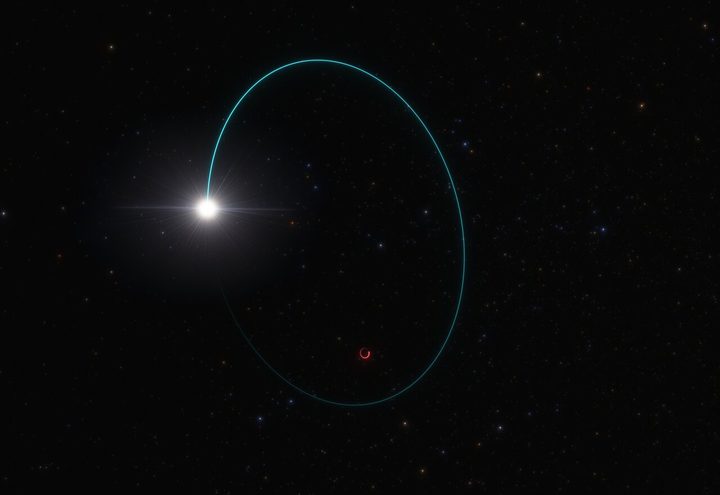
Astronomers have found the most massive stellar black hole in our galaxy, thanks to the wobbling motion it induces on a companion star. This artist’s impression shows the orbits of both the star and the black hole, dubbed Gaia BH3, around their common centre of mass. This wobbling was measured over several years with the European Space Agency’s Gaia mission. Additional data from other telescopes, including ESO’s Very Large Telescope in Chile, confirmed that the mass of this black hole is 33 times that of our Sun. The chemical composition of the companion star suggests that the black hole was formed after the collapse of a massive star with very few heavy elements, or metals, as predicted by theory.
Astronomers have found the most massive stellar black hole in our galaxy, thanks to the wobbling motion it induces on a companion star. This artist’s impression shows the orbits of both the star and the black hole, dubbed Gaia BH3, around their common center of mass. This wobbling was measured over several years with the European Space Agency’s Gaia mission. ESO/L. Calçada/Space Engine (spaceengine.org)

The monster black hole was discovered using data from Gaia, a space-based telescope that is collecting huge amounts of data to build a 3D map of the Milky Way. The astronomers were able to detect the black hole even though they could not see it directly because it is part of a binary pair, and it creates a wobbling motion in the orbit of its companion star.

To check their results, the team used more data from ground-based telescopes like the Very Large Telescope, which has a spectrograph instrument they used to study the companion star.

When two stars form a stellar binary, they tend to be made up of similar material. So by studying the composition of the companion star, the researchers could learn about what kind of star was present before it came to the end of its life and collapsed to become the black hole. They found that it is low in heavy elements, which astronomers refer to as metals, and it matches up with findings of other massive stellar black holes that have been detected in other galaxies.

Although the data from Gaia is traditionally released in large batches every few years, with the next data release set for 2025, the researchers chose to share this data early to give other groups the opportunity to study this massive and nearby black hole. The hope is that it could be studied in more depth by tools like the Very Large Telescope to learn more about whether the black hole is actively feeding on matter from its surroundings.

The research will be published in the journal Astronomy & Astrophysics.

Georgina Torbet
Georgina has been the space writer at Digital Trends space writer for six years, covering human space exploration, planetary…
Stunning close-up footage shows NASA’s moon rocket roaring to space
On its first crewed flight, NASA's lunar rocket displays its awesome power.
NASA's SLS rocket roars skyward at the start of the Artemis II mission on April 1, 2026.

As NASA’s Artemis II astronauts journey back to Earth following their breathtaking close encounter with the moon earlier this week, the space agency has just shared some stunning footage (below) of the rocket launch that sent the crew on its way on April 1.

The close-up tracking shot shows the awesome power of the Space Launch System (SLS) rocket’s four core RS-25 engines together and its two solid rocket boosters as the 98-meter-tall vehicle roars away from the launchpad at the Kennedy Space Center in Florida.

Read more
How to watch NASA’s moon crew splash down at end of historic mission
The Orion spacecraft's final moments before splashdown will be the most perilous of the entire mission.
Earth and the moon as seen from the Orion spacecraft during the Artemis II mission in April 2026.

The Artemis II astronauts have looped around the moon, captured some extraordinary imagery (above), set a slew of records, and are now on their way back to Earth.

The 10-day mission will reach its climax on Friday, April 10, during a dramatic homecoming that will see the Orion spacecraft enter our planet’s atmosphere at a speed of nearly 25,000 miles per hour.

Read more
Notable firsts of the Artemis II moon mission … so far
The Artemis II crew are now on their way home, so let's take a look at the mission's achievements so far.
The moon as seen from the Orion spacecraft during the Artemis II mission.

Having just looped around the moon in a historic flyby of our nearest neighbor, the Artemis II crew are now on their way back to Earth.

NASA’s Victor Glover, Reid Wiseman, and Christina Koch, along with the Canadian Space Agency’s Jeremy Hansen, launched aboard the Orion spacecraft from the Kennedy Space Center on April 1, lifted to space by the mighty SLS rocket.

Read more