
Ready to scan the night sky to look for evidence of dark matter, identify near-Earth asteroids, and much more, the camera for the upcoming Vera Rubin Observatory is now complete. This is the world’s largest digital camera for astronomy, with a staggering 3,200 megapixels, and it will be placed in the Rubin Observatory in Chile.
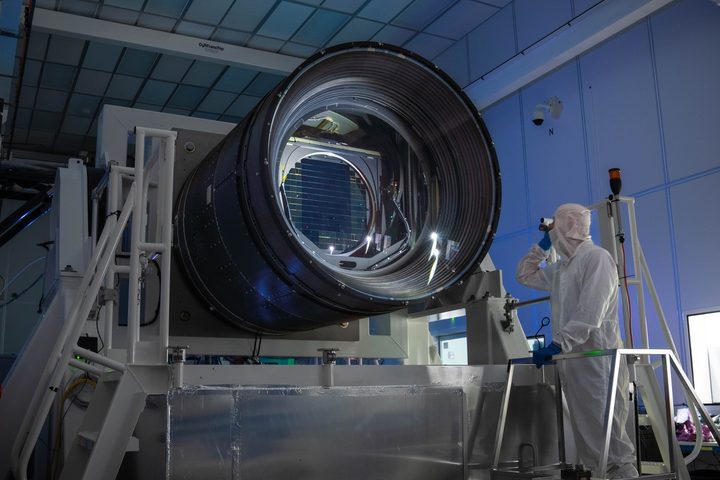
The camera is vast, weighing around 3 metric tons, making it about the same size and mass as a small car. With a huge front lens that is 5 feet across, it will be able to take incredibly detailed images of large sections of the sky. Built at the Department of Energy’s SLAC National Accelerator Laboratory (SLAC), it will be used for the Legacy Survey of Space and Time (LSST), a 10-year project to image the southern sky and spot transient objects like supernovae.
“With the completion of the unique LSST Camera at SLAC and its imminent integration with the rest of Rubin Observatory systems in Chile, we will soon start producing the greatest movie of all time and the most informative map of the night sky ever assembled,” said Director of Rubin Observatory Construction, Željko Ivezić of the University of Washington, in the statement.
The huge scale of the camera makes it incredibly powerful, able to capture a very wide field of view (meaning it can take in a large portion of the sky with each observation) and to resolve very fine detail.
“Its images are so detailed that it could resolve a golf ball from around 25 kilometers (15 miles) away while covering a swath of the sky seven times wider than the full Moon. These images, with billions of stars and galaxies, will help unlock the secrets of the Universe,” said SLAC professor and Rubin Observatory Deputy Director and Camera Program Lead Aaron Roodman.
The camera has been tested at SLAC and is now ready to be shipped to Chile, where it will be installed onto the Simonyi Survey Telescope later this year. This telescope, as part of the Rubin Observatory, is located at the top of the Cerro Pachón mountain — a location that brings some challenges to installation.
Rubin is set to begin its survey in 2025 when it will scan the sky to learn about the movements of distant galaxies to help uncover information about dark matter and other key topics in astronomy.
“More than ever before, expanding our understanding of fundamental physics requires looking farther out into the universe,” said Kathy Turner, program manager for the DOE’s Cosmic Frontier Program. “With the LSST Camera at its core, Rubin Observatory will delve deeper than ever before into the cosmos and help answer some of the hardest, most important questions in physics today.”


