  1. Home
  2. Space
  3. News

The first views of the eclipse are coming in, and they’re stunning

Add as a preferred source on Google

Eclipse mania is gripping swaths of the U.S. as today is the day that a total solar eclipse passes across the country from Texas to Maine. The eclipse began in Mexico at 2:07 p.m. ET and is sweeping up and across the U.S., with plenty of excellent views despite concerns about the weather in many places.

NASA is live-streaming views of the eclipse captured from various locations along the path of totality, which is a great way to enjoy the event if you are outside the region where it is visible.

2024 Total Solar Eclipse: Through the Eyes of NASA (Telescope Feed)

Views of the eclipse so far have been shown from Mexico, Arkansas, Texas, Illinois, and Ohio. The eclipse will soon hit the northeastern part of the country, with Pennsylvania, New York, and New England eclipses coming up shortly.
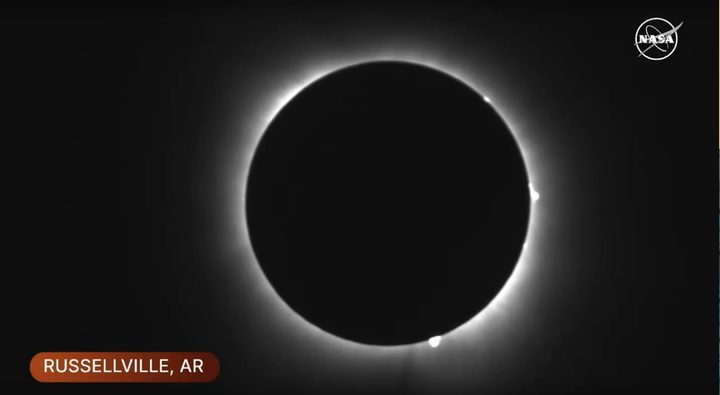
Still from the NASA livestream of the total eclipse in Russellville, Arkansas on March 8, 2024.
A still image from the NASA live stream of the total eclipse in Russellville, Arkansas, on March 8, 2024. NASA TV

If you’re heading out to watch the eclipse in person, be sure to be safe and use eclipse glasses or make a pinhole camera to observe the eclipse indirectly. If you are in the path of totality, you can take your eclipse glasses off once the sun is fully eclipsed, but make sure to put them back on as soon as the sun starts to brighten again.

Recommended Videos

If you are outside the path of totality and are seeing a partial eclipse, then you should keep your eclipse glasses on the entire time. Also, don’t try to observe the eclipse using a camera, binoculars, or a telescope unless you have special equipment for doing so. NASA has more advice on how to stay safe and enjoy the event.

Eclipses happen when the moon passes between the Earth and the sun, temporarily blocking out the sun’s light. During this time, you can see the sun’s atmosphere, or corona, and scientists use this opportunity to observe the stellar atmosphere and learn more about the sun.

An eclipse is total when the moon totally covers the face of the sun, making it dark and cold for a few minutes in the middle of the day. This tends to cause unusual natural activity, with animals changing their behavior and weather systems being disrupted as well. If you are observing the eclipse, NASA requests that you make note of any effects that you see on wildlife and other natural phenomena to assist with research into the topic.

The last major eclipse in the U.S. was in August 2017, when a total solar eclipse was visible across 14 states. There won’t be another eclipse that covers this much of the U.S. until 2044, as today’s path of totality is 115 miles wide, with 32 million people in the U.S. living within the path.

Georgina Torbet
Georgina has been the space writer at Digital Trends space writer for six years, covering human space exploration, planetary…
Stunning close-up footage shows NASA’s moon rocket roaring to space
On its first crewed flight, NASA's lunar rocket displays its awesome power.
NASA's SLS rocket roars skyward at the start of the Artemis II mission on April 1, 2026.

As NASA’s Artemis II astronauts journey back to Earth following their breathtaking close encounter with the moon earlier this week, the space agency has just shared some stunning footage (below) of the rocket launch that sent the crew on its way on April 1.

The close-up tracking shot shows the awesome power of the Space Launch System (SLS) rocket’s four core RS-25 engines together and its two solid rocket boosters as the 98-meter-tall vehicle roars away from the launchpad at the Kennedy Space Center in Florida.

Read more
How to watch NASA’s moon crew splash down at end of historic mission
The Orion spacecraft's final moments before splashdown will be the most perilous of the entire mission.
Earth and the moon as seen from the Orion spacecraft during the Artemis II mission in April 2026.

The Artemis II astronauts have looped around the moon, captured some extraordinary imagery (above), set a slew of records, and are now on their way back to Earth.

The 10-day mission will reach its climax on Friday, April 10, during a dramatic homecoming that will see the Orion spacecraft enter our planet’s atmosphere at a speed of nearly 25,000 miles per hour.

Read more
Notable firsts of the Artemis II moon mission … so far
The Artemis II crew are now on their way home, so let's take a look at the mission's achievements so far.
The moon as seen from the Orion spacecraft during the Artemis II mission.

Having just looped around the moon in a historic flyby of our nearest neighbor, the Artemis II crew are now on their way back to Earth.

NASA’s Victor Glover, Reid Wiseman, and Christina Koch, along with the Canadian Space Agency’s Jeremy Hansen, launched aboard the Orion spacecraft from the Kennedy Space Center on April 1, lifted to space by the mighty SLS rocket.

Read more