  1. Home
  2. Space
  3. News

Supercomputer simulates the entire universe, from Big Bang to now

Add as a preferred source on Google

An international team of researchers has produced the most accurate simulation of the universe to date, using supercomputers to model the entire history of the universe from the Big Bang to the present day.

The project, named SIBELIUS-DARK, created a simulation that reaches out 600 million light-years from Earth, including 130 billion simulated particles. It was created using the DiRAC COSmology MAchine (COSMA) supercomputer from Durham University.
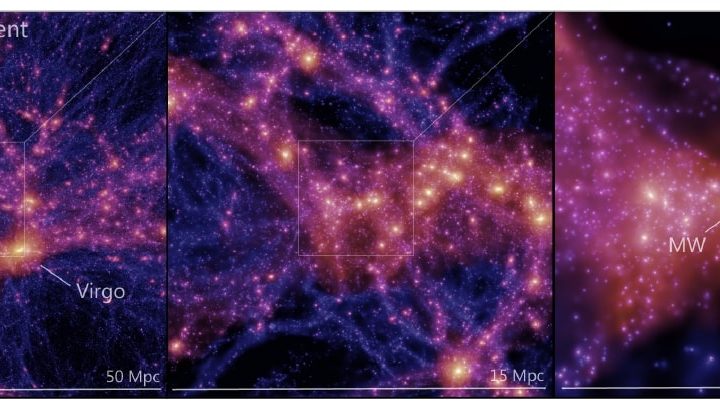
Simulation of the Milky Way galaxy and the Andromeda galaxy (known as M31).
At the very center of the simulation (and our own Universe) is the Milky Way galaxy, and our nearest massive neighbor, the Andromeda galaxy (known as M31). Dr Stuart McAlpine

The simulation can help answer questions in cosmology, as well as visualize phenomena like dark matter by seeing the way it clumps into regions called halos. “The simulations simply reveal the consequences of the laws of physics acting on the dark matter and cosmic gas throughout the 13.7 billion years that our universe has been around,” explained one of the authors, Carlos Frenk of Durham University, in a statement.

Recommended Videos

The researchers worked on the simulation by using algorithms that reproduced our local area of the universe, centered on Earth, spreading out to cover our Milky Way and also nearby galaxies like the Andromeda galaxy. This was based on a model called the Cold Dark Matter model, which is a standard model in cosmology.

“The fact that we have been able to reproduce these familiar structures provides impressive support for the standard Cold Dark Matter model and tells us that we are on the right track to understand the evolution of the entire Universe,” said Frenk. Co-author Matthieu Schaller from Leiden University concurred, adding: “This project is truly ground-breaking. These simulations demonstrate that the standard Cold Dark Matter Model can produce all the galaxies we see in our neighbourhood. This is a very important test for the model to pass.”

The researchers now want to use the model to test cosmological models further, hoping to understand more about how the universe came to be the way it is. “By simulating our Universe, as we see it, we are one step closer to understanding the nature of our cosmos,” said lead author Stuart McAlpine of the University of Helsinki. This project provides an important bridge between decades of theory and astronomical observations.”

The research is published in the journal Monthly Notices of the Royal Astronomical Society.

Georgina Torbet
Georgina has been the space writer at Digital Trends space writer for six years, covering human space exploration, planetary…
Stunning close-up footage shows NASA’s moon rocket roaring to space
On its first crewed flight, NASA's lunar rocket displays its awesome power.
NASA's SLS rocket roars skyward at the start of the Artemis II mission on April 1, 2026.

As NASA’s Artemis II astronauts journey back to Earth following their breathtaking close encounter with the moon earlier this week, the space agency has just shared some stunning footage (below) of the rocket launch that sent the crew on its way on April 1.

The close-up tracking shot shows the awesome power of the Space Launch System (SLS) rocket’s four core RS-25 engines together and its two solid rocket boosters as the 98-meter-tall vehicle roars away from the launchpad at the Kennedy Space Center in Florida.

Read more
How to watch NASA’s moon crew splash down at end of historic mission
The Orion spacecraft's final moments before splashdown will be the most perilous of the entire mission.
Earth and the moon as seen from the Orion spacecraft during the Artemis II mission in April 2026.

The Artemis II astronauts have looped around the moon, captured some extraordinary imagery (above), set a slew of records, and are now on their way back to Earth.

The 10-day mission will reach its climax on Friday, April 10, during a dramatic homecoming that will see the Orion spacecraft enter our planet’s atmosphere at a speed of nearly 25,000 miles per hour.

Read more
Notable firsts of the Artemis II moon mission … so far
The Artemis II crew are now on their way home, so let's take a look at the mission's achievements so far.
The moon as seen from the Orion spacecraft during the Artemis II mission.

Having just looped around the moon in a historic flyby of our nearest neighbor, the Artemis II crew are now on their way back to Earth.

NASA’s Victor Glover, Reid Wiseman, and Christina Koch, along with the Canadian Space Agency’s Jeremy Hansen, launched aboard the Orion spacecraft from the Kennedy Space Center on April 1, lifted to space by the mighty SLS rocket.

Read more