  1. Home
  2. Space
  3. News

Why this week’s moon mission is so special for Jeremy Hansen

We're only days away from the first crewed Artemis mission!

Add as a preferred source on Google
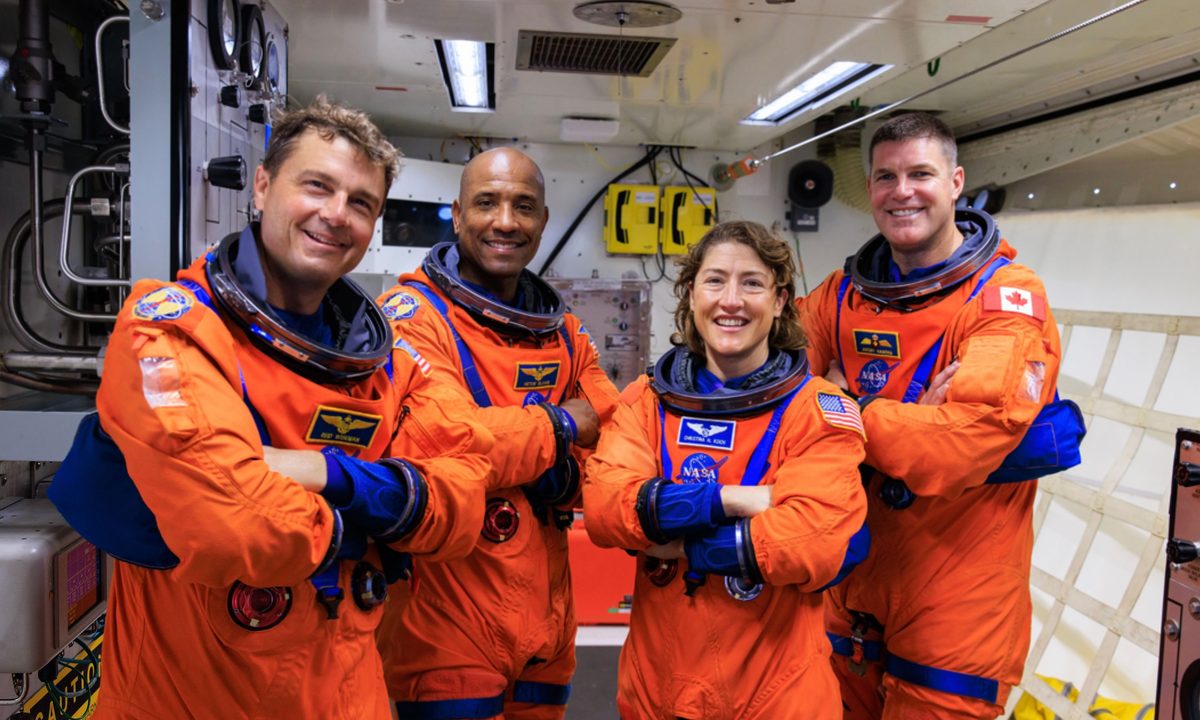
Artemis II NASA astronauts (left to right) Reid Wiseman, Victor Glover, and Christina Koch, and CSA (Canadian Space Agency) astronaut Jeremy Hansen
Artemis II NASA astronauts (left to right) Reid Wiseman, Victor Glover, and Christina Koch, and CSA (Canadian Space Agency) astronaut Jeremy Hansen. NASA

NASA is engaged in the final preparations for the much-anticipated Artemis II mission that will send astronauts toward the moon for the first time in more than five decades.

The space agency is targeting 6:24 p.m. ET on Wednesday, April 1, for the launch from the Kennedy Space Center in Florida.

Recommended Videos

The four crew members — NASA astronauts Reid Wiseman, Victor Glover, and Christina Koch, together with CSA (Canadian Space Agency) astronaut Jeremy Hansen — will travel aboard an Orion spacecraft launched by NASA’s formidable SLS (Space Launch System) rocket.

After a couple of days in low-Earth orbit checking the spacecraft’s systems, the crew will send the Orion on course for a rendezvous with our nearest neighbor. The 10-day voyage won’t touch down on the moon but instead fly around it before returning home.

The mission is of course super special for every single one of those crew members, but for Hansen it comes with added personal impact as the flight will mark his very first time in space.

While Wiseman, Glover, and Koch each flew to the International Space Station (ISS) on their first orbital experience, Hansen will be traveling several hundred thousand miles further from Earth for his debut space ride.

Hansen will also become the first non-American, and first Canadian, to travel to the moon, a historic achievement that will cement his place in history and make him a national hero.

“I just want Canadians to feel that pride,” Hansen told CBC when he was announced as one of the Artemis II crew members in 2023. “I just want Canadians to realize, hey, we are up to big things here in Canada and can accomplish the seemingly impossible if we believe in ourselves.”

Artemis II is also a groundbreaking mission for Glover and Koch, who are about to become the first Black person and the first woman to travel to the moon — major milestones in their own right.

With only days to go before the targeted launch date, the four crew members are now in quarantine, poring over the flight plan and making sure they’re all set for the mission of a lifetime.

Want to know more about the mission? Then watch NASA’s video showing exactly how it expects the flight to unfold.

Trevor Mogg
Contributing Editor
Not so many moons ago, Trevor moved from one tea-loving island nation that drives on the left (Britain) to another (Japan)…
Scientists have found a hidden galaxy inside the Milky Way, and they’re calling it Loki
A lost dwarf galaxy may be hiding inside the Milky Way.
milky-way-hidden-galaxy-loki

Our home galaxy has a secret buried inside. A new study published in the Monthly Notices of the Royal Astronomical Society suggests that the Milky Way swallowed an ancient dwarf galaxy billions of years ago, and its stellar remains are still embedded within ours.

Researchers have named this lost galaxy Loki, after the Norse trickster god, and the name is quite fitting because it remained hidden in plain sight for a very long time.

Read more
NASA aims September launch for Roman space telescope and it’s going to be a huge shift
An earlier target for Roman means one of NASA’s most ambitious observatories is getting close, with the potential to open a huge new era in space discovery
Machine, Wheel, Astronomy

NASA is now aiming to launch the Nancy Grace Roman Space Telescope as soon as early September 2026, a faster timeline than its earlier commitment to fly no later than May 2027. That alone makes this one of the agency’s most important missions to watch over the next few months.

The reason is simple, Roman is built to scan vast parts of the sky with sharp infrared vision.

Read more
Blue Origin successfully re-uses a New Glenn rocket for the first time ever
Blue Origin achieves first New Glenn reflight despite payload setback
Blue Origin

Blue Origin has achieved a major milestone in its spaceflight ambitions by successfully reusing a booster from its heavy-lift New Glenn rocket for the first time. The historic launch, conducted on April 19, marks a significant step forward for Jeff Bezos’ space company as it seeks to compete with rivals like SpaceX in the rapidly evolving commercial launch market.

A Milestone With A Mixed Outcome

Read more