
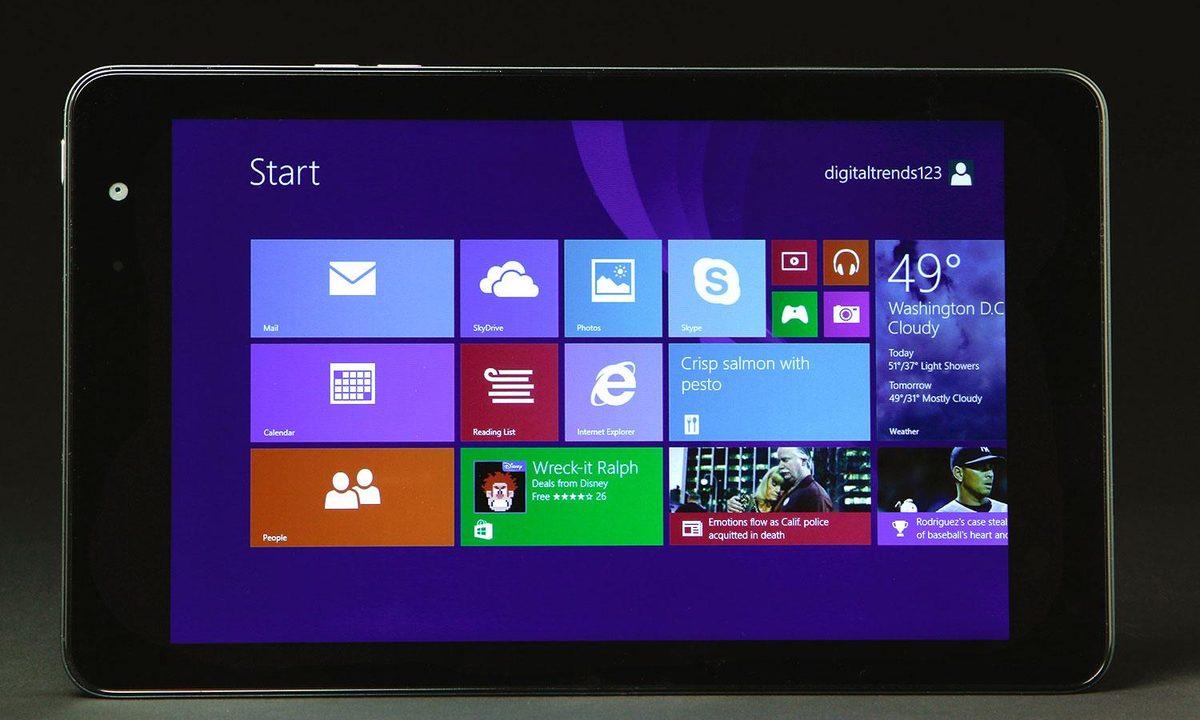
“Dell’s $300 Windows 8 tablet has a bright IPS screen and solid build. But the ability to run Windows desktop software doesn’t overcome a limited tablet app selection and Windows 8.1’s difficulties on a small screen.”
- Nice IPS screen
- Active Stylus support
- Build quality feels solid
- Decent battery life
- Stylus sold separately
- No HDMI-out
- We still need (way) more Win 8 apps
- Weaker performance than some ARM tablets
“Why you can trust Digital Trends – We have a 20-year history of testing, reviewing, and rating products, services and apps to help you make a sound buying decision. Find out more about how we test and score products.“
With Windows PC sales in free-fall as tablet sales soar, the big-name PC makers are desperately trying to woo customers back from their iPads and Android slates.
Convertible laptops, in their myriad shapes and sizes, have been a moderate success, thanks to the likes of Lenovo’s Yoga and Asus’ T100. But their complex designs mean prices are generally high, leaving many potential customers still turning to tablets.
From a specs standpoint, most of these Windows tablets are mostly the same on the inside.
From a specs standpoint, most of these small Windows tablets are pretty much the same on the inside. The most recent models run on Intel’s much-improved ‘Bay Trail’ Atom processors, have 2GB of RAM, start out with a cramped 32GB of internal storage, have sub-1080p screens, and are priced between $300 and $400.
As these new Windows tablets go, Dell’s Venue 8 Pro is priced on the low-end, starting at $300. It’s also comfortable to hold, thanks to a textured plastic back, and sports a digitizing layer for active stylus support. But the stylus isn’t included in the base price, which is a shame since this feature is a big part of what sets the Venue 8 Pro apart from similar options, like Lenovo’s Miix 2 and Acer’s W4.
Solid feel, but heavy
The Venue 8 Pro definitely doesn’t feel like a budget device. Its back is made of a grippy textured plastic, and there’s no discernable flex. Silver metal power and volume buttons live on the left edge (when holding the device in portrait orientation), near the top, where you’ll also find the Micro USB/charging port. Further down on the same side is a MicroSD card slot, housed behind a door. You’ll want to add some storage, especially if you opt for the 32GB base model; there’s only about GB of storage space available out of the box. As we found out when trying to install our benchmark software, that space fills up quickly.
The bottom of the device (or the left edge when holding it in landscape) houses the tablet’s single speaker. Sound output gets fairly loud (for a tablet), but quality isn’t great – especially at max volume, where there’s a fair amount of distortion.


The left edge lacks any ports or buttons, but on the top sits a headphone jack and the Windows Start button. The start button’s placement here is out of the ordinary; it’s usually found on the front, below the screen. There isn’t really enough bezel along the sides of the screen for a button, though, so Dell decided to add a physical button up top. This certainly takes some getting used to. We found ourselves instead just swiping in from the right with our thumb to bring up the Charms Bar, and tapping on the Start Button there.
The Venue 8 Pro weighs in at 0.87lbs, which is decidedly heavier than the 2013 Nexus 7 (0.64 pounds), and Retina Display iPad Air (0.73 pounds). Granted, the Nexus 7 has a screen that’s an inch smaller, so it’s not surprising that it’s lighter. But we did notice the Dell’s weight much more while lying in bed reading Flipboard and Zinio magazines than we did with the Nexus 7. But the Nexus 7 can’t run windows software, so you do get more functionality for the extra weight.
A nice screen, but no 1080p
Windows tablets have a problem when it comes to screen resolution. Increasingly, Android and Apple tablets sport resolutions at or above 1080p. Drop one of those screens into a small Windows tablet, and things will look great in the Modern UI where the apps live. But jump into the traditional Windows desktop, and buttons and menus become too small.
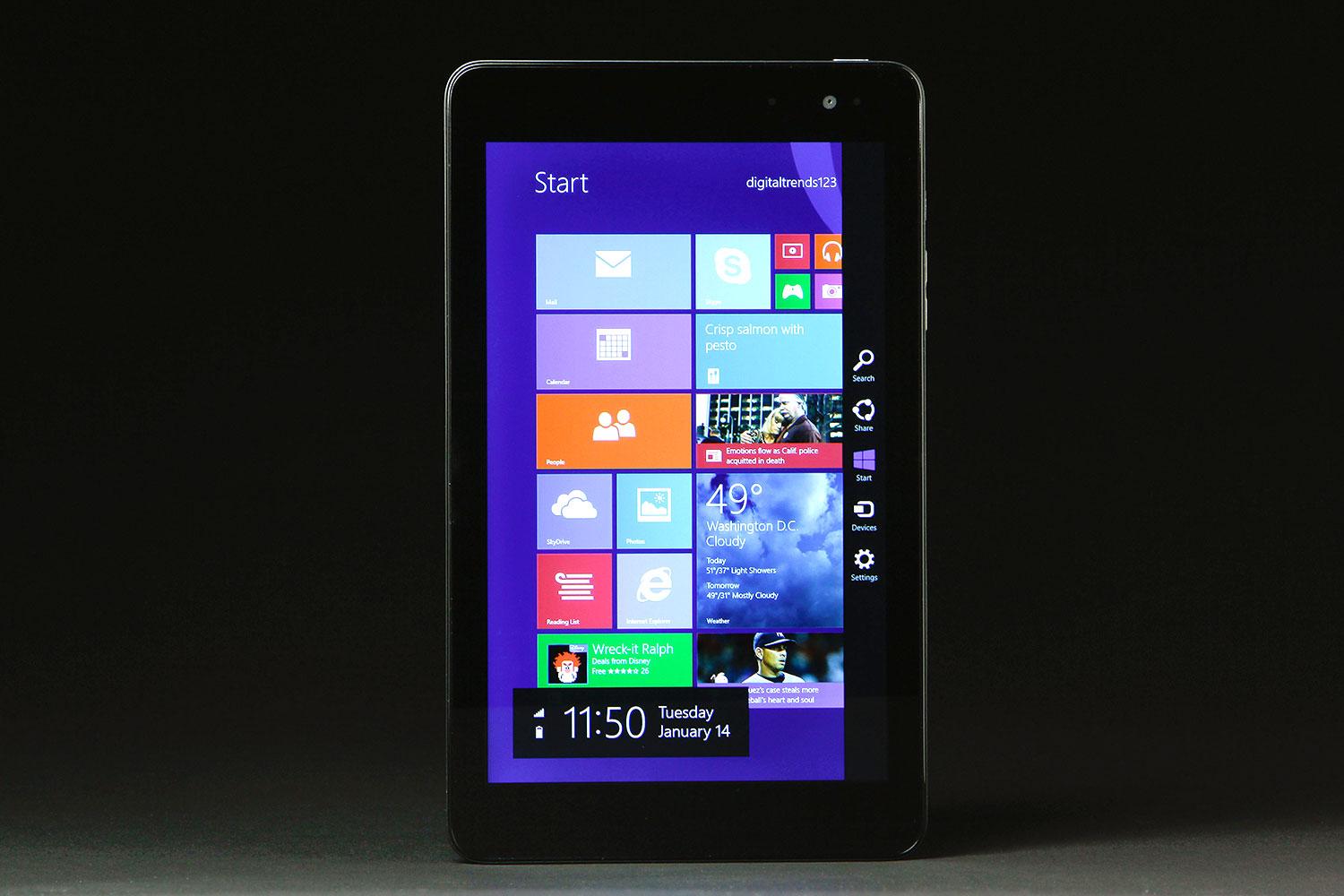
Even with the 1,280 x 800 pixel screen in the Venue 8 Pro, many of the clickable desktop items (like things in the system tray) are frustratingly small. You can fix that by upping the OS scaling in settings, but the tablet doesn’t do this by default. And assuming you’re savvy enough to change the scaling setting, the end result, while it looks better, makes the traditional Windows environment feel cramped, as if you’re using a low-resolution screen.
Dell does get credit, though, for delivering a high-quality IPS screen in the Venue 8 Pro, with no viewing angle issues and plenty of brightness. But we did find the adaptive brightness setting, which is enabled by default, to be too distracting – often raising and lowering the brightness by large amounts for no discernable reason. We switched it off.
Win 8.1 works well, but we still need more (and better) apps
Windows 8.1 works pretty well at a basic level as a tablet OS, giving you a now-familiar tiled interface for your frequent apps, while all other programs and apps are just a swipe (up from the bottom) away. Multitasking also works pretty well, with the ability to snap multiple apps to separate portions of the screen, or swipe in from the left to quickly cycle through open apps.


The real problem is that old Windows 8 refrain: the lack of apps in the Windows Store. Granted, app selection has gotten much better in the last year or so, and big-name apps keep arriving here and there. Many popular apps, like Flipboard, Facebook, Twitter, Mint, Netflix, and YouTube, are now available. But as we reported last November, app development for Windows 8 seems to be falling, rather than rising. And the current count of something above 125,000 available apps is a far cry from the more than a million apps available on both Android and iOS, with notable absences like Gmail, Instagram, and many touch-based games.
The Venue 8 Pro is cheap, but definitely doesn’t feel like a budget device.
Numbers aren’t everything, either. Windows 8 apps don’t appear to get updates as often as their counterparts on other operating systems. As a result, apps like Windows 8 Facebook look dated, and many others lack the stability or features of found on other operating systems.
We will say, though, that Web browsing works very well on the Venue 8 Pro. The combination of Internet Explorer 11 and Intel’s Atom processor make for as smooth a browsing experience as any we’ve had on any mobile device.
Camera complications
Tablet cameras typically aren’t great. And the 5-magapixel rear-facing shooter here is no exception (there’s also a 2-megapixel camera up front for video chats). But really, we don’t care. Tablets are too big and unwieldy to make for good cameras anyway, whether you care about looking silly or not. The camera here is passable, at best. Daytime shots look all right, but as soon as the light dims, noise becomes a big problem.
The camera wasn’t reliable on our unit, either. Often after taking a few shots, the camera app locked up, with a grey screen showing up where the camera image should be on the screen. This issue would often clear up after a few minutes, or after a reboot. But at least once, after a camera lockup, the tablet suffered a blue-screen crash and rebooted.


These crashes and reboots appear to be a storage issue. Once we freed up a few gigabytes of space on the internal drive, the camera functioned normally. But Windows failed to make this issue clear. And unless you opt for the 64GB model (which costs $50 more), it’s extremely easy to fill up the tablet’s boot drive. We added a few apps, a couple games, and two benchmark tests, and the drive nearly burst at the seams.
Specs and performance
A lack of storage space also complicated our benchmark testing on the Venue 8 Pro. We couldn’t begin to fit our full Windows benchmark folder on the tablet’s solid-state drive. Installing one benchmark at a time on the system also proved problematic. We couldn’t get PCMark 8 to install at all. PCMark 7 would install, but would error out with a non-specific error. We started uninstalling as many apps as possible, until we had 3GB or so of free space, and then we were finally able to get the benchmark going.
Unless you opt for the 64GB model, it’s extremely easy to fill up the tablet’s boot drive.
Bottom line: The Venue 8 Pro should be able to run most traditional Windows programs, but it often won’t run more demanding programs, like Photoshop, particularly well. In fact, on more than one occasion while on the Desktop, we got a warning about low memory, asking us to close programs and/or reboot. It’s best to limit your expectations on the Windows software front and stick to things like Office and other fairly lightweight programs. If you’re going to run Windows programs at all, you should definitely opt for a model with at least 64GB of storage.
On the graphics front, the Venue 8 Pro’s Intel HD graphics stand up well to the Nexus 7. In 3DMark’s cross-platform Ice Storm Extreme test, the Dell tablet scored 8,787, while the 2013 Nexus 7 scored 7,562. But newer mobile devices with Snapdragon 800 chips tend to have more graphics muscle. Nokia’s Lumia 2520, for instance, scored about 15,000 on the same 3DMark test.
Great battery life for a laptop, but nothing special for a tablet
We were also able to get our Windows-based Battery Eater benchmark up and running on the Venue 8 Pro. And in the low-drain Reader’s test, which better equates to the kinds of things most users will do with a tablet, the tablet lasted 8 hours and 26 minutes with screen brightness set to 70 percent. By comparison, the Acer V5 budget laptop we mentioned earlier lasted just 4 hours and 21 minutes on the same test.
But Dell’s claim of “9.9 hours” of longevity is about even with Apple’s 10-hour iPad Air claim. And we got 11-12 hours of use from Nokia’s Lumia 2520 tablet. By tablet standards, the Venue 8 Pro lasts about as long as we’d expect, but not much more.
Conclusion
If you’re on the lookout for a solid 8-inch Windows tablet for running a mix of apps and Windows programs, Dell’s Venue 8 Pro is a solid choice at a reasonable price – especially since we’ve recently seen it on sale at Staples for $280. But it isn’t alone in its affordability: Lenovo’s similarly sized and specced 8-inch Miix 2 is available at Best buy for even less—currently $250. We can’t vouch for the Miix 2’s build quality or screen (both pretty good on the Venue 8 Pro). But the Miix 2 has a Micro HDMI-out port for easily connecting to a second screen, which the Dell tablet lacks.
With any Windows tablet, we’d recommend paying extra for at least 64GB of on-device storage. And unless you’re dead-set on the 8-inch form factor, we think you should also consider a larger tablet, like Dell’s own Venue 11 Pro, which starts at $500, or HP’s Omni 10 ($400) if you plan on regularly running traditional Windows software.
As for those on the fence about picking up a Windows 8 tablet or an Android or Apple device, unless you need compatibility with Windows software, we recommend waiting another generation for Windows 8 to mature as a tablet platform. Windows app selection isn’t at the point that we’d consider the bare minimum (although it is getting close), and iOS and Android feel much more mature in the little areas that really add up, like camera settings, customizability (in Android, at least), email, and ease of access to settings like screen brightness.
Highs
- Nice IPS screen
- Active Stylus support
- Build quality feels solid
- Decent battery life
Lows
- Stylus sold separately
- No HDMI-out
- We still need (way) more Win 8 apps
- Weaker performance than some ARM tablets


