
Gray Powell might as well have left nuclear launch codes on the steps of the Kremlin.
When the tipsy Apple engineer stumbled out of Gourmet Haus Stadt in Redwood City back in 2010, leaving behind an iPhone 4 prototype, he took Apple’s notoriously impenetrable veil of secrecy with him.
Days later, the press had dissected every last detail of Apple’s new phone, and there may have been no one more crushed by the leak – besides the red-faced engineer – than Ken Tomita and Joe Mansfeld.
If you’re going to stand on Apple’s shoulders, you had better be quick on your feet.
And on the day it launched, the iPhone 4 leaked.
“Nobody bought any,” Tomita recalls. “Basically no one cared about the iPhone 3G anymore, everyone started thinking about the iPhone 4 prematurely because of the leak.”
The iPhone 4’s flat shape made the complex techniques Grove had developed to deal with the swooping 3G obsolete overnight. It also taught them an important lesson: If you’re going to stand on Apple’s shoulders, you had better be quick on your feet.
The incident – and its agonizing lesson – became part of Grove’s DNA as it has sprouted from scrappy startup to one of the most nimble players in the considerable Apple ecosystem – a space estimated to be worth $5 billion by 2015. This fall, the very same day Apple announced it’s new iPad Mini Retina, Grove unveiled an impressive new case for it, sporting a unique articulated cover made from laser-cut bamboo. They had designed it in less than a week.
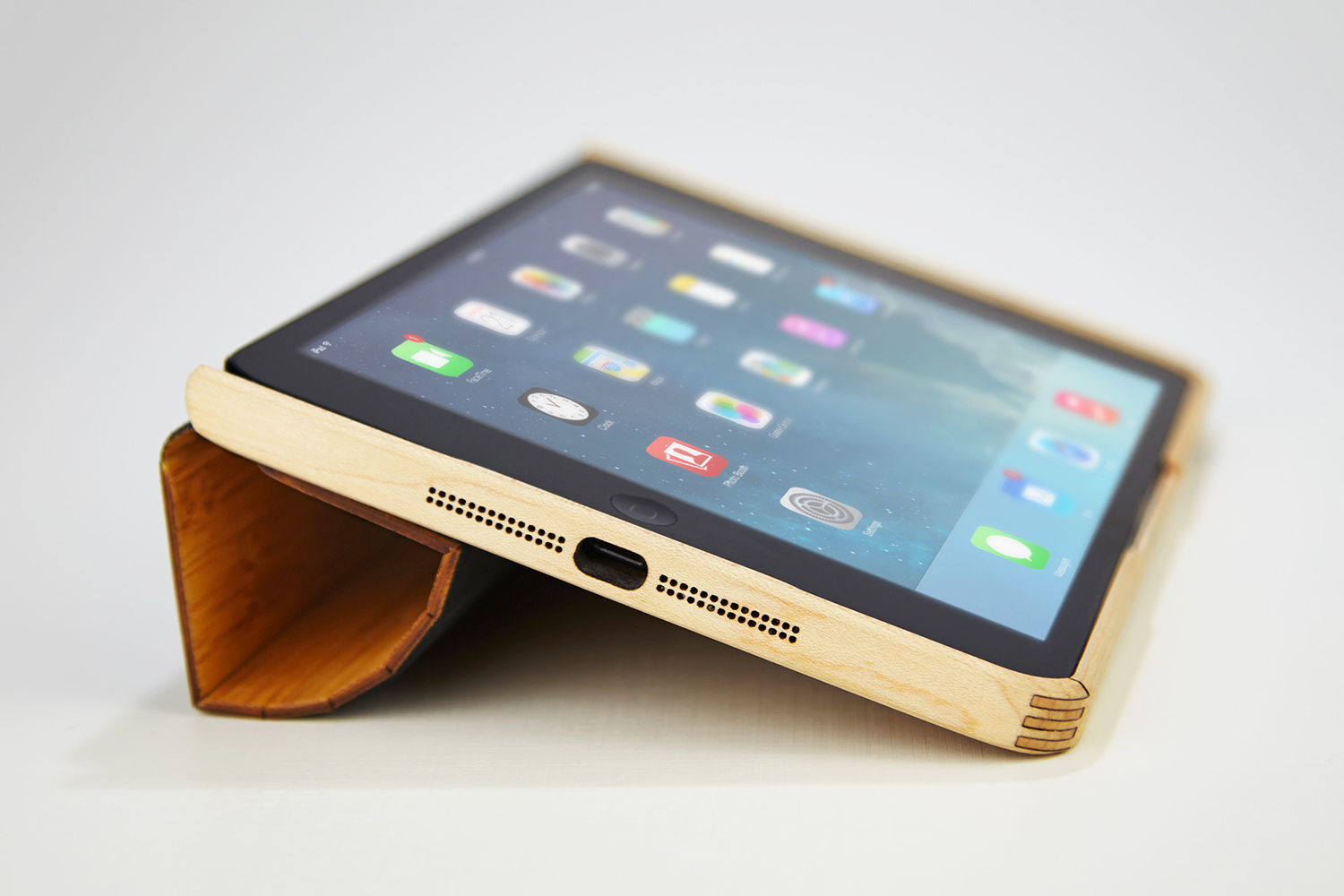


It started – once again – with a leak. Only this time they were ready for it. “Apple isn’t as tight with their new product launches anymore,” Joe grins. “I’ve noticed that everything leaks three to six months before the products even come out, which is good for us.”
Apple’s loose lips allowed Grove to start working on the case for the iPad Mini before it even officially existed. “The process of developing this was pretty nuts,” Mansfield says, showing off the final model. “We basically figured out the specs for the new iPad and worked around the clock to make a photo-ready prototype.”
The design is as clever as it is undeniably attractive. Rather than milling the whole thing out of a single chunk of material, it’s built more like furniture – an exercise near and dear to Tomita, who worked as a carpenter before he started Grove. Where two pieces of wood intersect, Grove uses a finger joint not unlike something you might see used to construct a desk drawer, but cut by lasers and rounded off to match the profile of the iPad.
“Apple doesn’t give specs to anyone,” he explains. “We either have to guess or be really fast. We’re really fast.”
The edges are constructed of rock maple – the same ultra-tough wood that gets knocked silly in bowling pins and stomped around in skateboard decks. But Grove hasn’t abandoned its signature bamboo – a thin sheet of it backed by microsuede forms the cover. Precisely spaced laser cuts allow the bamboo to flex in a controlled way, rolling back into a cylinder thats acts as either a beefy, book-like handle, or a stand.
Without a finished product in front of them until just days before it had to go on sale, Grove’s Web team had to scramble to get the word out, too. “We basically had one day for our team to photograph this thing, touch up the photos and build the site,” Tomita says.
The end result: One of the best-looking, most original iPad Mini 2 cases on the market appeared online the same day as the Retina-screened iPad Mini.
If Grove’s latest products, seem radically different from where they were just four years ago, it’s because the company is too. They’ve inhabited three different locations in as many years, and grown from two guys with a CAM machine to 16.
That’s still tiny compared to monoliths like Belkin and Incipio, but they learned to flip the script and use their small team to outmaneuver the big guys. “When a new iPhone comes out, everyone wants it, and everyone wants it fast,” says Tomita. “I think that actually plays to our strength.”
“Apple doesn’t give specs to anyone,” he explains. “We either have to guess or be really fast. We’re really fast.” Ideas can go go from napkin to wood in a matter of hours because the same guys that dream stuff up have the capability to build it. “When Joe and I are working well together, it just clicks,” Tomita says. “We don’t have bureaucracy.” And the manufacturing process can be equally efficient. “I don’t have to fly to China and wait for all these molds to get made and stuff like that.”
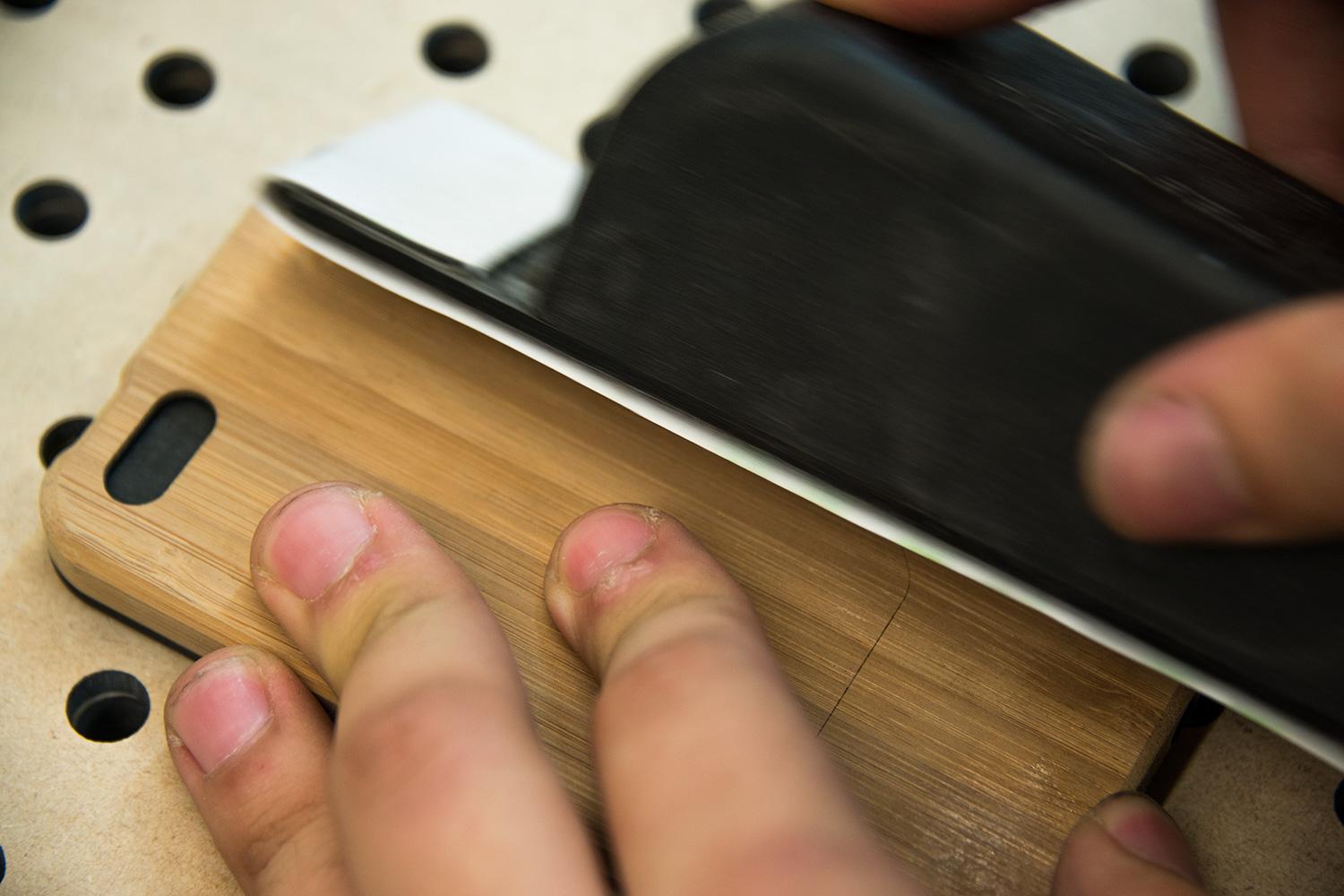


Part of that seat-of-the-pants building process plays to their personalities. “Both me and Joe are more like spontaneous guys,” Tomita says. “We’re good at just being thrown in there and just doing things on the fly. I’m used to doing project work for festivals and stuff. You only have like a week, you just have to make stuff up and go with it.”
The detritus from this unconstrained creative process litters Grove’s office: whimsical laser cuttings of bears and gears, pennant lamps made from bamboo, a tiny ball-in-maze game made from laminated plywood. At Mansfield’s standing desk, a lamp made from two entwined pieces of bamboo droops just a bit too low from the laser perforations that allow it to curve – an early attempt at the same technique later perfected for the bamboo cover on the new iPad case.
“We do all kinds of side projects,” Tomita says, recalling a few recent ones. “Joe made this acrylic birdhouse that was amazing. Me and our production manager Sean, we made a huge boombox out of 96 sheets of acrylic, laser cut. It’s completely clear.” Next up: A bamboo chandelier for the main workspace.


These guys can’t sit still. Which is a good thing for a company whose designs will become antiquated once a year like clockwork, based on the machinations of a highly secretive company hundreds of miles away.
Ultimately, the challenge suits them. “If we were just making belts or something, we would just design it once and it would be around for decades,” Mansfield explains. “We have this opportunity – we’re forced to constantly innovate. It puts a lot of pressure on us, but I think in the end it’s a good pressure. It’s a good stress.”
Tomita agrees. “We’re used to all of sudden picking things up and rearranging the shop. That’s just part of the culture here. That’s what makes us strong.”


