  1. Home
  2. Tablets
  3. Computing
  4. News

Intel embraces immersion, debuts RealSense 3D camera

Add as a preferred source on Google

At CES 2013, Intel promised a commitment to what it calls “perceptual computing,” the use of gestures, facial recognition, and other interface technologies to control a PC, but only some of what was hoped for was actually delivered on throughout the year. The company is redoubling its efforts in 2014, however, with a family of hardware and software products it calls RealSense.

The higlight is Intel’s RealSense 3D camera. As its name implies, the camera has the ability to see in three dimensions, making it possible to perceive distance as well as capture an image. In other words, the camera works more like the human eye.
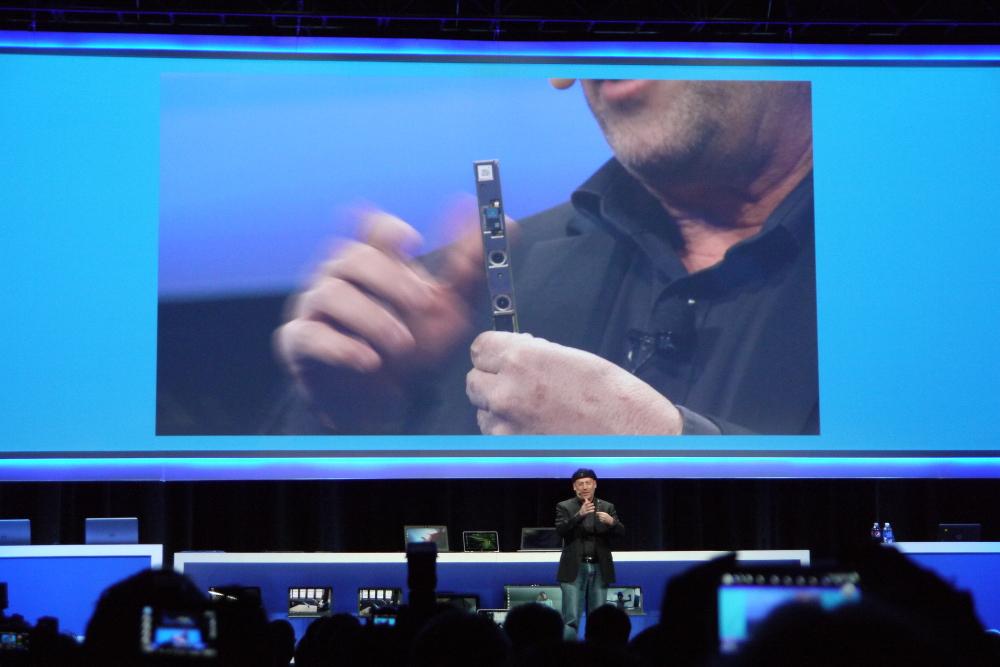
intelces2
Image used with permission by copyright holder

Though depth perception is a trait most people take for granted, it’s important for Intel’s vision of interfacing with computers using hand gestures. A perception of distance is required to accurately detect these new forms of visual input, so the RealSense 3D camera is an integral part of Intel’s attempts to expand how computers are used.

Recommended Videos

It will be so integral, in fact, that Intel plans for it to ship as a standard feature in ultrabooks, all-in-ones, and tablets planned for release by Acer, Asus, Dell, Fujitsu, HP, Lenovo, and NEC. Intel showed working systems from Asus, Lenovo and Dell at its CES 2014 press conference.

So, what can RealSense do? Intel showed several demos including 3D object scanning, real-time video editing which can isolate objects or remove the background, and gesture interaction similar to that shown by Leap last year, though we hope Intel’s version works better once it becomes a reality. Games were also demoed, of course, though no well-known titles were shown.

intelces3
Image used with permission by copyright holder

Intel isn’t focused entirely on the visual, however. The company is continuing its partnership with voice recognition software developer Nuance, with the announcement of a new product called Dragon Assistant, which will be available on tablets and PCs this year. Assistant will work somewhat like Siri for ultrabooks; users will be able to search, play music and create appoints using voice commands.

The promise of RealSense seems infinite, but can Intel actually deliver on the broad range of features and functions it boasts? We’ll just have to wait and see.

 
Matthew S. Smith
Matthew S. Smith is the former Lead Editor, Reviews at Digital Trends. He previously guided the Products Team, which dives…
A ‘meh’ iPad Pro refresh lands in 2027 with a cooling boost to handle your demanding workloads
Apple may bring vapor chamber cooling to the iPad Pro in 2027
Apple iPad Pro 2025 on a table

Apple’s next iPad Pro may not look dramatically different, but it could get one upgrade that makes a lot of sense for an ultra-thin tablet. Better cooling.

According to Bloomberg, Apple is testing four new iPad Pro models planned for spring 2027. The tablets are expected to keep the current 11-inch and 13-inch display sizes, while focusing mostly on internal improvements, including faster chips. Apple has also reportedly tested a vapor chamber cooling system for the iPad Pro, which could help improve sustained performance and reduce overheating.

Read more
Huawei MatePad Pro Max beats Apple’s iPad Pro to become the thinnest 13-inch tablet
Huawei takes aim at Apple's iPad Pro with an ultra-thin flagship tablet
Huawei MatePad Pro Max

Huawei has officially begun selling the MatePad Pro Max in Germany, bringing its flagship tablet to Europe nearly two months after its global debut. The company is making one claim louder than any other: at 4.7mm, the MatePad Pro Max is now thinner than Apple's 13-inch iPad Pro, which measures 5.3mm. That makes it one of the slimmest large-screen tablets currently available. The question, however, is whether being the thinnest is enough to convince buyers in a market where software ecosystems often matter more than hardware.

An engineering achievement that comes with familiar compromises

Read more
A new OLED gaming tablet from Red Magic puts liquid cooling on display
Red Magic’s compact gaming tablet gets a 185Hz OLED screen, visible cooling and 80W charging
Redmagic Gaming Tablet 5 Pro Design

After multiple teasers, Red Magic has finally launched its new compact gaming tablet in the Chinese market. Dubbed the Gaming Tablet 5 Pro, the device is built around the same idea that has made Red Magic phones stand out: high-end gaming hardware, aggressive cooling, and a design that does not try to hide what it is.

The tablet will not stay limited to China. Red Magic says the Gaming Tablet 5 Pro will launch globally as the Red Magic Astra 2 Gaming Tablet, with international pricing and availability set to be announced on July 17.

Read more