

“Microsoft's new Surface Pro X is the 2-in-1 I've dreamed of.”
- Beautiful thin-bezel display
- Absurdly thin and light
- New stylus is easy to charge
- LTE comes standard
- Pen and Type Cover not included
- Microsoft's SQ1 chip must prove itself
“Why you can trust Digital Trends – We have a 20-year history of testing, reviewing, and rating products, services and apps to help you make a sound buying decision. Find out more about how we test and score products.“
The Surface Pro 7 was updated at Microsoft’s Surface event, but it was hardly mentioned from the stage. All the attention was on the Surface Pro X, a brand new version of the Surface Pro that includes slimmed bezels, a thin-and-light design, and a nifty new way of storing and charging the pen.
That’s for good reason. The Surface Pro 7 is just an update. The Surface Pro X? It’s the modern Surface PC I’ve always wanted.
Editor’s note: Want to know more about Microsoft’s other Surface devices? Check out our reviews of the Surface Laptop 3, Surface Pro 7, and Surface Neo.
Bezels, begone!
Every aspect of the Surface Pro X has been modernized. It starts with the chassis itself, which is the thinnest and lightest Surface device ever made. It’s 0.2 inches at its thickest and weighs just 1.68 pounds. That portability goes a long way toward making the Surface Pro X comfortable for one-hand usage. The weight feels well-distributed and balanced in the hand, making for a device that’s enjoyable to pick up and play with.
Then there’s the screen itself. It’s a 2,880 × 1,920 display with a 3:2 aspect ratio, and it’s bright and beautiful. It’s a larger 13-inch screen compared to the Surface Pro 7, though Microsoft has squeezed it into the same footprint. That’s thanks to thinner bezels that flank either side of the screen.
 The top bezel is still a bit thick to support the IR camera used for Windows Hello facial recognition, but it feels as sleek and modern as the iPad Pro. The bezel makes even more of an impression when you fold up the magnetic Type Cover, which makes that bottom border disappear.
The input elements of the Type Cover are familiar. The same great keyboard and Microsoft Precision touchpad remain, the only difference being the slightly larger touchpad size.
A disappearing stylus
Another thing the Surface Pro X can make disappear is the new stylus. It’s called the Surface Slim Pen, and the storage solution Microsoft engineered is particularly intuitive. It’s not the first time I’ve seen a stylus stored above the keyboard, but Microsoft’s implementation sets a new standard.
When stored, the Type Cover can fold up to a raised position and completely hide it. Even better, when the pen is stored, it’s also recharging, noted by a small, green light. Just like that, Microsoft has completely solved the problem of losing the Surface Pen or replacing batteries.
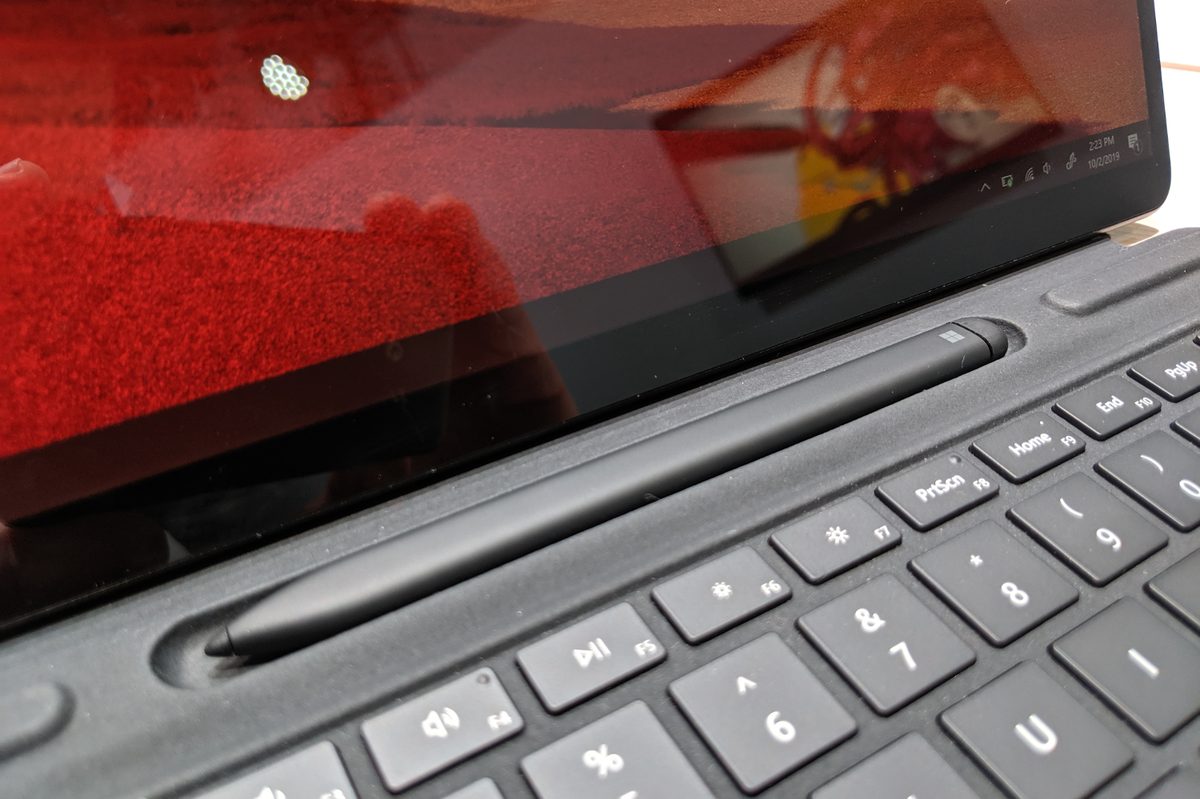
The new pen itself doesn’t have the same heft and feel as the traditional Surface Pen, which was rounder and heavier. The trade-off for this brilliant storage solution, however, feels worth it. Because it’s now charged on the device itself, the system even knows when you take the pen out, automatically prompting you to use it in an application.
Microsoft embraces an ARM-based future
The Surface Pro X marks a significant departure away from the Surface Pro line. The Surface Pro X uses an ARM-based that’s been jointly made with Qualcomm. Microsoft hasn’t released the specifics yet, but the company says it has Snapdragon DNA, combined with an “A.I. accelerator” to make for a completely custom chipset called the “Microsoft SQ1.” If I had to guess, I’d expect the chip to be based on the Snapdragon 8cx, the PC-specific chip found in laptops like the Galaxy Book S.
This tighter control of the silicon is an important move for Microsoft. Previous ARM-based Surface tablets have been mired by limitations and bad implementation. But by partnering closely with Qualcomm, Microsoft (like Apple) seems convinced it has the future of its premium devices. That points to an interesting future of Surface products.
Microsoft claims the Surface Pro X has performance that measures up to three times as fast as the Surface Pro 6. That’s an ambitious claim, and we’ll have to see how that holds in further testing.
Another important piece of the puzzle is LTE, which comes integrated in Qualcomm chips. It’s not an extra cost, and won’t release late, as the Surface Pro LTE models have in the past.
As for ports, Microsoft heard the complaints and went all-in on USB-C. Gone is mini-DisplayPort and USB-A. Instead, you get just two USB-C slots, a headphone jack, and the magnetic Surface Connect dock.
The Surface Pro X is available now for $999. That price doesn’t include the Pen and Type Cover.


