
Touchable 3D technology unveiled to enhance video games, driving, 3D printing
Miraisens has created touchable 3D technology. The applications range from enhancing video games to making it easier to design 3D-printed creations.

This sensor turns your iPad into a 3D scanner, but get ready to practice
We try out Occipital’s new Structure Sensor, a device that you mount to your iPad so it can 3D scan objects.

Is this ‘holographic’ smartphone revolutionary, or just a Fire Phone clone?
A Chinese smartphone company named Takee claims to have produced the world's first smartphone with a holographic display. It appears to use similar technology to Amazon's Fire phone, but potentially putting it to greater effect.
New technology can track a football’s exact location on the field
Sorry, football coaches: Your ability to challenge referee calls may soon become obsolete. Researchers have created a new technology that uses magnetic fields to track a football's exact position on the field.

Amazing? Hardly. Why Amazon’s 3D smartphone is silly
Amazon is rumored to be introducing its first smartphone at an event on June 18. If the gossipers have got it right, the device may have an unusual 3D menu system, but we fear this is a gimmick that won't provide any benefit to owners.

Your next smartphone could have a holographic projector inside it
Startup Ostendo Technologies could be about to make all your Star Wars fantasies come true, thanks to a gadget called the Quantum Photonic Imager, which is capable of projecting 3D video images from your smartphone.

Praying mantis dons world’s smallest 3D glasses (in the name of research, naturally)
Praying mantises in the UK have been donning 3D specs in a unique experiment that could lead to new methods for implementing 3D recognition and depth perception in computer vision and robots.

Draw these white lines in an animated GIF, and it will blow through your mind
By simply adding two vertical white lines within an animated GIF, you can create moving images that seemingly pop out toward you.
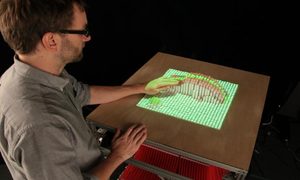
MIT develops inFORM, blows your mind by rendering digital stuff in 3D physically
Wish you had the tech that the Jetsons got to use on a daily basis? Get a load of the inFORM from MIT.

Look what I built, Ma! Texas firm makes world’s first 3D-printed metal gun
3D printers that can make guns? That's not news. 3D printers that can make metal guns? That is.

Creating 3D is a cinch thanks to the Kúla Deeper accessory for DSLR cameras
The Kúla Deeper is an accessory that turns any DSLR into a 3D camera, using a simple frame with mirrors, plus a companion software called Kúlacode.

Skype achieves video calls with 3D holographic avatars, but don’t hold your breath
How about attending a business meeting at your company where everyone around the table except you is a 3D holographic avatar? If Skype and Microsoft choose to push ahead with their technology, it could become a reality.

No remortgage needed: How to build an earthquake-inducing home theater for $3,000
Our DIY guide shows how to build an impressive home theater from the projector to the power strip for about $3,000.

3D TV autopsy: Did it finally die, or was it never alive to begin with?
3D TV wasn't the cash cow manufacturers hoped it would be and now broadcasters are jumping ship due to lack of interest. Is 3D officially dead?

BBC suspends all 3D content production due to low demand
Definitely another nail in the coffin for the future of 3D television, BBC has decided to end a two year trial of 3D content production citing extremely low demand for the service among UK viewers.
Poppy adds another dimension to your iPhone’s camera
Poppy, the latest Kickstarter superstar gadget, has infiltrated the Web, promising to turn your ordinary iPhone camera into one that can take 3D pictures.
Goodbye 3D programming, ESPN 3D shutting down by end of the year
As 3D adoption continues to limp along among U.S. consumers, ESPN has made a decision to stop producing 3D programming and get rid of the ESPN 3D channel in order to free up resources for Ultra HD.
Sherbourn is back: Check Out the SR-8100 7.1 Channel Receiver
Sherbourn Technologies Pro-caliber SR-8100 7.1 A/V receiver has more than enough bells and whistles for a 2013 home theater set-up for about $800.

Harman Kardon AVR 3700 7.2 receiver brings support for 3D, 4K/Ultra HD and Airplay
For under $1,000, the new AVR 3700 from Harman Kardon offers support for Ultra HD 4K, 3D, and AirPlay but no MHL or high resolution audio formats.
Boxee TV now supports DLNA and 3D playback, but can it really compete with the Roku 3?
Boxee TV has rolled out support for DLNA and 3D, a new TV guide, and easier DVR programming but does that make it any cheaper or better than the Roku 3?
Danny Boyle: ‘I don’t know if 3D will survive’
The 3D trends continue to rise but director Danny Boyle doesn't believe the format is here to stay, and will instead be replaced by innovations in sound?
HP working on new holographic 3D display technology for smartphones and tablets
HP has revealed it's working on a new type of 3D screen suitable for use on small devices such as smartphones and tablets, which will be viewed without glasses and provide an almost holographic image.
Could the new Oz movie do for 3D cinema what the original did for color?
When The Wizard of Oz debuted in 1939, it introduced audiences to the wonders of what color film could do. Is it possible Oz the Great and Powerful could pull the same routine for 3D in 2013?
Microsoft brings interactive SpaceTop 3D desktop interface to life
Computers will no longer be restricted to only two dimensions thanks to the SpaceTop 3D interface, which lets users reach inside a computer screen.
‘Doctor Who’ goes 3D for its half-century special edition
How do you celebrate the 50th anniversary of one of the most famous science fiction television characters? You take him to the third dimension, of course.
Brooklyn artist makes 3D portraits using DNA from your unwanted trash
A Brooklyn artist has swept up hair, chewing gum, and cigarette butts from New York City to garner enough data to create 3D portraits of these DNA owners.

Are these digital camera features must-have extras or useless fillers?
Separate the gold from the gimmicks with our guide to all the latest digital camera features.
Microsoft applies for patent on 3D electromagnetic stylus
Who says handwriting is a lost art? If Microsoft's technology becomes a reality, we'll have whole new options for our scribbles and doodles.

Netflix rolls out Super HD and 3D streaming to specific ISPs
Definitely ideal for fans of the Netflix Instant streaming video service, subscribers with 1080p televisions may be able to take advantage of Super HD soon.

Audi Q7 Sound Concept rocks CES 2013 with 24 speakers and “3D sound”
The Audi Q7 Sound Concept's 24 speakers and 1,800 watts of power are meant to immerse passengers in whatever they're listening to.
Hands-on preview of Samsung’s 3D-capable NX300 Smart Camera
Samsung gets a head start on its CES camera announcements with its new NX300 Smart Camera, featuring dual-band Wi-Fi, hybrid autofocusing, and 3D.

The Queen’s annual Christmas speech to be broadcast in 3D this year
British citizens with 3D glasses can invite the Queen into their living rooms as the annual Christmas broadcast from Her Majesty gets transmitted in 3D.

More 3D Star Wars re-releases scheduled for next year
Two new Star Wars movies are coming in 2013, but you probably shouldn't get too excited just yet.

Forget ultrasound photos – now you can get a 3D model of your unborn baby to show friends
Aren't ultrasound photos of unborn babies just a bit old hat now? A clinic in Japan clearly thinks so, as it has just started a new service offering expectant mothers a 3D model of the fetus instead.

Photos actually ‘pop’ with BumpyPhoto
Get your photos 3Ded using BumpyPhoto and their 3D printing technology.
Sculpteo turns your mug into a mug
The 3D printing trend gets a new outlet with Sculpteo, an app designers can take advantage of.

3D television and projector sales are on the rise
While many studios are still struggling to produce quality 3D entertainment in the form of movies and television shows, consumers within the United States seem to be embracing upgrading 3D hardware.

HP TouchSmart 620 adds 3D to touchscreen all-in-one
Hewlett-Packard proves it can be as trendy as any other PC maker, adding 3D display capabilities to its TouchSmart 620 dekstop all-in-one PC.