1. Home
  2. Trash
  3. News

NASA’s Juno craft has found some weird stuff in Jupiter’s atmosphere

Add as a preferred source on Google
Shallow Lightning on Jupiter (NASA Visualization, feat. Music by Vangelis)

NASA’s Juno spacecraft has found some striking oddities in the planet’s atmosphere, including exotic lightning and slushy hail “mushballs.”

Juno spotted an unusual form of lightning which is formed not from water clouds, like lightning is here on Earth, but from an ammonia-water solution. This “shallow lightning” sparks through Jupiter’s atmosphere, creating flashes which were captured by Juno’s Stellar Reference Unit camera.
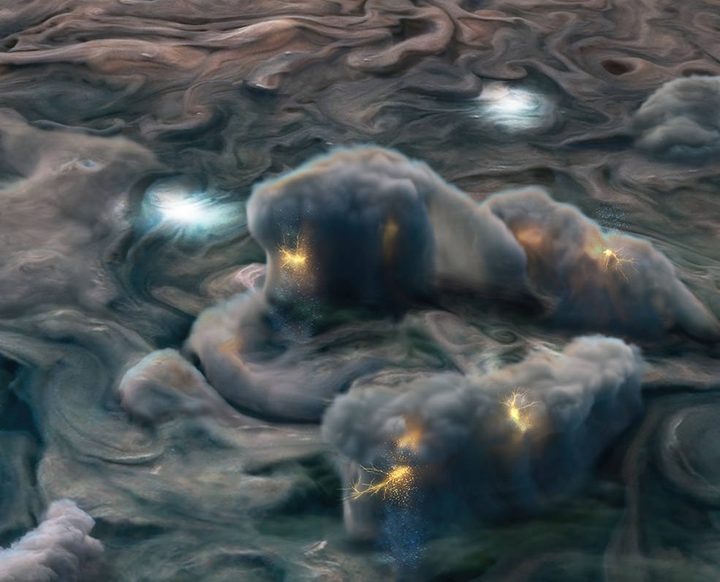
This illustration uses data obtained by NASA's Juno mission to depict high-altitude electrical storms on Jupiter
This illustration uses data obtained by NASA’s Juno mission to depict high-altitude electrical storms on Jupiter. Juno’s sensitive Stellar Reference Unit camera detected unusual lightning flashes on Jupiter’s dark side during the spacecraft’s close flybys of the planet. NASA/JPL-Caltech/SwRI/MSSS/Gerald Eichstädt/Heidi N. Becker/Koji Kuramura

Scientists had seen these flashes on Jupiter before, back in the 1970s from the Voyager mission, but they assumed these lightning storms were originating in deep water clouds, the same way they would be on Earth. But the new findings, taken from Jupiter’s dark side, show that something more complicated is going on.

“Juno’s close flybys of the cloud tops allowed us to see something surprising — smaller, shallower flashes — originating at much higher altitudes in Jupiter’s atmosphere than previously assumed possible,” lead author Heidi Becker, Juno’s Radiation Monitoring Investigation lead at NASA’s Jet Propulsion Laboratory, explained in a statement.
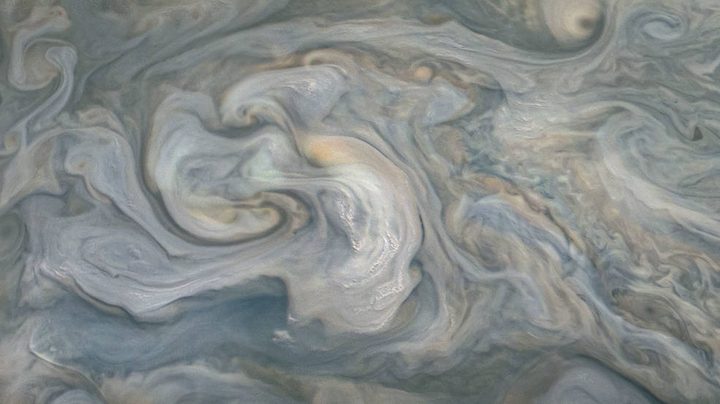
JunoCam image of small, bright "pop-up" clouds
In the center of this JunoCam image, small, bright “pop-up” clouds are seen to rise above the surrounding features. Clouds like these are thought to be the tops of violent thunderstorms responsible for shallow lighting. NASA/JPL-Caltech/SwRI/MSSS/Kevin M. Gill © CC BY

The Juno researchers believe that lightning is possible at higher altitude on Jupiter than on Earth due to the ammonia in the atmosphere. Violent storms push water-ice up high into the atmosphere where it meets ammonia vapors and forms the ammonia-water solution which gives birth to the lightning.

“At these altitudes, the ammonia acts like an antifreeze, lowering the melting point of water ice and allowing the formation of a cloud with ammonia-water liquid,” Becker said in the statement. “In this new state, falling droplets of ammonia-water liquid can collide with the upgoing water-ice crystals and electrify the clouds. This was a big surprise, as ammonia-water clouds do not exist on Earth.”

These findings also help to explain a mystery about Jupiter, which is why there are varying amounts of ammonia in different parts of the planet’s atmosphere. Another group of researchers has found that ammonia forms into slushy hailstones, called “mushballs,” which are heavy and therefore fall deep into the atmosphere, carrying ammonia down closer to the planet’s surface.

The findings are published in the journal Nature.

Georgina Torbet
Georgina has been the space writer at Digital Trends space writer for six years, covering human space exploration, planetary…
The Digital Trends App Bundle is yours to try for a whole week, free
Digital Trends App Bundle

Recently, we've entered an exciting collaboration with Maple Media, creating a bundle of 17 apps worth having on your phone. From relaxed fun to serious productivity boosts, these apps cover all your bases and provide a fun boost to your phone. Normally, the bundle is $9.99 per month (far lower than the cost of using the apps individually), but for your first 7 days you can get access to the bundle for free. View the full Digital Trends App Bundle for a complete list of the apps, or read on for a summarized take.

Start your free trial

Read more
The Galaxy S26 Ultra might not see much of a battery upgrade after all
It looks like it will stay the same as the last five years.
The back of the Samsung Galaxy S25 Ultra.

What's happened? This week, China's Quality Certification Center released information about a battery (EB-BS04898ABY) with a maximum capacity of 4,855mAh. That's the same capacity as was previously seen in the Samsung Galaxy S25 Ultra, and fans have taken this certification to mean the Galaxy S26 Ultra will not see a capacity increase after all.

The Samsung Galaxy Ultra models have had the same battery capacity for the last five years.

Read more
The Galaxy Tab S10 Lite is official, and it’ll be here sooner than you think
Galaxy Tab S10 Lite

What's happened? Samsung has officially announced the Galaxy Tab S10 Lite, a budget-friendly alternative to the Galaxy Tab S10. The device has been rumored for months, but this is the first time Samsung has officially acknowledged its existence.

The Galaxy Tab S10 Lite will have a 10.9-inch display and a peak brightness of 600 nits — a bit on the lower side, versus the iPad Pro's maximum brightness of 1,600 nits.

Read more