
NASA’s Juno mission, launched in 2011, has collected a wealth of information about Jupiter since it arrived in 2016. It has discovered unexpectedly storm-free poles, learned about the planet’s complex weather system, observed bizarre geometric storms, and captured some truly beautiful images. And this week the craft it pulled off a feat of precision engineering, performing its longest propulsive maneuver in a race against the setting sun.
The dramatic intervention was necessary because, like many spacecraft, Juno is solar powered. The mission was originally intended to end in 2018, but the craft entered a different orbit than planned, so its mission was extended to 2021. This extra time put the craft at risk of being trapped by an eclipse, as on its previous path it would have had to spend 12 hours in transit across the planet’s shadow with any direct sunlight. That would have drained its batteries completely and ended the mission.
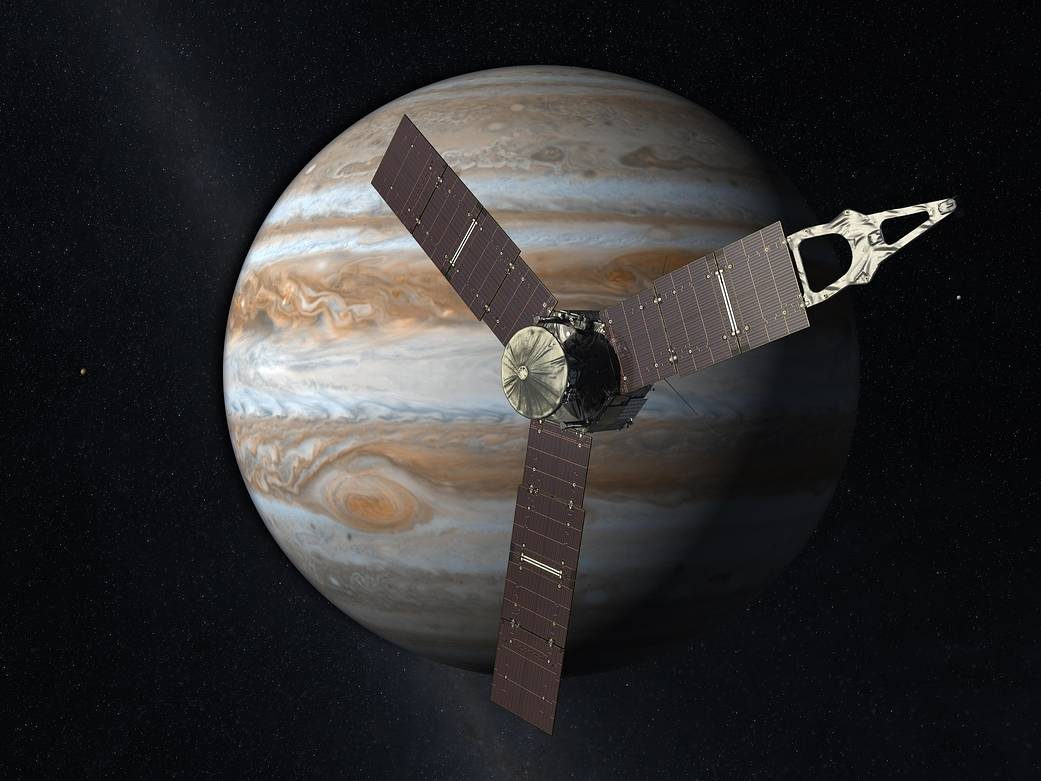
So the NASA researchers came up with a solution to change the orbital velocity of the craft by 126 mph using its reaction-control thrusters. The maneuver lasted for 10.5 hours, which is five times longer than the system had been used for before. It used up 160 pounds of fuel and allowed the craft to avoid the deadly shadow that was chasing it down.
“With the success of this burn, we are on track to jump the shadow on November 3,” Juno’s principal investigator, Scott Bolton of the Southwest Research Institute, said in a statement. “Jumping over the shadow was an amazingly creative solution to what seemed like a fatal geometry. Eclipses are generally not friends of solar-powered spacecraft. Now instead of worrying about freezing to death, I am looking forward to the next science discovery that Jupiter has in store for Juno.”
These kinds of creative adjustments are necessary due to the inherent uncertainties of space exploration, according to the researchers. “Pre-launch mission planning did not anticipate a lengthy eclipse that would plunge our solar-powered spacecraft into darkness,” Ed Hirst, Juno project manager at NASA’s Jet Propulsion Laboratory, explained in the statement. “That we could plan and execute the necessary maneuver while operating in Jupiter’s orbit is a testament to the ingenuity and skill of our team, along with the extraordinary capability and versatility of our spacecraft.”


