The Apple Watch is an incredible health wearable. From step tracking and sleep tracking to 24/7 heart rate monitoring and ways to take ECG and SpO2 readings, there’s not much it can’t do. But one of its biggest missing features has long been blood glucose monitoring. It’s a feature we’ve heard murmurings about for years and years, and according to one new report, it may finally be happening.
Per a report from Bloomberg, Apple recently reached “major milestones” in its quest to bring blood glucose monitoring to the Apple Watch. The company reportedly has “hundreds of engineers” working on the “moonshot-style project” to make noninvasive blood glucose monitoring on the Apple Watch a reality. And thanks to those engineers, Apple now has a functioning proof of concept for the technology — a huge step in eventually bringing it to the Apple Watch for everyone.
How blood glucose monitoring could work
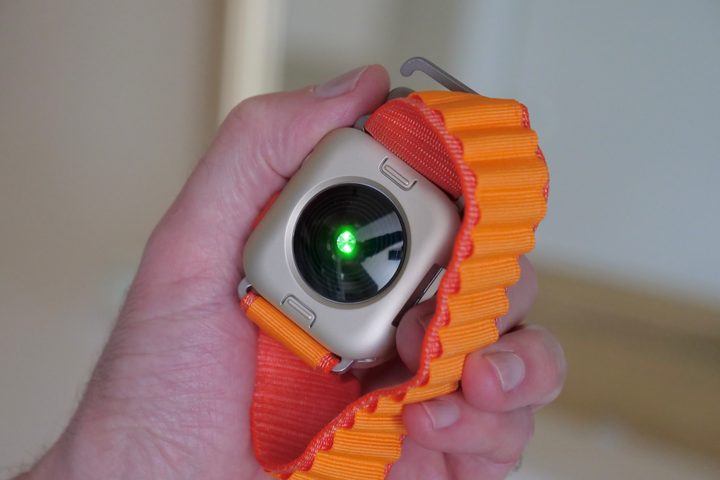
How’s Apple doing it? Per the report, Apple is using a technology called “silicon photonics” combined with “optical absorption spectroscopy” measurements. The report says it works via “lasers to emit specific wavelengths of light into an area below the skin where there is interstitial fluid — substances that leak out of capillaries — that can be absorbed by glucose. The light is then reflected back to the sensor in a way that indicates the concentration of glucose. An algorithm then determines a person’s blood glucose level.”
Apple is apparently working with TSMC (the same company that manufactures its A-series chips in the iPhone) to create its own custom silicon for these photonic chips.
As it currently stands, the proof-of-concept device Apple developed is about the size of an iPhone and is worn on someone’s arm. A previous version of the prototype was so big that it needed a laptop to function. Apple has a lot of work left to get the technology to fit inside the chassis of an Apple Watch, but this is still a remarkable step forward in a technology so many have been anxiously waiting for.
When is this coming to the Apple Watch?
As such, we likely still have a while to wait before blood glucose tracking is actually available on an Apple Watch. Apple reportedly now sees the feature as “viable” and is actively working to make it fit in the wearable footprint, but that’s all going to take a lot of extra work and time.
That means we shouldn’t expect blood glucose monitoring in the Apple Watch Series 9 later this year, and probably not in the eventual Series 10. Could it be ready in 2025? Maybe 2026? Possibly! But this early on, it’s difficult to say with any level of certainty.
And while we’ll still be waiting a while for blood glucose monitoring to be available on the Apple Watch, don’t forget that numerous other companies are also working to make noninvasive blood glucose tracking a reality on wearables. This past September, a research team at Kennesaw State University developed a functioning blood glucose tracking sensor with a reported 90% accuracy rating. We’ve also seen similar work from Samsung, Rockley Photonics, and others.