
“The Recon Tech controller is a solid upgrade over the stock Xbox One controller for a reasonable price.”
- Solid construction
- Double wireless range
- Sweat-resistant surfacing
- 3.5mm headphone jack
- Minimal customization
“Why you can trust Digital Trends – We have a 20-year history of testing, reviewing, and rating products, services and apps to help you make a sound buying decision. Find out more about how we test and score products.“
As Microsoft has expanded its Xbox One hardware line with the Xbox One S and upcoming Project Scorpio consoles, it makes sense that we see a similar expansion of its first-party peripherals. The Xbox One Elite Controller arrived in late 2015, offering a high-end alternative to the Xbox One’s already-solid stock gamepad with quality materials and fine-tuned customization.
Microsoft has now split the difference, with the Recon Tech “special edition” wireless controller, which brings adds some of the Elite’s features to the standard gamepad, creating a mid-range upgrade over the basic model for players who are interested in a premium product, but may balk at the Elite’s $150 price tag.
A “tactical” option
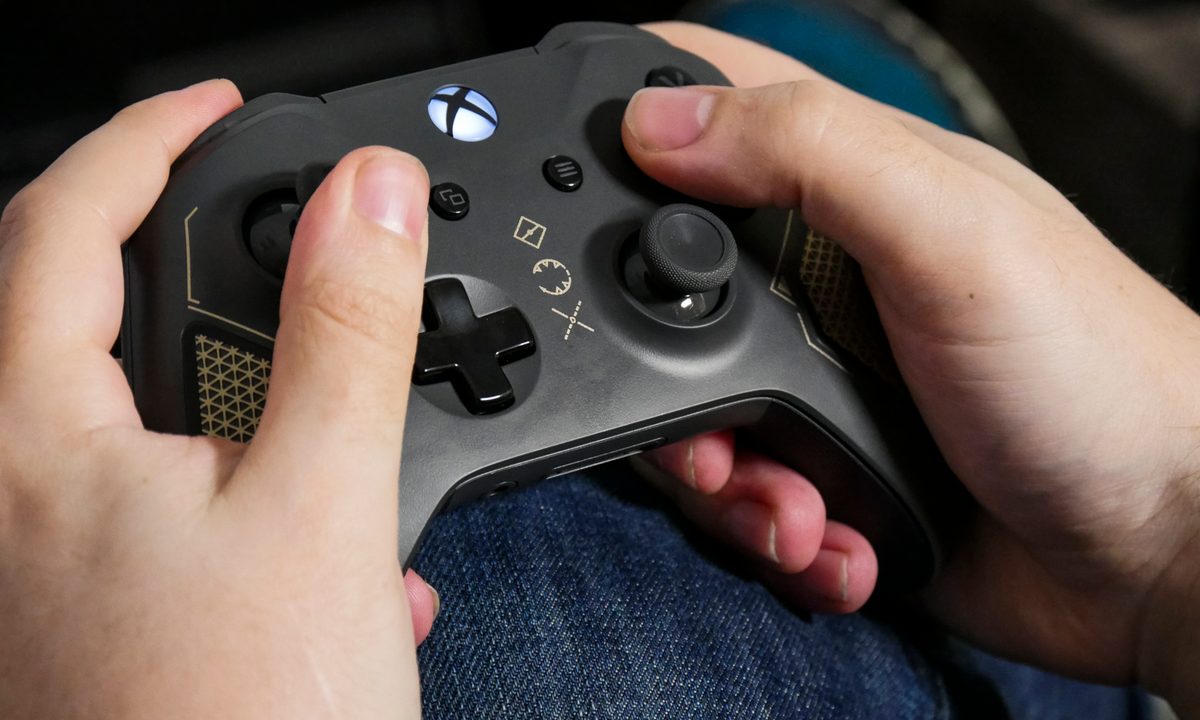
Where previous Xbox gamepads were either generic or themed after particular games, the Recon Tech is designed to make more of a statement that might not appeal to all flavors of gamer. The name “Recon Tech” evokes a sort of tough guy militarism that is immediately apparent in the gamepad’s aesthetic. The body is a matte, gunmetal grey while the shoulder buttons and thumbstick bases are highlighted with a glossy finish. The d-pad and face buttons are black, but they also encompass four colored pips, which serve to help orient Xbox One players who have come to rely on the color-coding for X, Y, A, and B buttons.
“Recon Tech” evokes a sort of tough-guy militarism that is immediately apparent in the gamepad’s aesthetic.
There are also three gold icons or hieroglyphs down the center of the gamepad, though they appear to be purely decorative. Breaking up the grey on either grip is a gold, triangular pattern, reminiscent of the UI design from Eidos Montréal’s recent Deus Ex games. More than just an aesthetic flourish, the triangles form a slightly raised grid, aiding grip and mitigating the effect of sweaty palms from extended play. The gold panels on the front are matched with grey, textured plastic on the undersides of the grips, similar to the Elite, though not covering quite as much area.
The stock Xbox One gamepad’s smooth plastic is solidly constructed, but its matte finish does nothing to prevent the accumulation of sweat and subsequent slippery hold. The Recon Tech’s textured surface prevents this with textured points of contact for your fingers and thumb on the front and back, while smooth plastic in the middle lets it rest and shift easily in your hands.
Under the hood, the Recon Tech is effectively the same as a standard Xbox One controller, allowing for easy wireless connection or Bluetooth to either Xbox One consoles or Windows 10 PCs, though at double the effective range of previous gamepads. It also finally includes a 3.5mm stereo headphone jack on the gamepad itself, bypassing the need for the bulky Xbox One headset adapter.

Although it does not offer the expanded customization options found on the Xbox Elite controller, such as replaceable buttons and optional back-paddles, a “premium controller” without those features, which include bits that could fall off and roll away under the couch, will be a perfect fit for many players.
The unchanged core of its design, however, is masterfully-refined form of the basic Xbox One gamepad, which remains our favorite contemporary video game controller. The curvature and weight allow it to sit perfectly in our hands with minimal strain for extended play sessions where the DualShock 4 might leave us feeling a little sore in the wrist. Through three versions of the Xbox console Microsoft has perfected its core input device, and we would strongly recommend everyone stick with it. Accordingly, we also recommend sticking with first-party peripherals to guarantee that quality and compatibility.
Our Take
We love the Xbox One Elite gamepad, but $150 is just too expensive to make it a reasonable buy for most gamers. At $70, the Recon Tech is a much easier ask. While it doesn’t have some of the advanced customization offered by the Elite, it’s a solid upgrade over the stock option.
Is there a better alternative?
Depending on your budget, there are a huge range of compatible gamepads available. Microsoft supports a wide range of alternate controllers, especially at the Recon Tech’s $60 price point or thereabouts. Among first-party peripherals, however, this is the best value currently available, with its headphone jack, improved wireless, and textured surface.
How long will it last?
The upcoming release of Project Scorpio may lead to a sea change for gaming console life cycles, making it possible that gamers will be able to stay within the Xbox One ecosystem for much longer than previous generations. Accordingly, that could mean that Recon Tech will remain a relevant gamepad for many years.
Should you buy it?
If money is no object, we still recommend the Xbox One Elite controller, which offers the same upgrades as the Recon Tech gamepad, plus many others. If that’s too much money, though, it is absolutely worth it to spend an extra $10 for the Recon Tech.