1. Home
  2. Space
  3. Emerging Tech
  4. News

Scientists detect strange repeating radio burst on the other side of the cosmos

Add as a preferred source on Google

It seems like every time we attempt to take a step toward better understanding our cosmos we are left with more questions than answers — a regular Bonini’s Paradox. Just a few years ago we didn’t even know that the cosmic phenomena known as fast radio bursts (FRB) — rare, bright, and inexplicable signals from beyond our galaxy — existed. And until recently, only one of these FRBs had been recorded on more than one occasion. However, last week, a team has recorded yet another repeating FRB.

The scientific community has been perplexed by these enigmatic signals for the past 10 years. Currently, the explanation behind these FRBs range from outbursts of neutron stars to some sort of propulsion system used by an alien civilization on the opposite side of the universe. Some have even suggested these signals are the result of dark matter — another space thing we know very little about — smacking into black holes.

Recommended Videos

In 2015, researchers once again “heard” an FRB known as FRB 121102 that was first observed in 2012. Just last week, UC Berkeley postdoctoral researcher, Dr. Vishal Gajjar, found FRB 121102 blipping yet again. Gajjar used the SETI Breakthrough Listen program at the Green Bank Telescope in West Virginia to make the discovery. Over the course of five hours of observation across the entire 4 to 8 GHz frequency band, Gajjar and the team uncovered 15 “new” pulses coming from FRB 121102. But what does it mean?

“The possible implications are two folds,” Gajjar explained to CNET. “This detection at such a high frequency helps us scrutinize many (of FRB 121102’s) origin models. The frequency structure we see across our total band of 4 to 8 GHz also allows us to understand the intervening medium between us and the source.”

According to Gajjar, the repetitive nature of this particular FRB and the series of hyperactivity may rule out the colliding black holes origin hypothesis. A more probable explanation could involve pulsars, however, what is exactly emitting these powerful signals is still largely a mystery.

“As the source is going into another active state means that the origin models associated with some sort of cataclysmic events are less likely to be the case of FRB 121102,” explained Gajjar. “It should be noted that they can still be valid for other FRBs.”

The SETI team has requested other researchers to take advantage of this current FRB 121102 heightened activity window. The latest findings on FRB 121102 and the more than 400 terabytes of data from the recent observation will be more throughly detailed in a forthcoming report. While the jury is still out on FRBs, we’re still patiently waiting for the response to the interstellar Arecibo Message radio signal we transmitted into the cosmos in 1974. Perhaps when the aliens on the other side of the universe receive that, they’ll be equally as perplexed and intrigued…

Dallon Adams
Former Editorial Assistant
Dallon Adams is a graduate of the University of Louisville and currently lives in Portland, OR. In his free time, Dallon…
Lightsails have hit another speed bump on the road to interstellar travel
The coolest interstellar travel idea may get betrayed by the light pushing it
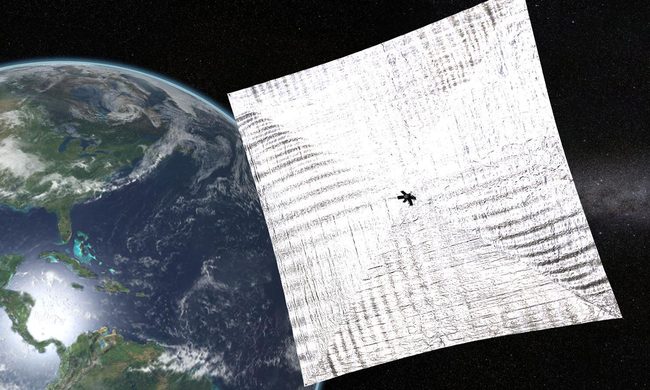
LightSail in Earth orbit

Laser-powered lightsails are one of the coolest answers to spaceflight. It might not be as sci-fi-sounding as a warp drive, but now, its practicality has also come under question. Using lightsails, a spacecraft could unfurl an ultra-thin reflective sail and let a powerful laser push it toward another star, without relying on fuel.

The tech was simple and elegant--except it's also more complicated than it sounds. A new preprint from researchers Chao Shen and Jiaze Li of the Harbin Institute of Technology suggests that relativistic lightsails may run into a hidden propulsion problem once they start moving extremely fast.

Read more
The galaxy has an exoplanet size mystery, and NASA’s EVE mission wants to solve it
This planet-hunting mission wants to catch baby worlds before they grow up
Artist’s Illustration of Exoplanets Orbiting Barnard’s Star

Mankind venturing into space ended up creating more questions than it answered, and one of the dilemmas is related to the planet sizes. Astronomers have found plenty of rocky super-Earths and plenty of puffier sub-Neptunes, but far fewer planets with a radius of about 1.8 times Earth’s.

That gap is known as the radius valley, and a proposed mission called the Early eVolution Explorer, or EVE, wants to figure out why it exists. NASA has a simple plan: look at planets while they are still young. The mission concept, detailed in a new arXiv preprint and covered by Phys.org, would focus on newly formed star clusters to see what small planets look like before billions of years of evolution.

Read more
We just got a hot signal that a Tesla and SpaceX merger could happen, after all
Tesla

For years, the idea of Tesla and SpaceX becoming a single company has lived somewhere between ambitious business theory and Elon Musk fan fiction. The two companies already share DNA, leadership influence, engineering talent, and long-term goals. But every time the topic surfaced, it felt more like an interesting thought experiment than a realistic possibility. Now, one of the most important people at SpaceX has added fresh fuel to the conversation.

Speaking in a recent CNBC interview, SpaceX President and COO Gwynne Shotwell was asked about the possibility of closer ties between Tesla and SpaceX. Her response wasn’t a flat-out denial. In fact, she suggested that bringing the two companies together could make life a little easier for Musk. That may sound like an offhand comment, but coming from Shotwell, it’s noteworthy. She’s been at SpaceX since its earliest days and remains one of the company's most influential executives.

Read more