  1. Home
  2. Cars
  3. News

Waymo autonomous vehicles will reach 7 million test miles this week

Add as a preferred source on Google
waymo taxi
Waymo

Waymo just keeps burning up the pavement. On Tuesday, June 5, the company’s chief business development officer, Shaun Stewart, announced that the company’s fleet of autonomous vehicles will reach 7 million miles by the end of this week. That means that Waymo’s testing pace has accelerated significantly in the last month or so — after all, it was only a few weeks ago that Waymo’s CTO Dmitri Dolgov announced that Waymo had hit 6 million test miles driven at the Google I/O conference. And before that, the Alphabet subsidiary celebrated 5 million miles driven in February.

While it took the company more than a year to go from 1 million to 2 million test miles, it’s clearly upped the ante since then, according to a chart the self-driving trailblazer recently created.
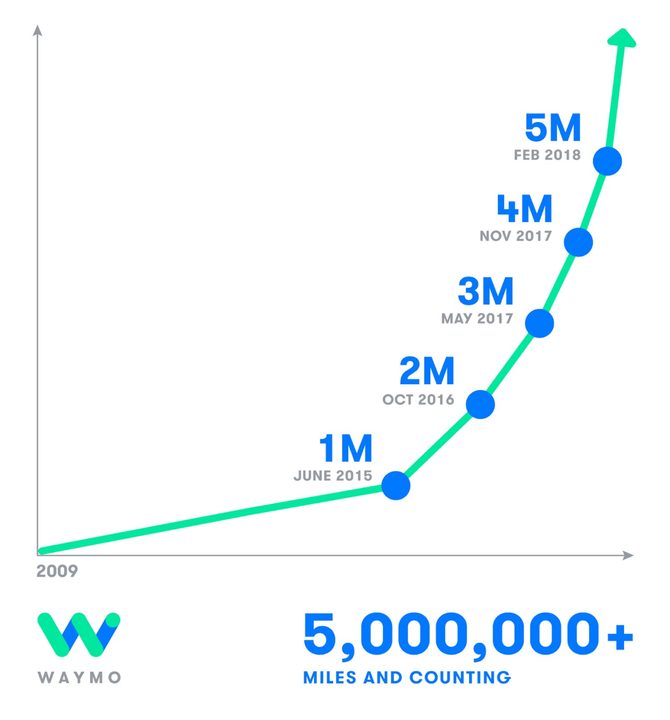
Image used with permission by copyright holder

This rapid growth doesn’t come as too much of a surprise. After all, Waymo is planning to launch a self-driving taxi service at some point in 2018, so it makes sense that it’s getting as much test-driving in as possible before taking on human passengers in a broader capacity. At the end of March, Waymo revealed that it had signed a deal with Fiat Chrysler Automobiles (FCA) to add 62,000 hybrid minivans to its existing fleet. This builds upon the “thousands” of minivans the company ordered in January and brings the total number of driverless vehicles to … quite a few. As it stands, the company is already testing 600 autonomous Chrysler Pacifica minivans on public roads in the United States.

Recommended Videos

While there are other companies also eager to break into the commercial self-driving space, it’s clear that none have been quite as successful as Waymo. Not only has the company logged the most number of miles thus far, but its recent order of FCA minivans is the largest ever placed in the industry.

Of course, even as Waymo forges ahead, the self-driving arena is not without its dangers. In March, Uber was forced to suspend testing of its autonomous fleet after a fatal crash in Tempe, Arizona. And Tesla has come under scrutiny for its own Autopilot feature, as most recently, one of the company’s Model S vehicles crashed into a police vehicle while the self-driving feature was turned on.

While Waymo hasn’t had nearly as dramatic of a setback, we’ll just have to wait and see if the company can continue on the impressive trajectory it’s set for itself thus far.

Lulu Chang
Fascinated by the effects of technology on human interaction, Lulu believes that if her parents can use your new app…
After acing range and charging, Chinese EV brands flaunt three-wheel driving on SUVs
BYD, Aito, and Li Auto are making active suspension the new battleground after range and charging
Machine, Wheel, Transportation

Chinese EV brands have spent years trying to win on range, charging speed, and screens. Now the fight is getting stranger, with premium SUVs showing off three-wheel driving as the next battleground.

According to Car News China, BYD’s Denza B8 Flash Charge Edition, Huawei-backed Aito M9, and Li Auto L9 are all being used to show how active suspension can lift a wheel while the vehicle keeps moving at low speed. The demos look theatrical, and the intended uses are practical, including tire changes, off-road recovery, and crossing uneven ground without getting stuck.

Read more
This Android Auto update is trying to change how you drive and use your car
Road, Electronics, Credit Card

I use Android Auto every day, and at this point, it feels like a quiet co-driver sitting on my dashboard. That’s exactly why this upcoming refresh from Google actually matters. It is not just a visual tweak; it is a proper overhaul of how Android Auto should feel inside a modern car. The biggest change is the design. Google is bringing its Material 3 Expressive design language from phones into cars. That means Android Auto is getting a more modern, more fluid look with expressive fonts, smoother animations, and even support for wallpapers. This should really make the entire interface feel less rigid and more alive while you are driving.

Widgets finally make Android Auto feel useful at a glance

Read more
BYD’s latest EV costs just over $10,000, goes 250 miles, and packs a LiDAR, too
LiDAR, 250 miles, and a five-figure price tag: the 2026 Seagull is proof that the future of affordable EVs is already here, just not in the West.
BYD 2026 Seagull.

BYD has officially unveiled the 2026 Seagull, sold internationally as the Dolphin Mini or Dolphin Surf, and the numbers deserve your attention. 

The updated compact EV’s price starts from 69,900 yuan, which is around $10,300, in China, and tops out at 85,900 yuan, which is around $12,600. It debuted at the 2026 Beijing Auto Show before going on sale this week (via CarsNewsChina). 

Read more