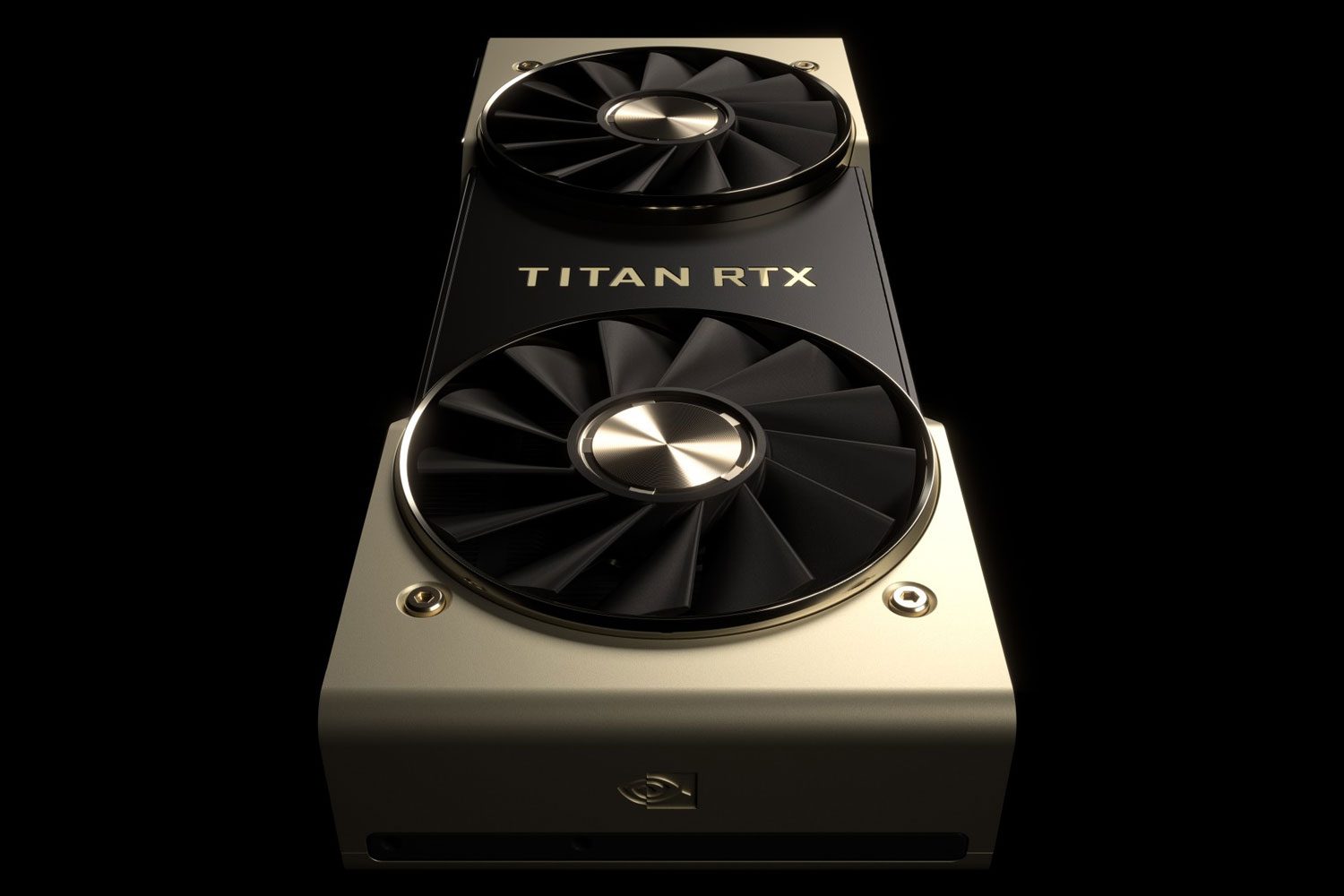
Nvidia’s RTX series of graphics cards are all rather expensive and all rather powerful, but the most expensive and most powerful of them all, is the Titan RTX. Sitting one notch above the RTX 2080 Ti and targeted more at enterprise and prosumer users than gamers, the Titan RTX represents the pinnacle of graphics card power available today.
Should you buy one? Probably not, but it doesn’t hurt to indulge your imaginary bottomless wallet now and again. Here’s everything you need to know about the Nvidia Titan RTX.
Pricing and availability
The Titan RTX was first teased in a number of “accidental” reveals by the likes of Linus Tech Tips and the Slow Mo Guys at the end of November, but it didn’t appear to bother Nvidia too much. It followed up with the official announcement days later. It revealed the Titan RTX in all its gold-tinted glory, alongside its eye-watering price tag of $2,500.
What we don’t know, is exactly when it will be released. Based on previous generation’s release dates for Titan cards, they typically hit the digital and real store shelves a couple of months after the main lineup. With AMD expected to make a big splash with Navi at CES in January too, we’d be surprised if Nvidia didn’t make these cards available before then.
Nvidia has suggested the Titan RTX should be available before the end of the year, so we’re going with that assumption. If it slipped into early 2019, though, perhaps to try to steal some CES thunder, it wouldn’t surprise us.
Architecture and performance
The Titan RTX is based on the same Turing architecture as other cards in the RTX range such as the 2070, 2080, and 2080 Ti. However, it is what could be classed as a ‘fully-unlocked’ RTX card, because it uses the same TU102 GPU core as the 2080 Ti, only with none of its CUDA cores disabled. Here’s how it compares to other cards in the RTX line up.
| Titan RTX | RTX 2080 Ti | RTX 2080 | RTX 2070 | |
| CUDA cores: | 4,608 | 4,352 | 2,944 | 2,304 |
| Tensor cores: | 576 | 544 | 368 | 288 |
| RT cores: | 72 | 68 | 46 | 36 |
| Base speed: | 1,350MHz | 1,350MHz | 1,515MHz | 1,410MHz |
| Boost speed: | 1,770MHz | 1,545MHz | 1,710MHz | 1,620MHz |
| Memory: |
24GB GDDR6 | 11GB GDDR6 | 8GB GDDR6 | 8GB GDDR6 |
| Memory speed: | 14Gbps | 14Gbps | 14Gbps | 14Gbps |
| Memory interface: | 384-bit | 352-bit | 256-bit | 256-bit |
| Memory bandwidth: | 672GB/s | 616GB/s | 448GB/s | 448GB/s |
| TDP: | 280 watts | 250 watts | 215 watts | 185 watts |
While clock speeds and core counts are all welcome improvements over the 2080 Ti, the starkest difference between those two powerful cards is the memory. Where the 2080 Ti has 11GB of high-speed GDDR6, the Titan RTX sports 24GB. Considering few games will even take advantage of the full complement of memory that the 2080 Ti comes with, this should highlight the intended audience for the RTX Titan. Such mammoth quantities of memory lets it deal with enormous datasets (perfect for AI), and heavy computational tasks in datacenters.
The boosted hardware over the 2080 Ti delivers the kind of raw power bonuses that you might expect. In single and double precision tasks, the Titan RTX is 10-20 percent more capable than the 2080 Ti, as per Anandtech. Arguably more important though, is the tensor performance improvement. Even with a modest improvement in tensor core count, the Titan RTX can offer performance in excess of double that of the 2080 Ti when those cores are leveraged, delivering a total of 130 TFLOPs. That’s even in excess of the capabilities of the Titan V, which has a greater transistor count, as well as a greater number of CUDA and tensor cores.
What all of this means, is that the Titan RTX bridges the gap between the highest performing gaming hardware and the enterprise-focused Quadro cards. At $2,500, the Titan RTX is very expensive, but it’s well under half the cost of the Quadro RTX 6000, making it a viable option for those who can’t quite justify such expense. It should also work brilliantly as a strong workstation card that can also be used for high-end gaming, for that particularly niche audience.
In terms of the RTX Titan’s real world performance, we don’t know exactly what it can do. It should be better than just about any card we’ve ever seen when it comes to gaming performance, but almost no one will use it for that task, so that’s largely unimportant. Except if you love hardware, so we can’t wait to see what it can do when reviewers get their hands on it.
Ray tracing? DLSS?
Perhaps the most intriguing question to be answered by the release of the Titan RTX, is how well will it handle Nvidia’s new visual technologies: Ray tracing and deep learning super sampling (DLSS)? We’ve seen middling and downright poor performance of Nvidia’s new RTX cards when it comes to ray tracing in games like Battlefield V, and DLSS has real potential, but isn’t as groundbreaking as Nvidia might like you to believe.
In theory, the Titan RTX will be better at ray tracing than the 2080 Ti. It’s much faster clock speed should keep its head above water at higher resolutions and the additional four RT cores might keep frame rates bumped up enough to be considered playable, but it’s still hard to imagine even this powerhouse from being able to deliver playable frame rates with ray tracing enabled at 4K.
We’d love to see it happen, but we’re not holding our breath that even the Titan RTX can handle it.