
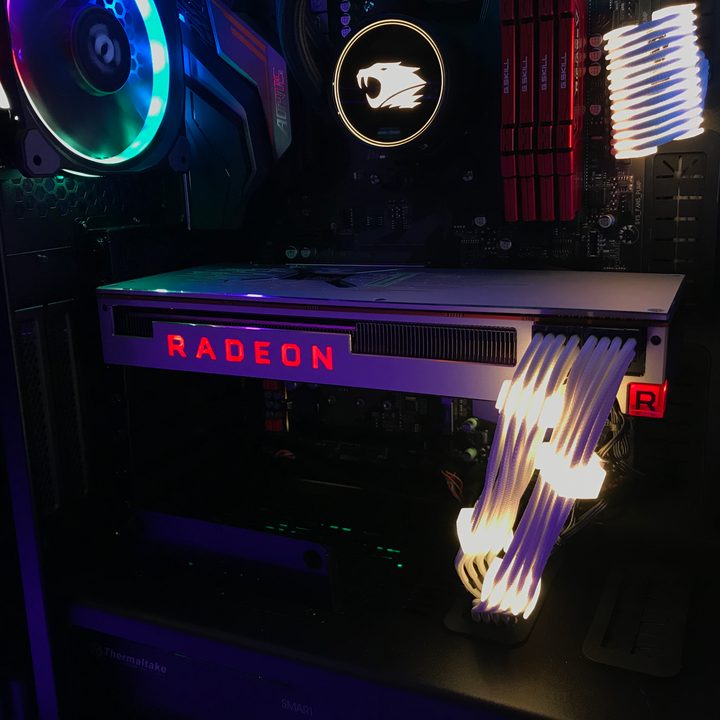
AMD’s Radeon VII may be more than just a direct performance competitor for Nvidia’s RTX 2080, it might be able to offer similar features, too. Although AMD has ruled out ray tracing on its graphics cards until it becomes more of a mainstream feature, it could adopt something akin to Nvidia’s deep learning super sampling (DLSS). Its plan is to support an open alternative developed by Microsoft called DirectML.
One of the big selling points for Nvidia’s latest Turing-generation of graphics cards was its feature set. Beyond the raw power of the new GPUs, Nvidia talked up their ability to handle ray tracing and DLSS, the latter of which is a form of upscaling and anti-aliasing that is designed to produce 4K-like visuals, at a 1,440p overhead. It was a bespoke technology, as far as Nvidia was concerned, enabled only through its specifically designed Tensor cores which populate every RTX graphics card.
But AMD is looking to go a different route to enable much the same technology but power it with its standard GPU cores. Microsoft’s DirectML was announced back in March 2018, with Microsoft talking up the potential of bringing deep neural networks (DNN) to gaming. They could be used for everything from on-the-fly difficulty adjustments in-game, to streamlining the developmental process. But it also discussed the potential to use DirectML for supersampling, and even gives an example of Nvidia doing so.


- 1. Can you spot the super sampled image?
- 2. How about now?
AMD’s Adam Kozak conducted an interview with Japanese tech site, 4Gamer (via Toms Hardware) and suggested that AMD’s upcoming 7nm Vega 2 Radeon VII graphics card was fully verified to utilize the technology and that early test results with the card showed positive results.
As exciting as it is for gamers that such a feature would be available on AMD hardware, it’s even more impactful that this is a technology that isn’t locked down to a specific manufacturer. In much the same way that AMD’s Freesync technology is more affordable and widely available than Nvidia’s GSync, DirectML could have a much lower barrier for entry. That goes doubly so when you consider that AMD graphics are expected to power the next-generation of game consoles. If the company adopts DirectML super sampling, then it seems likely that game developers would do so en masse in turn.
The only hitch to this new technology is that it requires DirectX12. Although there are still a limited number of DX12-supporting games at this time, that will likely change in the years to come, which could make DirectML an important graphics technology in turn.


