

Volvo sister company Polestar isn’t shy about its intentions to lock horns with Tesla. Its first model, simply called 1. is more of an eco-friendly grand-tourer than a true Tesla fighter, but its second model — called, you guessed it, the Polestar 2 — is aimed directly at the Model 3. It’s more upmarket than cheaper electric cars like the Chevrolet Bolt and the Nissan Leaf, it’s jam-packed with tech, it stands out with a head-turning design, and its’s shaping up to be the 3’s first real rival. Here is how these two electric sedans compare, and how they differ.
Design
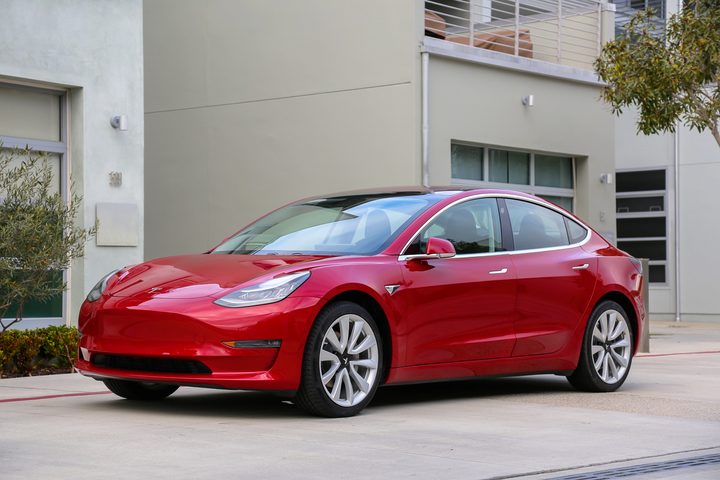
Introduced in March 2016, the Tesla Model 3 took the company’s design language in a striking new direction. It stands out with swept-back headlights and a low hood, a feature made possible because an electric motor is markedly smaller than a gasoline-burning engine. Its tall, arched roofline helps create a generous amount of space for five passengers and their gear. Out back, it borrows styling cues such as horizontal lights connected by a strip of chrome trim from the bigger Model S and Model X, but it’s not a carbon copy of either. Tesla avoided the Russian doll-type approach to styling that many of its competitors are stuck in.
The Polestar 2 gives off Volvo vibes, and that’s not a coincidence. It evolved from the 40.2 concept Volvo introduced at its Gothenburg, Sweden, headquarters in 2016. Like the design study, it rides a little bit higher than a conventional sedan; its taller ride height reminds us of the limited-edition S60 Cross Country we drove in 2015. Adding ground clearance made it easier for engineers to integrate a bulky battery pack into the chassis. The end result is a distinctive, segment-bending design that blurs the line between a crossover and a sedan.
Performance
Tesla offers three versions of the Model 3 called Mid-Range, Long-Range, and Performance. The Mid-Range car comes with a 62-kWh lithium-ion battery pack that delivers up to 264 miles of range. It’s equipped with a single electric motor mounted over the rear axle, so it’s rear-wheel drive. Tesla hasn’t released the car’s horsepower output, but it quotes a 0-to-60-mph time of 5.6 seconds.
Next up is the Long-Range model, which is only offered with dual-motor all-wheel drive. The two motors draw electricity from a bigger, 75-kWh battery pack, which stores enough electricity for up to 310 miles of range. The extra power — Tesla hasn’t specified how much of it — lowers its zero-to-60-mph time to 4.5 seconds. Finally, the range-topping Model 3 Performance keeps the Long-Range’s 310-mile range but scoots to 60 mph from a stop in 3.3 seconds, which is on par with some of the hottest performance cars on the planet.


At launch, the Polestar 2 will come in a single configuration. Its drivetrain is built around a 78-kWh lithium-ion battery pack that delivers electricity to two electric motors, each mounted over one of the axles. Its output checks in at 408 horsepower and 437 pound-feet of torque, which is enough for a sub-5-second sprint to 60 mph, and Polestar estimates the 2 will be capable of driving for up to 275 miles on one charge. That’s better than many electric cars on the market, including the Mid-Range version of the Model 3, but it falls short of the top-spec variants.
Though Polestar hasn’t announced a dedicated, performance-oriented model, it offers a Performance Pack that bundles a firmer suspension, bigger brakes made by Brembo, and specific alloy wheels wrapped by sport tires. Pricing for the Performance Pack hasn’t been announced yet.
Interior and tech
Technology is an integral part of every Tesla, and the 3 is no different. The company placed a 15-inch, TV-like touchscreen on the dashboard and grouped all of the car’s key functions inside of it in order to reduce distractions — and complexity during the manufacturing process — to the strict minimum. This layout takes the minimalist cabin design automakers are moving toward to unprecedented heights because the screen replaces a vast majority of the buttons, switches, knobs, and stalks commonly found inside a car. Early customers complained about serious build-quality problems, but as of early 2019, Tesla seems to have mostly figured out how to put together the Model 3 reliably.
Enhanced Autopilot is available for $5,000. It adds eight cameras, 12 ultrasonic sensors, and a forward radar that allow the car to change lanes, read speed limit signs, navigate freeway off-ramps, brake if it detects a collision is imminent, and park itself. The system is semi-autonomous, meaning drivers need to remain alert at all times.
The Model 3 doesn’t use a key or a key fob. Instead, owners use their smartphone to lock or unlock the car via Bluetooth signal. Tesla still provides a backup option in the form of an NFC card that unlocks and starts the car.


The 2 inaugurates an Android-based infotainment system that will later spread to other models, including members of the Volvo portfolio. It’s displayed on a frameless, 11-inch touchscreen attached to the dashboard. The driver faces a digital instrument cluster, which gives the cabin a high-tech feel, but Polestar hasn’t left out conventional buttons and stalks. The 2 notably retains a volume knob on the center console. We haven’t sat inside the car yet, but the better-than-average build quality we’ve experienced in recent Volvo models bodes well for Polestar’s first mass-produced model.
Polestar hasn’t revealed which electronic driving aids it will offer on the 2 yet. It promises the car is compatible with Phone-as-Key technology, which makes sharing the car as easy as sending a text message.
Pricing and availability
Made in California, the Tesla Model 3 is available now all across the United States. The Mid-Range, rear-wheel-drive model starts at $42,900, and buyers are eligible for a $3,750 tax credit; Tesla lost the full $7,500 credit after it delivered its 200,000th car. The Long Range version with dual-motor all-wheel drive carries a base price of $49,900, while the range-topping Performance version starts at $60,900. Tesla will release an entry-level model priced closer to $35,000 before the end of 2019.
Polestar 2 production will begin in early 2020 in a new facility in China. Pricing will start at $63,000 during the first year of production, because Polestar will only build an upmarket variant named Launch Edition. Many buyers will be eligible to claim the full $7,500 tax credit. After the first year, Polestar will release more affordable variants of the 2 that should start in the vicinity of $40,000 before incentives enter the equation.
Motorists will be able to subscribe to the 2 through a Polestar-specific version of the Care By Volvo subscription service. Terms, conditions, and pricing haven’t been released yet, but we know the firm will conveniently bundle the car payment, insurance, maintenance, and even wear-and-tear items into a flat monthly fee. It’s a service Tesla doesn’t offer — yet.


