  1. Home
  2. Computing
  3. News

Microsoft and Facebook’s undersea Marea cable breaks data transfer speed record

Add as a preferred source on Google
Marea undersea cable
Image used with permission by copyright holder

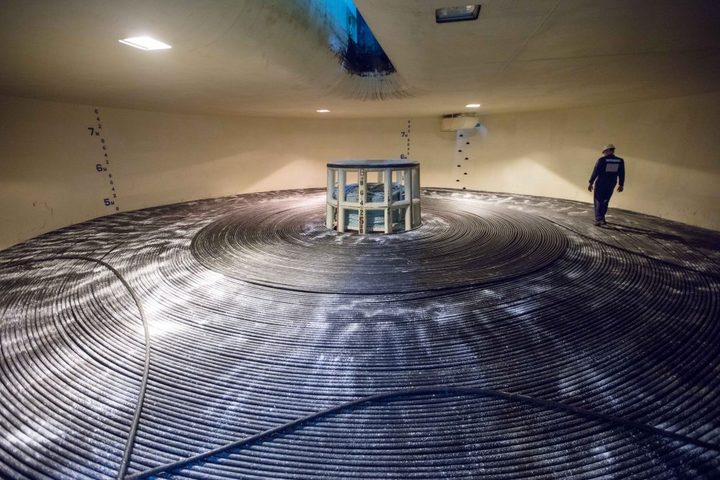
Microsoft and Facebook’s transatlantic undersea cable, known as Marea, just broke another record. The long undersea cable, which was completed in September 2017 as a joint project between the two technology giants, is capable of data transfer speeds up to 20 percent faster than what was previously thought possible. Marea already holds the record for the highest capacity undersea cable with a theoretical total capacity of 160 terabits per second (Tbps).

But a team of researchers from Infinera was able to add yet another world record to Marea’s claim. By using and modulating lasers, the researchers were able to record even faster data transfer speeds than what was previously thought possible. “A new experiment has achieved a record fiber optic cable capacity of 26.2 terabits per second across more than 6,000 kilometers of the Marea transatlantic fiber optic cable,” the Optical Fiber Conference and Exhibition announced in a press release.

Recommended Videos

The new record will be beneficial to those who build or rely on data centers. The cable connects Bilbao, Spain, and Virginia Beach, Virginia, in the U.S., and since the project was finished, the areas around Virginia Beach and nearby North Carolina have become popular locations to build data centers. Still, as The Verge reported, it may be a while before we see the gains achieved by researchers in the real world. Currently, the average transfer speed across the Marea cable is around 9.5 Tbps.

In the past, data transfer speed across an optical fiber is constrained by both fiber capacity and optical reach. Fiber capacity limits how much data can be sent, while optical reach is the distance that the data must travel across. “In simple terms, if you try to push the limits of fiber capacity you will reduce the reach,” Pierre Metz, one of the study’s researchers, said.

Researchers claim that the overall system was operating close to the theoretical maximum transfer rate, or the Shannon Limit, so it may be more difficult to top the new speeds achieved by Infinera researchers. “That means that every gain we make becomes harder and harder,” Mertz said.

Details about the experiment will be showcased at the conference, which begins on March 3 in San Diego, but Metz said that lessons learned from the Infinera experiment are already being used to build next-generation chipsets in a technique called probabilistic constellation shaping (PCS), which will hopefully lead to faster chips in the future.


Chuong Nguyen
Silicon Valley-based technology reporter and Giants baseball fan who splits his time between Northern California and Southern…
ChatGPT is recommending scam websites that will steal your credit card info
The chatbot is surfacing fraudulent clones of defunct retail brands, and scammers are deliberately engineering sites to game its recommendations.
ChatGPT running on a laptop.

Scammers have found a new way to reach shoppers: getting ChatGPT to do their marketing for them. According to The Guardian, scam-checking service Ask Silver found that OpenAI's chatbot is recommending fraudulent retail websites built to harvest payment details from unsuspecting buyers. The sites mimic real storefronts and use official-looking URLs, making them difficult to spot without scrutiny.

Defunct brands are a prime target

Read more
McDonald’s new AI drive-thru has to prove it can handle hungry people
After its earlier ordering bot became a punchline, McDonald’s is testing a new system that promises fewer human handoffs.
Architecture, Building, Hotel

McDonald’s is bringing AI back to the drive-thru with a new Google-backed system called ArchIQ, also known as Archy. It’s starting in five locations under the company’s broader “> NEXT” technology push, with a franchisee claiming the system has already handled more than 1 million orders.

The bigger number is the one McDonald’s needs people to trust. About 90% of those orders reportedly needed no human intervention. That sounds promising, but this is not a clean reset. Its earlier IBM-backed AI drive-thru experiment ended after viral mistakes turned automated ordering into a public punchline.

Read more
Logitech’s Mobi Fold is a pocketable folding mouse for folks who despise trackpads
Logitech’s Mobi Fold looks like a tiny productivity taco
Logitech Mobi Fold

Laptop trackpads are fine until you get really busy. Editing a spreadsheet in an airport lounge, juggling tabs in a café, or trying to do proper work on a tiny hotel desk can make you miss the convenience of a mouse. Logitech has the answer to this with the new Mobi Fold, its first ultra-portable foldable mouse.

While a small portable mouse is something people carry, many choose to skip the added bulk, simply choosing to bite the bullet with the trackpad. But the Logitech Mobi Fold can simply fold flat, and can later be unfolded when you need to work. This makes it pretty convenient to carry. Logitech even made the mouse to automatically power on when opened and turn off when folded.

Read more